
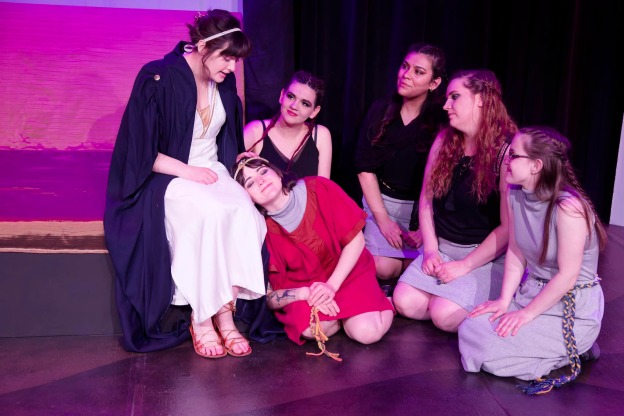
Alora Bowness (Penelope), Stephanie Swensrude (Telemachus), Monica Stewart, Karla Martinez, Sarah Spicer, and Katie Corrigan, in The Penelopiad. Photo Credit: Scott Henderson, Henderson Images
The lights come up on a simple set – a bed on a platform, white hanging panels lit to effect – and a young woman walks toward the audience. Now that I’m dead, I know everything, she says. After this intriguing statement, she goes on to explain that it’s not quite true – like everything else, it’s been simplified in the version we know.
Alora Bowness is Penelope In Walterdale Theatre’s current production of The Penelopiad. She caught my interest from these first lines, and continued throughout the performance, telling and illustrating her story with humility, determination, wry humour, and willingness to acknowledge the consequences of her choices.
But The Penelopiad, adapted by Margaret Atwood from her novella in 2007, doesn’t just examine the story of Penelope, but also of her enslaved maids. The narrative unfolds in short scenes, switching between Penelope telling the story, to ensemble members acting the story, to choral/choric recitation and dance by the maids, or sailors, or even at one point a flock of ducks. The story moves smoothly and with compelling pace, as directed by Kristen M. Finlay, from Penelope’s birth to a naiad mother (Mandy Stewart) and mercurial King Icarius of Sparta (Angela James-Findlay), through her childhood, her marriage to Odysseus (Katy Yachimec-Farries), move to Ithaca, and then what happens to her through the timeframe of Odysseus long journey to Troy and then home, as first told in Homer’s Odyssey.
I had seen the Citadel production of this play in 2013, using 13 talented young artists in that year’s Citadel/Banff Centre Professional Program. The Walterdale production is funnier than I remembered, and in the intimate Walterdale space I felt more engaged with the dangers and challenges of Penelope’s situation. I loved the costumes of the current production (Alodie Larochelle design) – all the maids wearing the same fabrics in grey and black, but in silhouettes that were different for each individual, with braided rope belts in different colours. The songs and poems of Atwood’s script were set to original music, lively or lyrical or haunting as appropriate (Gibson Finlay and Kristen Finlay, composition, Sally Hunt musical director).
Three things about the plot/theme struck me hard this time around. I’ve been thinking about them for days, and I’m planning to return this week for a second viewing, after which I will think about them some more.
- The relationship between Penelope and Odysseus is shown as nuanced and mostly positive. Classic tropes/assumptions of a girl married off to an older warrior do not hold. It is refreshing to see Odysseus gentle with his new bride and wooing her with stories, and their reunion after the many years of voyaging is equally gentle and consensual. He’s still the product of that particular patriarchal society and family, though.
- If one focuses on Penelope, it’s a relatively happy story – she overcomes early mortal danger, learns from many mentors and supports, manages the kingdom in Odysseus’ absence, and develops a famous ruse to protect herself from impatient suitors. But Atwood’s script and Finlay’s direction keep reminding the viewer that the story of the maids is just as important. Penelope’s monologue recounting life as an unappreciated girl-child of a royal mixed-marriage is followed immediately by a chorus of maids speaking bluntly to the audience. “We too were children. We too were born to the wrong parents. Poor parents, slave parents, peasant parents, and serf parents; parents who sold us, parents from whom we were stolen.” And the story of the maids is a tragedy. They do what Penelope asks of them – and it has terrible results for them.
- Those terrible results are due to some of Penelope’s strategies and choices. She acknowledges her mistakes in monologues from her afterlife. But they are also directly due to the customs and expectations of that patriarchal culture. Odysseus acts to punish them using limited information and an offensive set of assumptions. But he gets that information from his son Telemachus, a young man by then, and from his old nursemaid Eurycleia. Both actors in the Walterdale production were compelling, Stephanie Swensrude as the spoiled boy turned resentful young man and Vivien Bosley as the nurse/governess who petted and encouraged young Odysseus and then spoiled his son, turning him against his mother Penelope. I was reminded of how important it is for any society to raise boys to be compassionate and justice-seeking, and how wrong things can go when this does not happen. Unfortunately, this continues to be a timely and critical reminder. And as we move closer to Mother’s Day, I’m thinking about how the responsibility of setting the next generation on a better path should not just be placed on mothers, but on all of us.
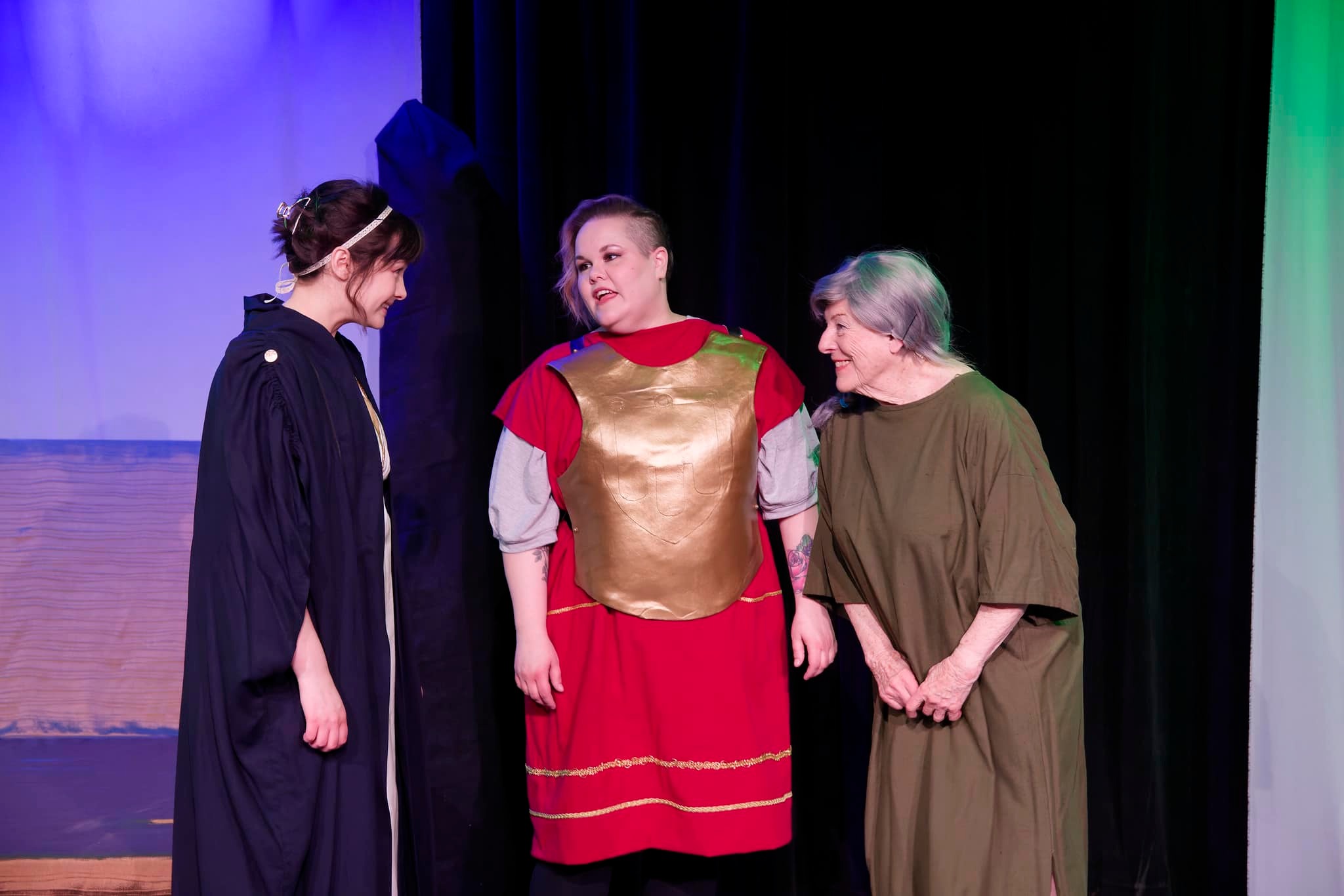
Alora Bowness as Penelope, Katy Yachimec-Ferries as Odysseus, Vivien Bosley as Eurycleia. Photo credit Scott Henderson, Henderson Images.
Thank you, cast and team of The Penelopiad, for making me think. The Penelopiad continues at Walterdale Theatre tonight through Saturday night, with an 8 pm curtain. Tonight, Wednesday, is pay what you can night; tomorrow, Thursday May 11, is limited capacity night, for patrons who would prefer more elbow room for better air quality. Masks are recommended but not required at all performances. Advance tickets are available here; some seats will be available at the door an hour before showtime.

 Ephemeral Pleasures