Tag Archives: alison yanota

Heathers: high school is more fun to watch than experience

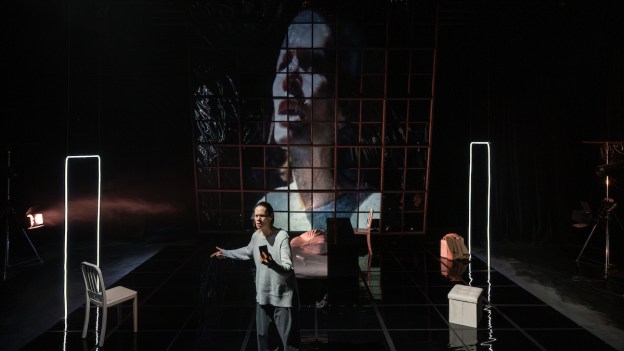
Scene from MacEwan University production of Heathers.
Photo Credit: Brianne Jang of BB Collective
Light Design: Heather Cornick, Set Design: Ross Nichol, Costume Design: Alison Yanota

Continuing on my recent run of seeing new productions of shows I’d seen in the past, tonight I watched opening night of the MacEwan University Musical Theatre program’s production of Heathers, by Laurence O’Keefe and Kevin Murphy, directed by Leigh Rivenbark. I saw the 1988 movie a long time ago, and the Citadel Young Musical Company production in 2016 (also directed by Leigh Rivenbark) but I didn’t remember them very well.

So I had the fun of encountering the musical almost fresh. Layne Labbe as Veronica and Jayden Leung as JD both had strong voices and compelling stage presence. Marina Mikhaylichenko was a disturbingly-mean Heather Chandler. Ashlin Turcotte (Martha, Veronica’s original best friend before her strategic social climbing) and Kara Adams (Ms. Fleming the hippie teacher) both had vocal solos that developed their characters and also demonstrated some impressive talents. It was also fascinating to watch the other ensemble members as high school students who all seemed to have distinctive characters, backstory, and connections with the others. Choreography (Courtney Arsenault) was well executed, and silhouette work behind windows was delightful.

I had forgotten how sharply satirical it was, skewering suicide-awareness campaigns, internalized homophobia, performative allyship, signing petitions without reading them, playing to the media, the misunderstood-loner-in-a-trenchcoat trope, bullying, bulimia, frenemies, and all the teenage stereotypes.

Heathers is playing at MacEwan’s Triffo Theatre all weekend. But if you don’t already have tickets, you’re probably out of luck. You might want to plan ahead to get tickets to the MacEwan production of The Prom, next March.

Women in wartime: Stars on her Shoulders is inspiring and timely

Meegan Sweet and Gabby Bernard in Stephen Massicotte’s Stars on Her Shoulders. Photo by Marc Chalifoux.

It makes sense that Remembrance Day weekend brings theatre about World War I. But this year Edmonton playgoers are fortunate to have two world-premiere productions on local stages, both by playwrights with Alberta roots. I wrote about The Two Battles of Francis Pegahmagabow in an earlier post.

Workshop West Playwrights’ Theatre is launching its “Saints and Rebels” season with Stephen Massicotte’s play Stars on Her Shoulders, about Canadian nurses in France in 1918. It is directed by artistic producer Heather Inglis. As the play starts, two of the nurses (Hayley Moorhouse and Meegan Sweet) are also patients in a hospital, convalescing from injuries sustained when another hospital was attacked. The story of the attack and of their injuries comes out gradually, as the nurses chafe at inactivity and engage with other hospital staff (Dana Wylie as a starched Scottish Matron, Dayna Lea Hoffman’s Georgie with irrepressible optimism, and Gabby Bernard as Enid, an earnest and well-meaning newbie.)

As Stephen Massicotte pointed out at the playwright talkback earlier this week, the plot is developed through relatively long scenes. Most scenes take place in Emma and Helen’s hospital “hut” or ward, with occasional visits to the Matron’s office or other locations. As we get to know more about Emma, Helen, and the other characters, we also see changes in them. They’re all politically aware, especially Emma (Sweet), who admits to writing her first protest petition at fourteen. So they follow the progress of suffragists (“Suffragette is a slur”, Emma corrects Enid) in working for the right to vote. They point out that the initial move to allow women military personnel to vote, and the female next-of-kin of male military, was an opportunistic move by a government who needed more support for conscription. And one wryly points out that even with a more general enfranchisement,conscientious objectors and immigrants and “Indians” [sic] will still be excluded. Helen (Moorhouse) starts out very guarded, standoffish and sarcastic even with longtime friend and nursing-school classmate Emma. I enjoyed watching her moments of relaxing her guard, and ended up very moved by her pain and bravery.

Emma and Helen want to get back to work soon. Their superiors (both the Matron on stage and the unseen men writing orders) want them to take time to recover, but they also want to present Emma and Helen with medals. This turns out to be a problem, however. Since the Canadian nurses are commissioned officers, they should receive the Military Cross, but the War Office wants to give them the Military Medal, which would be appropriate for enlisted personnel. Female nurses in other jurisdictions are not officers, and acknowledging some Canadian heroines this way would encourage feminists in Britain and other allied forces to negotiate their own status. So Emma protests, and the War Office sticks to their, ahem, guns. The “stars on her shoulders” refer to the lieutenant’s insignia each woman wears, and why they matter.

There’s so much detail to chew on in this play, which wraps up in under two hours. Not too much, and it all fits well with the distinct characters and their experiences. One speech in particular is disturbingly timely this week. I cried when Sweet’s activist character Emma is warning the others that women’s rights can never be assumed permanent – they can all be taken away, and vigilance will always be necessary.

The set is arranged as an alley stage (Brian Bast), with a few rows of seats on two long sides of the convalescent ward. Unlike some alley or in-the-round productions, I didn’t feel like I was missing anything due to where I was sitting. Back rows are on risers, and everyone is close to the action.

Workshop West’s season is their first with completely Pay-What-You-Will pricing, for subscriptions as well as single tickets. Tickets are available here, and Stars on her Shoulders runs until November 17th. I’m thrilled to support this initiative as a subscriber, and I’m excited about the rest of the season too. I think it’s the first time I’ve seen a play program thank donors that include both the Department of Veterans’ Affairs, and the local LGBTQ2S+ institutions Fruit Loop and Evolution Wonderlounge.

Two actors portraying youth in goth clothing, one male one female.

Candy and the Beast

Jake Tkaczyk, as Kenny, and Jayce Mackenzie, as Candy, in Candy and the Beast. Photo Brianne Jang, BB Collective Photography.

One of my Facebook correspondents called Candy and the Beast “this weird little play”. And he’s not wrong.

Trevor Schmidt’s latest original script on stage at Northern Light Theatre is disturbing and kind of delightful, both. I was thinking that it’s not quite like any of his other work that I’ve seen, but it takes advantage of a lot of things the writer/director/designer is good at. He’s good at poignant; he’s good at macabre; he’s clever at creating designs that enhance the mood and message of a production. He’s very good at the humour and dramatic-irony of naive child narrators, as we saw in Shadow Theatre’s recent production of Schmidt’s Robot Girls, about junior high school students in a science club making sense of families and friendship and growing up.

Candy and the Beast demonstrates all these strengths, in a performance a little over an hour long. The audience enters the Arts Barns Studio space in the fog and gloom, to be seated on low risers along one of the long walls and wonder what the menacing lumps on poles are, upstage. One of my neighbours, opening night, said that the lights were gradually coming up as showtime approached – but they weren’t coming up very much.

The play starts with two characters staring out at the world together through Hallowe’en masks and layers of goth-teen armour: Candy Reese (Jayce Mackenzie) is the main narrator, observing her little town and protecting her younger brother Kenny (Jake Tkaczyk). Younger, but not smaller – she prods Kenny to explain that he has a condition known as central precocious puberty, meaning that his body’s grown up while he’s still a little kid. So they call him The Beast. He says he doesn’t mind. She says he does.

And the town has some issues – not just the classism against trailer-park residents like Candy and Kenny and their parents, and general mistreatment of outsiders and weirdos, but a pack of howling animals in the nearby woods, and a serial killer at large – a killer picking off young blonde women, especially ones the town doesn’t care about. The story and mood reminded me a bit of Twin Peaks.

The sibling relationship between Candy and Kenny was one of the most compelling things about this play. The little boy adopts his tough big sister’s fashions, beliefs, and interests – his big sister beats up his bullies, helps him get to sleep, and reassures him that he’s not too old to trick-or-treat. As an oldest sibling, I found her mix of impatience and kindness easy to connect with. Their parents sound benign, but aren’t significant in the story. The play also says some important things about outsiders in a community.

Other characters brought to life in various scenes include self-absorbed real-estate agent Donna Crass shopping at the ice cream stand where Candy works, Sheriff Sherry Lau (“the long arm of the Lau”) updating townspeople about the investigation and search, a grandmotherly librarian helping Kenny research werewolves, and others. Tkaczyk, a member of the Guys in Disguise theatre-drag troupe, embodies some of these characters with distinctive voices and mannerisms.

The production is enhanced by Schmidt’s set and costume choices, dim and harsh lighting from Alison Yanota, and sound design and original music by Dave Clarke. The menacing lumps seen pre-show turn out to be a row of creepy heads on pikes, with the wall behind showing some graffiti left on the wall of Candy and Kenny’s trailer.

The performance includes several songs by Kenny (Tkaczyk), representing his thoughts, fears, and imaginings. They vary from eerie foreshadowing to a melodic ballad with a few songs reminding me of David Bowie’s 1980s repertoire, with effective use of recorded guitar track and echoey microphone.

I won’t reveal the plot events or provide any explanations of the mysteries, but I found some satisfaction at the end in a shift in the relationship between Candy and Kenny, as they become more honest with each other and give each other more comfort. I don’t know what will happen to these characters next, but I think it’s going to be okay. (And if you don’t think so, don’t tell me, because I really like both of them!)

Candy and the Beast is continuing at the Arts Barns Studio Theatre until next Saturday night, April 20th. Run time is about 65 minutes. Tickets are available here and at the door. (Tuesday Apr 16 is 2-for-1).

The unseen Mob

Kristin Johnson in Mob. Photo credit Marc J Chalifoux Photography and Video.

I liked seeing Mob, currently on stage at Workshop West Playwrights’ Theatre’s Gateway Theatre, without knowing much about what to expect. Afterwards, I wanted to talk about it, but I also wanted to give more people the chance to see it similarly unspoiled.

So, if you don’t want to know what it’s about or what happens, I can still give you several reasons to see it, and then you can stop reading. Starting with the names in the credits:

  • Heather Inglis, artistic producer of Workshop West as well as director of this play, has created a coherent season of challenging work, loosely categorized under the theme Borderlands.
  • Three good performers familiar to local audiences: Kristin Johnston, and Graham Mothersill, and Davina Stewart. Each of them portrays a fascinating complex character, not entirely likeable but sometimes funny and often relatable.
  • Designers include Darrin Hagen (eerie atmospheric soundscapes and original music), Beyata Hackborn (a set that starts out with an Instagram-perfect look and turns out to be both functional and symbolic), Alison Yanota (unusual lighting that escalates the tension), and Sarah Karpyshin (iconic costume design).
  • Program credits for Jason Hardwick (choreography) and Sam Jeffery (fight and intimacy direction) provide additional clues to the content in the show and the skill level with which it will be executed.

The action starts with projections, conveying a woman, Sophie, (Johnston) driving feverishly while voices overlap and reverberate in her head. As she arrives with her suitcase at a remote bed-and-breakfast, she is greeted by Martin (Mothersill), cringingly clumsy and twitchy as he over-explains that he’s at home this time of day because he’s lost his job. The visitor stands immobile on the threshold holding her suitcase, responding to his questions but not progressing the conversation. Is she exhausted? Is she hesitant to enter? Why is she there? She’s not giving anything away. Soon Martin’s aunt Louise (Stewart) bustles in with a limp, all aging-hippie style and colourful cane, to smooth over the conversational awkwardness and remind Martin how to behave with guests. The show is described as a thriller – at first I wasn’t sure whether the characters would be realistic or more gothic, whether there would be overt or psychological violence in the isolated-country-house trope or what. I’ve also seen Johnston play a lot of disturbed and disturbing characters on stage in the past few years, from Death Trap to Destination Wedding, Baroness Bianka’s Bloodsongs to We Had a Girl Before You. But the fears explored in Mob are completely realistic and timely. Which is much scarier.

Mothersill’s portrayal of Martin often made me want to laugh – but the menace conveyed by the soundscape and the unfolding story made me feel uncomfortable about laughing – not so much that I was pitying him, but that it might be dangerous to provoke him.

The performance is a bit over an hour and a half long, with no intermission. The script (written in French by Catherine-Anne Toupin and translated by Chris Campbell) has a compelling directness with no unnecessary dialogue.

Beforehand, I wondered why a three-hander would be called Mob. Isn’t a mob a larger angry group? Then I realized that the three people on stage were not the only ones involved – that the internet posters Sophie quotes, in overlapping overwhelming torrents of abuse, are in some ways present throughout, ubiquitous and inescapable.

Mob has a short performance run, ending next Sunday afternoon, November 12th. Get your tickets soon!

A Hundred Words for Snow is lovely

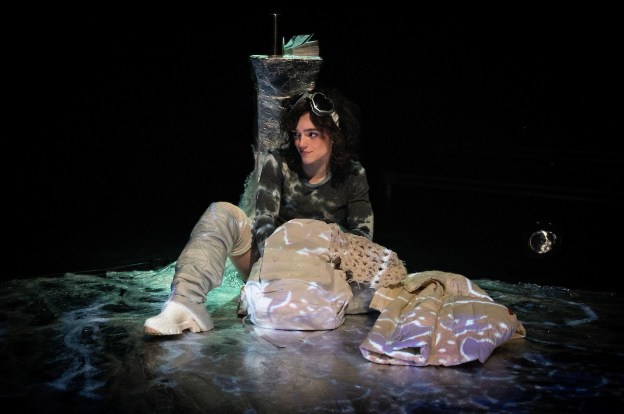
Dayna Lea Hoffman in A Hundred Words for Snow. Photo by Epic Photography

I’m not sure what adjectives to use to describe the current Northern Light Theatre production. Because I don’t want to diminish its significance and power if I call it charming, satisfying, thoughtful, or delightful. But it is all of those things, too.

Tatty Hennessy’s script is a more realistic narrative than many of the works Northern Light brings us. Its 15yo narrator (Dayna Lea Hoffman) is Rory, a recently-bereaved 15yo Londoner, relating her experiences and observations in a tone both unique and familiar. After her father’s funeral, she notes the problem of her father’s ashes being in an urn on the kitchen table and her mother being disinclined to do anything about this immediately – so she gets the idea of taking the urn on an adventure that the father, a geography teacher and armchair explorer, had daydreamed about with her and fantasy-planned in a notebook. Of course! She will borrow her mother’s credit card and go scatter the ashes at the North Pole – this makes complete sense to her.

As you should expect from a Northern Light show, brilliantly-executed design elements enhance the narrative. Alison Yanota is credited as production designer, taking care of set, costume, and lighting. Matt Schuurman designed projections on the floor, and Daniela Fernandez was sound designer. Trevor Schmidt directed. The performance is done in the round – I picked a side randomly and did not feel like there was any advantage to being on any side.

The script said some things about grief and about growing up that I am still thinking about. In particular, the concept of trying on grief responses to find what felt appropriate. I also really appreciated that the writer didn’t punish the teenage girl for not thinking things through and for trusting the people she met. As I think I’ve mentioned before in this blog, I’m tired of stories where teenage girls (and, by extension, the audience) are “taught a lesson” by having their risk-taking and initiative result in disasters, whether physical, social, sexual, or legal. Rory’s quest didn’t work the way she’d thought it should – but it still worked out.

Northern Light Theatre requires its patrons to wear masks in the Fringe Studio Theatre – and in the performances I’ve attended this season I’ve seen 100% compliance with this. The play runs until Saturday May 6th, and tickets are available here. I recommend it highly.

Three characters drink mimosas at brunch.

Teatro Returns with Caribbean Muskrat

Cast of Caribbean Muskrat: Rochelle Laplante, Rachel Bowron, Jackson Card @alwaysepicphotos

Teatro de Quindicina, the summer-season professional theatre at the Varscona specializing in the work of Stewart Lemoine, hasn’t had a season since 2019. I remember their last production “before”, the complicated and wacky Vidalia, involving three identical briefcases and a very big onion.

In 2022, they’re starting the season a bit earlier than usual, with Stewart Lemoine and Josh Dean’s Caribbean Muskrat, originally performed here in 2004. I love that Lemoine has such a lengthy back catalogue, because they often produce works that other people remember favourably but I haven’t seen before. Stewart Lemoine directed, Madeline Blondal designed the set conveying multiple locations with a few clever pieces, Alison Yanota designed the lighting, and Leona Brausen did the costume design.

Caribbean Muskrat has many of the common features of a Stewart Lemoine play. So a subscriber or occasional attendee could have a rough idea of what to expect, but could still be completely surprised by the plot and characters on stage.

The unique characters in this play include Dr Hadrien Burch (Jackson Card), an oddly-smug sleep clinician, his girlfriend (previously his patient) Cynthia Lodgepole, an ambitious restaurant owner/manager (yes, restaurateur and restaurateuse are the correct spelling) (Rachel Bowron), and Bess Wesley a Canada Customs official in charge of animal imports (Rochelle Laplante, most recently seen in Citadel’s Peter Pan Goes Wrong).

The unexpected plot starts with a rare rodent, the Caribbean muskrat, which Cynthia acquired when attending a resort time-share pitch in Bimini, and which is now being held at the local Customs office. While we don’t actually see most of the animals in the office (a dolly stacked high with travel crates and ventilated boxes emitting mysterious noises), the one we do see is handled so well that I had to look away and then look again to reassure myself it wasn’t real. The three characters’ lives intersect because of the muskrat. Various complications develop and the story takes several turns I didn’t predict.

Similar to many other Stewart Lemoine plays, Caribbean Muskrat includes specific details about a location which are funny to people who know the place while contributing to worldbuilding for those who don’t know it well. In this case, the play is set in Kelowna BC, so there was wine-tasting, side comments about the nearby community of Peachland, and an Ogopogo joke.

As I started to watch this play, I recalled another characteristic of the Teatro oeuvre that I’d forgotten, and I still don’t quite know what to call it. It’s not quite magical realism, but it’s just a few steps away from probability into a context where unlikely coincidences happen and are accepted. The odd things that happen in this story aren’t unlikely enough to pull me out of the story, but they are delightfully unexpected enough to pull me in. And I’ve missed that.

Caribbean Muskrat runs at the Varscona Theatre until April 17th. Tickets are available through the Varscona Theatre website as well as at the box office on show nights.

The Great Whorehouse Fire of 1921

Northern Light Theatre’s season starts off with a conflagration, at the Varscona Theatre, with Linda Wood Edwards’ play The Great Whorehouse Fire of 1921, directed by Trevor Schmidt. Sue Huff plays Mrs. Hastings and Twilla Macleod plays Mrs. Smith, both independent businesswomen in the small Central Alberta mining town of Big Valley. The social distance between them is large, as the blunt joyful pragmatic Hastings runs a whorehouse and Smith, a devotee of Queen Victoria and of propriety, runs a boardinghouse for unwed pregnant girls/women and helps to place their children for adoption. The costumes (production designer Alison Yanota) emphasize their differences, with Hastings in flamboyant reds and flapper style, and Smith in cool buttoned-up floorlength blues. Although both of them operate business/social enterprises dependent on men for their existence, the interactions between these two women and descriptions of offstage characters and action pass the Bechdel-Wallace test easily (“do two women have a conversation that is not about a man?”)

Productions of Northern Light Theatre often keep me guessing a bit about their genre or mood, which makes them more interesting to me than a more predictable play. As you might expect, the two characters start out hostile to each other and full of assumptions based on past hurts, but later find some similarities in their grief and in their ambitions. The funniest part is … something I’m not going to spoil, but the advice about avoiding unnecessary clothing repairs. It’s not a tidy ending, but it’s a satisfying one, leaving me thinking about middle-aged women making their own way and starting over, and about the harm done by mistrust and prejudice among groups of women.

The Great Whorehouse Fire of 1921 runs to Sunday November 28, with tickets available for digital viewing as well as in-person performance under the Restrictions Exemption Program. The Varscona Theatre is a large auditorium and audience members are asked to leave space between each party. The concession and washrooms are open. Running time is a bit under 70 minutes.

The next play I’ll be watching is the one I’m directing now, Walterdale Theatre’s 5@50 – another look at women in middle age, how they can support each other and how they can wound each other. Tickets are available at the link.