Summer theatre events – ephemeral and done

In July I attended two great local theatre events that I meant to post about. But in both cases, I thought … oh, I still have one more performance to see later, I can wait until I see that one last thing. And then the event was over so my recommendations wouldn’t have any immediate value, and the summer rushed on with other adventures – a trip to Jasper just before the evacuations, rehearsals for a new Fringe musical – and I haven’t written about any of the performances. So here’s a quick overview.

Found Festival, the small festival of “art in unexpected places” again included an interesting collection of hard-to-classify experiences, in corners of the neighbourhood and city that I don’t always pay attention to.

Madness and other Ghost Stories was an eerie and yet affirming evening of spooky and spirit-infused stories involving mental illness, neurodiversity, and the unexplored territory of inside one’s head. Philip Hackborn curated and hosted, in ways that clearly supported their artists’ safety and comfort. I found Calla Wright’s poetic tale particularly effective.

The Nature of Us was an installation in Queen Elizabeth Park, with sounds playing from unseen speakers, while people used the park paths on foot, on bicycles, on scooters, etc. Kevin Jesuino, Cass Bessette, and Jean Louis Bleau were the credited artists.

Lucky Charm was a progress showing for the FreshAiR artist Louise Casemore’s ongoing project, an invitation to a small audience group to attend a seance led by Harry Houdini’s widow (Casemore) and hosted by her friend/promoter (Jake Tkaczyk). I’m looking forward to seeing the full version next year.

Brick Shithouse was as close as Found Festival gets to a “mainstage” theatre presentation. It was held in a perfect space for this story, a dingy warehouse with a few rows of audience seats along one long wall, and the rest of the space configured as a rough fighting gym with camera/recording setup. Ashleigh Hicks was the author, Sarah J Culkin directed, and the performers were a stellar lineup of Mohamed Ahmed, Geoffrey Simon Brown, Alexandra Dawkins, Sophie May Healey, Jasmine Hopfe, Moses Kouyaté, and Gabriel Richardson. I loved the high energy of the piece and the way in which it quickly set up the scenario of this group of friends streaming their bouts to make money. Sam Jeffery was credited with the fight direction and intimacy direction, both of which were essential to create the intense-feeling experience for audiences while keeping the performers safe. The performances easily convinced me of the premise that the characters of various genders and sizes could fight each other effectively. And like the characters in Liam Salmon’s Subscribe or Like (WWPT, 2023), it was easy to see how they didn’t/couldn’t anticipate some of the things that might go wrong. Alex Dawkins was particularly effective and heartbreaking as a character without much to lose. In the high-energy loud performance, there were several times where I couldn’t see/hear all of the conversations and I felt like I was missing important information. Was that intentional? Maybe, but I wanted to know more. I wanted to see it again, but it was such a hot ticket I was lucky to see it once.

The other event I was looking forward to this July was Thou Art Here Theatre’s site-specific performance Civil Blood: A Treaty Story at the old fort at Fort Edmonton Park. Playwright Josh Languedoc, Thou Art Here principal Neil Kuefler, and others have been developing this concept since 2016 – telling the story of the Treaty 6 peoples through the lens of a Romeo&Juliet narrative. At Found Festival 2021, I heard a staged reading of a previous version at the River Lot 11 Indigenous Art Park off Queen Elizabeth Park Drive, and I was fascinated. This year’s production is told in and around the old fort. The company struggled with smoke and heat during rehearsal and ended up cancelling several performances. I count myself very lucky to have been able to see it twice, so I got to follow both “tracks” of the intertwining roving performance. I am always impressed when multiple-tracked roving shows are done with smooth timing and seamless stage management (Everyone We Know Will Be There: A House Party in One Act, Queen Lear is Dead), so I’m applauding stage managers Andrea Murphy and Isabelle Martinez. The audience was divided into two groups, one to follow the European characters and particularly the governor’s daughter Lily (Christina Nguyen), while the other followed the indigenous characters, especially hunter Ekah (Emily Berard). In each track, there was one character who acknowledged the presence of the audience, narrated to us, and directed us – Elena Porter as the governor’s wife Agatha Sampson, and Maria Buffalo as Takaw, an ancestor and possibly the chief’s grandmother. Eventually I realized that both these intercessors were no longer alive in the story’s timeline, so the choice made a lot of sense and also allowed smooth navigation, with the main characters never needing to cue the audience to follow.

Other performers in the 11-person company included Rebecca Bissonnette, Ivy Degagné (who was great as the young settler embracing the local culture and language – one glimpse of hope and how things could be), Doug Mertz, Cody Porter, Colby Stockdale, and Dylan Thomas-Bouchier.

The details of Civil Blood don’t match exactly with the details of Romeo and Juliet – they did match more in the 2021 version. The general concept of two houses alike in dignity, escalating tensions leading to tragedy and worse outcomes, and the passionate young person torn between the expected/appropriate romantic match and a more complicated attachment (Gabriel Richardson), were still there. I saw the two tracks more than a week apart, and I was intensely curious about the parts of the story that hadn’t been sufficiently explained on first viewing. When I attended the second time, I picked up a program and read the directors’ notes (Neil Kuefler and Mark Vetsch are credited as co-Directors this time), in which they encourage viewers to meet up at the community gathering/market after the performance and compare notes with people who saw the other track, since you can’t get the whole story from hearing one side. And – of course – what a brilliant illustration of how key this understanding is to working towards reconciliation, particularly in our Treaty relationships.

And now it’s August, and Fringe is starting in a few days. I’m stage managing the new satirical musical Regression, at the Playhouse performance space on 80th Avenue. And I’ll be volunteering in the beer tents, hosting visiting artists, and watching lots of performances. Watch this blog for notes on what I’ve seen!

Back to Avenue Q

Erin Harvey as Mrs. Thistletwat in Avenue Q. Photo Nanc Price.

I’ve now seen three productions of the Robert Lopez / Jeff Marx / Jeff Whitty musical Avenue Q. I saw the Off-Broadway transfer in New York in 2014, and the Citadel Theatre production in 2015. And when I first saw the announcement that Foote in the Door would be doing it in 2024, I had no trouble remembering various catchy tunes from the show, and more trouble getting the earworms out of my head afterwards.

As I wrote after seeing it Off-Broadway, it’s like Rent crossed with St. Elmo’s Fire for audiences who grew up with Sesame Street puppetry, a combination that’s hard to picture until you’ve seen it or are familiar with the cultural phenomenon.

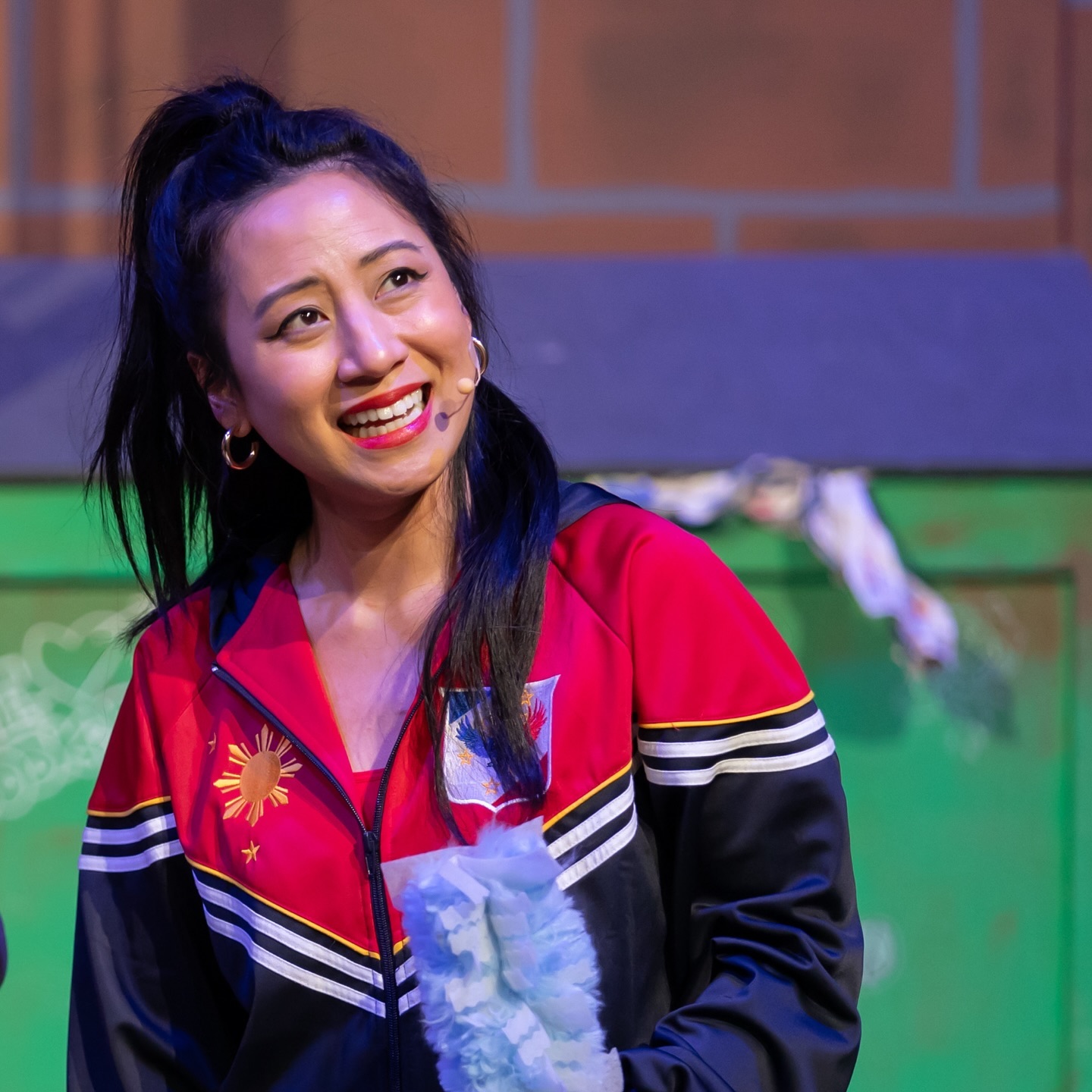
Ten years later, many audience members already know what to expect. The Foote in the Door production, directed by Trish Van Doornum, opened last night at Théâtre Servus Credit Union, to a full and enthusiastic house. I had wondered if some of the elements would require shock-value to be appreciated – “The Internet is for Porn”, Christmas Eve and “Everyone’s a Little Bit Racist”, and the puppet sex scene, in particular – but I thought the opening-night crowd was delighted whether or not they were caught by surprise. Christmas Eve, in the original production, sings “I coming to this country for opportunities, Tried to work in Korean deli, but I am Japanese!” and her speeches are full of comedic L-R switching and English-language-learner patterns. Those tropes are getting old – but in the Foote in the Door show, Christmas Eve is performed by Sunshine Bautista Mauricio, whose overall sass, determination, and compassion were more significant than the stereotypey trope. That early line is changed to “Tried to work in Korean deli, but I am Filipino!” (maybe she said Filipina, but I couldn’t hear clearly since the crowd was laughing and cheering). A couple of places later in the show, she says rude things to her husband in a language I don’t understand (Tagalog?) but some audience members definitely did. Those changes improved the show for me, demonstrated that it wasn’t just about entertaining white people.

Sunshine Bautista Mauricio as Christmas Eve. Photo by Nanc Price.

The current production uses a cast of nine performers, and I was especially impressed by the work of some of the ensemble members I was less familiar with. Erin Harvey (last seen in Walterdale’s Austentatious) was a puppeteer playing Mrs. Lavinia Thistletwat, occasionally covering Kate Monster, Lucy, and a Bad Idea Bear, with a hand in Russ Farmer’s embodiment of Nicky. The scenes where Kate and Lucy interact, with Ruth Wong-Miller doing both voices, fascinated me because my eyes kept fooling me about who was talking for which puppet character. Jay Duiker, whom I remembered as the Baker in FITD’s early-2022 Into the Woods, had a strong voice and good comic timing for wannabe-standup-comic Brian. Renell Doneza (with previous credits ranging from Walterdale’s Altar Boyz to the Citadel’s Prison Dancer) embodied various ensemble characters, and watching his own physicality as a contrast to the puppet Rod’s repressed rigidity was very clever. Jayden Leung, also credited with the video montages used in the show, was the remaining ensemble puppeteer, playing various characters including part of Trekkie Monster. Lead-puppet Princeton was performed by Stephen Allred, whose FITD resume started with an insightful interpretation of Laurie in the 2017 Little Women. And the building super Gary Coleman, often played by a woman, was Malachi Short, whom you may recall from Elope’s production of Joseph and the Amazing Technicolor Dreamcoat last year. Short, Harvey, and Leung are all current students in MacEwan University’s BFA in Musical Theatre Performance, and ones to watch in future years.

Ruth Wong-Miller as Kate Monster. Photo by Nanc Price.

There’s one bit in the show where Princeton decides to collect donations to fund another character’s dream, and he motivates other characters to pass the hat running up and down the theatre aisles. When I saw it in New York, the meagre takings that they counted afterwards included a Metro card (subway pass) – I wasn’t sure if that was scripted or not. Well, last night they pulled an ARC Card (local transit pass) out of the hat, so I guess I have my answer. And then after the curtain call, company co-founder Ruth Wong-Miller told the audience that the takings from the hat-passing, plus anything else we wanted to add to the ASMs’ hats in the lobby, would be donated to the Youth Empowerment & Support Services, who operate the Youth Emergency Shelter and other programs in the neighbourhood. This struck me as a great choice, not just for being hyperlocal but for building on the sympathies for the characters in the story, who are mostly a step or two away from the outcomes of the characters in Rent but who are still young and with limited resources. (So take some money, and not just for the concession!)

Avenue Q is full of short songs with lyrics that you might not want to sing at your recital, and musical-theatre melodies and harmonies that are hard to get out of your head. All the voices were strong, and the sound-mixing was well done (which I can’t always say on opening nights). Almost all the audience members near me managed to resist checking Oiler-score updates during the show – giving us a satisfying end to the evening in more ways than just a fun performance with happy and credible futures for the various characters.

Leland Stelck has designed a functional and interesting streetscape set, in the style of Sesame Street or In the Heights, and the musical ensemble directed by Grace Huang are visible downstage and occasional participants.

Avenue Q runs until June 8th, but several performances are already sold out. Remaining tickets are available here.

Tiny Beautiful Stories

Michelle Todd, foreground, and Michael Peng, Sydney Williams, and Brett Dahl, in Tiny Beautiful Things. Photo Marc Chalifoux.

If you haven’t already seen Tiny Beautiful Things, the Shadow Theatre production of the Nia Vardalos play currently running at the Varscona, do try to fit it in before it closes on Sunday afternoon.

Tiny Beautiful Things is a set of vignettes portraying the interactions of an advice-columnist, inspired by Cheryl Strayed’s essays based on her time writing as Dear Sugar. Michelle Todd is wonderful as the writer who lands the columnist gig, giving advice from her heart and from her own messy experiences. The character seemed so warm and human and honest, folding laundry in her house wearing mismatched loungewear/pajamas (Leona Brausen costumes), that I wanted to take her home.

The rest of the ensemble (Michael Peng, Sydney Williams, and Brett Dahl) portray people who write to her, and other people in her stories such as her mother. Each of them gets a chance to play people of various ages and genders, adding to the impression that there are a lot of different correspondents. I didn’t ever feel like any of the portrayals were caricatures.

During the performance, I was reminded of several other plays I’ve seen. The first comparison was with Veda Hille, Bill Richardson, and Amiel Gladstone’s Craigslist Cantata, the series of songs and sketches about transactional connections on an internet classified-ads site, but I quickly decided that Tiny Beautiful Things was less frivolous and more thoughtful, as the interactions through an advice-column were about seeking understanding, rather than finding second-hand property, missed-connections on a commute, or a metalhead roommate for a metal house (although that one was so catchy that now it’s an earworm again).

When I realized that the conversations between Sugar and the letter-writers, often physically located at Sugar’s kitchen table or in her living room, were being done without the actors touching, and usually facing towards the audience, I remembered Duncan MacMillan’s Lungs, also directed by John Hudson for Shadow Theatre, with Elena Porter and Jake Tkaczyk as an unnamed couple recollecting the milestones in their relationship, while speaking to an unseen listener and never touching, not even in the sometimes-hot sometimes-hilarious sex scenes. And then in one of Sugar’s conversations, they do touch, and it matters.

Sugar’s advice and support, completely grounded in love, and the heartbreaking range of the ordinary people’s problems, also reminded me of a newer script which none of you have seen yet, unless you’ve been in a rehearsal hall at Walterdale Theatre during preparations for next week’s new works festival From Cradle to Stage. The festival, running May 14-19, presents three staged readings each night, for a total of nine new scripts by local playwrights. I helped select them, so I think they’re all worth seeing – but the one that came to mind yesterday when I was watching Tiny Beautiful Things was Kristen M. Finlay’s Modern Day Saints. In Finlay’s script, ordinary contemporary women struggle to do the right thing in a range of difficult and painful and familiar situations, starting from a student without enough money to pay her tuition fees dealing with unsympathetic bureaucracy. As in Tiny Beautiful Things, the glimpses of compassion and hope in the ensemble vignettes are life-affirming.

Tiny Beautiful Things starts with an electronic tone, and then another – I thought, is that a message notification? is that a piece of original music? and then I thought, Oh, there’s a Darrin Hagen sound credit, I bet it is both. And it was.

It goes without saying that it made me cry. In a good way. It also made me feel grateful for having friends to tell life stories with, and for seeing how crafting an experience into a story helps make sense of it.

Tickets for Tiny Beautiful Things are here. Tickets for Walterdale’s From Cradle to Stage festival May 14-19 are here. Modern Day Saints plays on May 17 and May 18 – but descriptions of all the new plays in the festival, by Bridgette Boyko, Donna Call, Kristen M. Finlay, Grace Li, Shawn Marshall, Madi May, Blaine Newton, Logan Sundquist, and Michael Tay are here.

Two actors portraying youth in goth clothing, one male one female.

Candy and the Beast

Jake Tkaczyk, as Kenny, and Jayce Mackenzie, as Candy, in Candy and the Beast. Photo Brianne Jang, BB Collective Photography.

One of my Facebook correspondents called Candy and the Beast “this weird little play”. And he’s not wrong.

Trevor Schmidt’s latest original script on stage at Northern Light Theatre is disturbing and kind of delightful, both. I was thinking that it’s not quite like any of his other work that I’ve seen, but it takes advantage of a lot of things the writer/director/designer is good at. He’s good at poignant; he’s good at macabre; he’s clever at creating designs that enhance the mood and message of a production. He’s very good at the humour and dramatic-irony of naive child narrators, as we saw in Shadow Theatre’s recent production of Schmidt’s Robot Girls, about junior high school students in a science club making sense of families and friendship and growing up.

Candy and the Beast demonstrates all these strengths, in a performance a little over an hour long. The audience enters the Arts Barns Studio space in the fog and gloom, to be seated on low risers along one of the long walls and wonder what the menacing lumps on poles are, upstage. One of my neighbours, opening night, said that the lights were gradually coming up as showtime approached – but they weren’t coming up very much.

The play starts with two characters staring out at the world together through Hallowe’en masks and layers of goth-teen armour: Candy Reese (Jayce Mackenzie) is the main narrator, observing her little town and protecting her younger brother Kenny (Jake Tkaczyk). Younger, but not smaller – she prods Kenny to explain that he has a condition known as central precocious puberty, meaning that his body’s grown up while he’s still a little kid. So they call him The Beast. He says he doesn’t mind. She says he does.

And the town has some issues – not just the classism against trailer-park residents like Candy and Kenny and their parents, and general mistreatment of outsiders and weirdos, but a pack of howling animals in the nearby woods, and a serial killer at large – a killer picking off young blonde women, especially ones the town doesn’t care about. The story and mood reminded me a bit of Twin Peaks.

The sibling relationship between Candy and Kenny was one of the most compelling things about this play. The little boy adopts his tough big sister’s fashions, beliefs, and interests – his big sister beats up his bullies, helps him get to sleep, and reassures him that he’s not too old to trick-or-treat. As an oldest sibling, I found her mix of impatience and kindness easy to connect with. Their parents sound benign, but aren’t significant in the story. The play also says some important things about outsiders in a community.

Other characters brought to life in various scenes include self-absorbed real-estate agent Donna Crass shopping at the ice cream stand where Candy works, Sheriff Sherry Lau (“the long arm of the Lau”) updating townspeople about the investigation and search, a grandmotherly librarian helping Kenny research werewolves, and others. Tkaczyk, a member of the Guys in Disguise theatre-drag troupe, embodies some of these characters with distinctive voices and mannerisms.

The production is enhanced by Schmidt’s set and costume choices, dim and harsh lighting from Alison Yanota, and sound design and original music by Dave Clarke. The menacing lumps seen pre-show turn out to be a row of creepy heads on pikes, with the wall behind showing some graffiti left on the wall of Candy and Kenny’s trailer.

The performance includes several songs by Kenny (Tkaczyk), representing his thoughts, fears, and imaginings. They vary from eerie foreshadowing to a melodic ballad with a few songs reminding me of David Bowie’s 1980s repertoire, with effective use of recorded guitar track and echoey microphone.

I won’t reveal the plot events or provide any explanations of the mysteries, but I found some satisfaction at the end in a shift in the relationship between Candy and Kenny, as they become more honest with each other and give each other more comfort. I don’t know what will happen to these characters next, but I think it’s going to be okay. (And if you don’t think so, don’t tell me, because I really like both of them!)

Candy and the Beast is continuing at the Arts Barns Studio Theatre until next Saturday night, April 20th. Run time is about 65 minutes. Tickets are available here and at the door. (Tuesday Apr 16 is 2-for-1).

Mermaid Legs

Noori Gill, Mel Bahniuk, Dayna Lea Hoffman, and Tia Ashley Kushniruk in Beth Graham’s Mermaid Legs. Photo by Brianne Jang of BB Collective Photography

When I attended the Workshop West production of Beth Graham’s play Pretty Goblins in 2018, I was struck by how well the playwright (and the actors Nadien Chu and Miranda Allen, directed by Brian Dooley) captured the relationship between two sisters, through years of growing up together, experiencing challenges (some horrific) separately, supporting and resenting and understanding and accepting. After a performance I mentioned to the playwright that some of it had reminded me of my relationship with my own sister, and she said that she didn’t have sisters herself. An earlier play by Graham, The Gravitational Pull of Bernice Trimble, also focuses on three adult siblings, and their differing roles in coping with their aging mother. Again, the relationships as shown were nuanced and easy to relate to.

Skirts Afire, the annual Edmonton women’s arts festival at several local venues this week, is hosting the world premiere of Beth Graham’s Mermaid Legs at the Gateway Theatre. It too focuses on relationships among three sisters, the older ones Scarlett (Noori Gill) and Ava (Mel Bahniuk) and much-younger Billie (Dayna Lea Hoffman). We hear enough about their parents to accept that the sisters are each other’s primary supports. But fascinatingly, in the first scene one character says that this family does not talk about feelings. They show support by problem-solving for each other, by inviting each other for supper, by keeping track of one sister’s schedule and challenging another to ask a divorced co-parent to do his share. And sometimes – that is not enough.

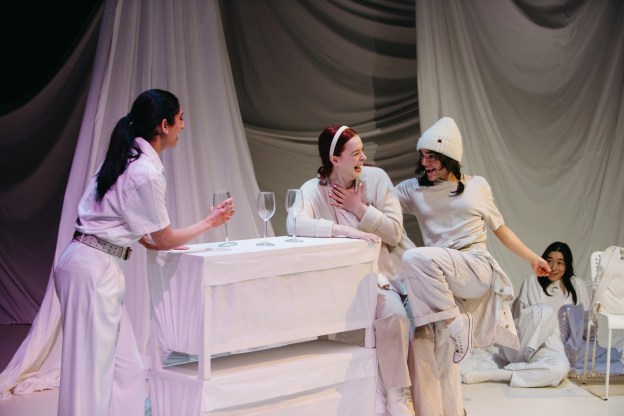
Direction is by Annette Loiselle, and design elements by other contributors enhance the storytelling as well: Narda McCarroll’s set design turns the black-box into a white world of fluttering sheets/wind/waves, uneven rocks, and shifting furniture. Ainsley Hillyard’s choreography for the three sisters and an ensemble of dancers (Mpoe Mogale, Alida Kendell, Tia Ashley Kushniruk) conveys everything from the weighting-down of depression and the struggling to reach through barriers of a broken connection, to the joy of dancing on a beach, alone or at a party. In one scene, tap dance conveys jarring, out-of-context, manic enthusiasm. Rebecca Cypher’s costume design has all the performers in shades of white, conveying their very different personalities in small details. Aaron Macri’s sound design with Binaifer Kapadia’s original music and Whittyn Jason’s lighting design all build the world and contribute to the message.

This play made me realize that many fictional stories about families dealing with the effects of a mood disorder are oversimplified. Sometimes movies or novels make it seem as if getting the right diagnosis, then getting the right medication, are straightforward steps leading to a happy ending — or as if flaws in those steps lead inexorably to a tragic ending.

Mermaid Legs shows that it isn’t that simple. And it shows that the identified patient isn’t the only one who needs to work at becoming healthier.

That it can show these things while being entertaining, beautiful to watch, relatable, and sometimes hilarious, is a tribute to not only the playwright but the whole team. (Oh, and when you think it’s almost over – watch for a very funny physical bit in the game of hairband-keepaway!)

Mermaid Legs is playing at Gateway Theatre (home of Workshop West Playwrights Theatre) until March 10th. Tickets, content warnings, and accessibility information are all available here.

Amigo’s Blue Guitar: thoughts about refugees and migrants

Sandy Roberts and Aldrick Dugarte, in Amigo’s Blue Guitar. Photo credit Scott Henderson, Henderson Images

I saw four good plays in the last couple of weeks, and didn’t make time to post about any of them before they closed: The Spinsters (Small Matters), The Drawer Boy (Shadow Theatre), Donna Orbits the Moon (Northern Light), and This is the Story of the Child Ruled By Fear (Workshop West / Strange Victory). I love theatre that reflects situations familiar in my community and my life and leads me to reflect on them, whether in a fantastical setting or a mundane one, and the four plays above all did that.

Joan MacLeod’s Amigo’s Blue Guitar, currently on stage at Walterdale Theatre, also portrays some real-world situations, in ways that are worth thinking about. The set (Leland Stelck) is a beautiful evocation of an offshore BC island cabin, with exposed wood and big windows, open to the mountains and the ocean, and a downstage dock. Text projected on the backdrop (director Bob Klakowich provided the projections) sets the context by providing information about the civil war and unrest in El Salvador in the early 1990s, and about refugees in general and their outcomes in Canada. The character Elias (Aldrick Dugarte) appears to the side, speaking Spanish and simple English, shifting from dreamlike musing about his memories to responding to immigration questions. 

The small-scale interactions and byplay among a family living on the island, with early-20s siblings Callie (Crystal Poniewozik) and Sander (Graham Schmitz) sniping at each other and defending each other, draft-dodger-fisherman father Owen (Richard Wiens) holding things together, and grandma Martha (Sandy Roberts) visiting from Oregon, are amusing and familiar. As the action opens, they are scrambling to respond as Sander’s well-intentioned scheme to sponsor a refugee from El Salvador is suddenly becoming real, with Elias due to arrive any minute. 

The action of this play takes place over the first six months that Elias is in Canada. The interactions between Elias (pronounced uh-LEE-uss) and the various family members start out embarrassingly awkward, as they don’t speak much of each other’s language and they don’t know much about each other’s country. It is fascinating to watch the superficial assumptions on all sides break down, as they gradually speak more and ask more questions. We see that Sander’s commitment to rescuing Elias, after hearing an inspiring speaker in his sociology class, was actually based on very little knowledge – “I imagined you every morning, living in a village atop a mountain”. “San Salvador is a large city”. As the other family members each get to know Elias better and appreciate him, Sander becomes distant and almost resentful. Sander is completely unequipped for dealing with effects of Elias’s significant trauma. I have been thinking ever since about good intentions not being sufficient, when dealing with any marginalized individuals. Meanwhile, Elias begins to make his own choices about his Canadian life and his future, not the ones recommended by the host family and immigration authorities. 

Graham Schmitz, Aldrick Dugarte, and Crystal Poniewozik in Amigo’s Blue Guitar. Photo credit Scott Henderson, Henderson Images.

Another theme running through the story is about Owen’s history as a US draft dodger during the Vietnam War. Forty years on, he’s still hurt by the memory of his parents rejecting him, and still dining out on his bravery in crossing the border. He wants to connect with Elias to validate the courage in his own migrant journey, which is both charming and patronizing. 

Richard Wiens and Graham Schmitz in Amigo’s Blue Guitar. Photo credit Scott Henderson, Henderson Images.

The cast and production team for Amigo’s Blue Guitar were supported in their work by cultural consultant Leo Campos-Silvius, a community cultural leader originally from Chile. After this Sunday’s matinee performance (2 pm), there will be a panel discussion with Leo Campos-Silvius, director Bob Klakowich, and discussion moderator David Goa. The audience will have the opportunity to listen and to ask questions of the participants. 

Amigo’s Blue Guitar continues at Walterdale Theatre until Saturday February 17th. Tickets are available here. 

13 actors play clerks and customers in an old-style perfume shop

She Loves Me

A busy day in Maraczek’s Parfumerie, with Georg Nowack (Russ Farmer, downstage right) gatekeeping job applicant Amalia Balash (Ruth Wong-Miller, in cream figured dress) Photo Nanc Price Photography.

The pre-set for She Loves Me, at Théâtre Servus Credit Union (La Cité Francophone), is simple. A storefront with a bench in front of it, a backstage orchestra visible over the top. But as the stories unfold, the set (Leland Stelck) unfolds more literally, revealing the main set of a parfumerie in 1930s Budapest, and later shifting quickly to create a romantic cafe, a hospital room, and whatever else is needed. The counters, shelves, displays, and stock convey a store filled with luxuries and needs. It felt like it would be interesting to browse more closely – like going to Lush (without its overpowering mix of scents).

The show focuses on the parfumerie’s owner, Mr Maraczek (Brian Ault) and its employees (Andrew Kwan, Russ Farmer, Scott McLeod, Brendan Smith, and Christina O’Dell) along with job-applicant Amalia Balish (Ruth Wong-Miller). Like a Maeve Binchy novel, the script (Joe Masteroff) and clever direction (Melanie Lafleur) convey that all the characters have interesting stories that we want to hear more about. And not just the principal characters – the ensemble makes up a store full of recurring customers, a romantic cafe full of – romances – and other intriguing bits which I won’t tell you.

My two favourite ensemble bits of this show were “Twelve Days to Christmas” – putting a familiar retail spin on the Advent season – and the whole scene in the cafe. The cafe scene made good use of the depth of stage available to them, and with the raked auditorium seating of the Théâtre Servus, the audience could appreciate the performances upstage of the three women dining at the bar-counter and their server. Not having looked at the show program before the show started, I was surprised to see that this white-jacketed cafe server was Brendan Smith, whom I’d enjoyed on local stages since his appearance in Walterdale’s Light in the Piazza. I had been impressed by the enthusiasm and voice of the young shop delivery boy but with costuming and posture I hadn’t identified him as Smith! Other romantic couples are also enjoying drinks and dancing, and playing out their own narratives, while Amalia waits alone at a centre table for her mysterious pen-pal sweetheart. Aaron Schaan and Julia Stanski, spotted shopping together in earlier scenes, seem to have a proposal accepted. Real-life couple Trish van Doornum and Michael McDevitt are snuggling at a side table. Side flirtations are suggested in a fun dance number involving peeping from behind menu folders.

The premise of having couples meet through a newspaper Lonely Hearts Club correspondence column, getting to know each other through letters without revealing mundane life details, was updated to email for the 1998 movie You’ve Got Mail. Dating app experiences in 2023 encourage providing photos early on, so the plot-device of accidentally falling in love with a co-worker based on their text communication seems less timely, but the story is still easy to relate to.

I was pleasantly surprised at the range of sexual/romantic lives accepted among the main characters. Ilona, the woman who spends time at her lovers’ apartments (Christina O’Dell), is not vilified for it. Her co-workers as well as the audience are genuinely rooting for her to find a nice man who deserves her – or to have a nice evening at the library if that’s where she finds happiness now. Georg Nowack (Farmer) is single, so the boss assumes he must be spending his evenings at cabarets and nightclubs with a different woman every night, but no, he prefers quiet evenings at home.

I also appreciated that this story didn’t follow the trope of an independent woman being attracted to a cranky rude man despite herself, and then winning him over. Instead, Amalia is openly critical of Georg when he is being rude, only begins to appreciate him when he does something thoughtful (bringing her vanilla ice cream when she is sick), and then we see them gradually building trust and then affection over the days of a busy Christmas retail season.

White man dressed in 1930s overcoat, hat, and scarf sings joyfully.
“She Loves Me” – Russ Farmer as Georg Nowack. Photo by Nanc Price Photography

The songs and instrumental music (Sheldon Harnick, Jerry Bock) enhance the experience throughout. Elizabeth Raycroft directs an orchestra of 11, and the performers all have good songs for their voices. I particularly enjoyed “Vanilla Ice Cream” and “Try Me” and the harmony in “I Don’t Know His Name”.

Two women with ornately curled hair and form-fitting business wear wrap small presents while chatting.
Ruth Wong-Miller and Christina O’Dell in “I Don’t Know His Name”, She Loves Me 2023. Photo Nanc Price Photography

In 2015, Foote In The Door did She Loves Me as their first mainstage production ever. Since then, Broadway audiences have also had another chance to appreciate this musical, and there’s a cast recording of that 2016 Broadway production – I was delighted to discover that Christina O’Dell’s role of Ilona was played by Jane Krakowski of 30 Rock.

The company has been producing musicals ever since, at the Fringe as well as in their mainstage seasons. I attended opening night of that first production, so it was a treat to watch this one and recognize many familiar names of people who had been with the company from early days or who have joined Edmonton’s musical theatre community more recently. The deeper proscenium stage and more sharply raked seating at Théâtre Servus for this production supported different choices in directing and design to connect the audience intimately with the performers and allow interesting ensemble play. Costume choices for this production (Viola Park) were more subtle than in the 2015 show, with the parfumerie clerks mostly in well-fitting understated grey suits rather than plain green shopcoats, and glimpses of colour being added gradually, particularly in Amalia’s garments and accessories. As is current practice for many local companies now, some program information is displayed on a projection screen before the show starts, with the full program available via QR code. (I don’t have a good system for saving my online programs, the way I have boxes of hardcopy programs for everything from Fringe shows to Broadway.) And of course, in 2023 some of us attend the theatre wearing masks.

She Loves Me is playing Wed-Sat evenings and Sunday matinees until November 26th. Tickets are available here.

The unseen Mob

Kristin Johnson in Mob. Photo credit Marc J Chalifoux Photography and Video.

I liked seeing Mob, currently on stage at Workshop West Playwrights’ Theatre’s Gateway Theatre, without knowing much about what to expect. Afterwards, I wanted to talk about it, but I also wanted to give more people the chance to see it similarly unspoiled.

So, if you don’t want to know what it’s about or what happens, I can still give you several reasons to see it, and then you can stop reading. Starting with the names in the credits:

  • Heather Inglis, artistic producer of Workshop West as well as director of this play, has created a coherent season of challenging work, loosely categorized under the theme Borderlands.
  • Three good performers familiar to local audiences: Kristin Johnston, and Graham Mothersill, and Davina Stewart. Each of them portrays a fascinating complex character, not entirely likeable but sometimes funny and often relatable.
  • Designers include Darrin Hagen (eerie atmospheric soundscapes and original music), Beyata Hackborn (a set that starts out with an Instagram-perfect look and turns out to be both functional and symbolic), Alison Yanota (unusual lighting that escalates the tension), and Sarah Karpyshin (iconic costume design).
  • Program credits for Jason Hardwick (choreography) and Sam Jeffery (fight and intimacy direction) provide additional clues to the content in the show and the skill level with which it will be executed.

The action starts with projections, conveying a woman, Sophie, (Johnston) driving feverishly while voices overlap and reverberate in her head. As she arrives with her suitcase at a remote bed-and-breakfast, she is greeted by Martin (Mothersill), cringingly clumsy and twitchy as he over-explains that he’s at home this time of day because he’s lost his job. The visitor stands immobile on the threshold holding her suitcase, responding to his questions but not progressing the conversation. Is she exhausted? Is she hesitant to enter? Why is she there? She’s not giving anything away. Soon Martin’s aunt Louise (Stewart) bustles in with a limp, all aging-hippie style and colourful cane, to smooth over the conversational awkwardness and remind Martin how to behave with guests. The show is described as a thriller – at first I wasn’t sure whether the characters would be realistic or more gothic, whether there would be overt or psychological violence in the isolated-country-house trope or what. I’ve also seen Johnston play a lot of disturbed and disturbing characters on stage in the past few years, from Death Trap to Destination Wedding, Baroness Bianka’s Bloodsongs to We Had a Girl Before You. But the fears explored in Mob are completely realistic and timely. Which is much scarier.

Mothersill’s portrayal of Martin often made me want to laugh – but the menace conveyed by the soundscape and the unfolding story made me feel uncomfortable about laughing – not so much that I was pitying him, but that it might be dangerous to provoke him.

The performance is a bit over an hour and a half long, with no intermission. The script (written in French by Catherine-Anne Toupin and translated by Chris Campbell) has a compelling directness with no unnecessary dialogue.

Beforehand, I wondered why a three-hander would be called Mob. Isn’t a mob a larger angry group? Then I realized that the three people on stage were not the only ones involved – that the internet posters Sophie quotes, in overlapping overwhelming torrents of abuse, are in some ways present throughout, ubiquitous and inescapable.

Mob has a short performance run, ending next Sunday afternoon, November 12th. Get your tickets soon!

Multi-Vs: a showcase of stage combat in an unfolding story

When I walked into the Varscona Theatre auditorium yesterday, I saw an exciting number of different objects distributed carefully about the stage. I saw some swords, some short blades, some long and short sticks, shields, and some things that didn’t look like weapons – a shoe? a backpack? It reminded me of when I entered the Citadel’s Maclab Theatre to watch their Romeo and Juliet, and from my seat beside the vom I could see swords laid out carefully in the vom hallway.

The action of Multi-Vs starts with two characters in modern/science-fictional body-armour and police-issue-type cargo pants, Nathania Bernabe and Jackie T. Hanlin. The pair are credited as playwrights, fight and movement choreographers, and performers, for this Affair of Honour production.

The start of the play is all fighting – fighting with various weapons and unarmed grappling. Dialogue and light / sound cues suggest that the two actors are shifting from one virtual-reality to another. I enjoyed not knowing at first why the switches and what their goal was, and then figuring that all out gradually as the action continued.

I don’t know enough about stage combat (or film combat, or video games, or swordplay in general …) to tell you what they were doing or tell you just how good it was. But it was very fun to watch, and very athletic. And when there appeared to be slaps or punches, they all looked real and sounded loud.

Multi-Vs has one holdover performance at the Varscona on August 29th (tomorrow.) Varscona holdovers are listed here, with a ticket link. Official Fringe holdovers at the Arts Barns are listed here. Grindstone hasn’t yet announced a holdover list, I don’t think.

  • 26 unique productions viewed and reviewed
  • 33 total performances viewed (1 more of Die-Nasty, 6 more of Late Night Cabaret)
  • 10 performances as crew
  • 12 venues attended
  • 4 volunteer shifts in the beer tents
  • 2 green onion cakes (one with sour cream, thank you PZ)
  • 0 parking tickets
  • 1 great Fringe Theatre Festival 2023!

A full Saturday at Fringe 2023

On the final weekend of Fringe, I’m in “just one more!” mood. Saturday ended up including Ken Brown’s Life After Life After Hockey, Natasha Mercado’s Tree, into a black shirt into the booth for a performance of i carry your heart with me, then the last episode of Die-Nasty and the last Late Night Cabaret.

Life After Life After Hockey was a masterclass in solo narrative, with a throughline, clear transitions, and interesting actions. The creator-performer Ken Brown takes us through the creation, performance, and lengthy touring career of his 1980s solo Life After Hockey, and about how it led to the next things in his life, with challenges and joys. There are familiar experiences and recognizable names in the hockey parts of his story, but also in the parts about becoming a theatre creator and inspiring generations of other local theatre creators through his time teaching at Macewan and afterwards. For a solo, it had a lot of special guests – but that is not a complaint at all, they were delightful. Holger Peterson playing harmonica, Dana Wylie singing and playing guitar, Edmonton’s former poet laureate Pierrette Requier reading a poem about Edmonton, etc. Stage 13, La Cité – Servus Credit Union Théâtre.

Natasha Mercado’s Tree was a charming solo about a tree who longs to be human. Lots of low-key audience participation (“now I need a babbling brook through the forest – just this side of the room”) and a bit of a twist that I thought was going to turn into The Giving Tree. (It didn’t – which is good because I can’t stand that book). A game-show “Would You Rather” explored some of the possibilities available only to humans, good and bad. Stage 7, Chianti Yardbird Suite.

Die-Nasty’s Fringe series wrapped up with a few more deaths, everyone in jail exonerated especially Liz Nicholls (Kristi Hansen) who was recognized as the Spirit of the Fringe in an inspiring song, and the traditional port-a-potty hookup between Liz and the gonzo podcaster Fisher T Johnson (Mark Meer). Die-Nasty’s fall season opens its curtain on Monday October 23rd, set in a 1920s circus sideshow, and the first one’s free! (a successful marketing ploy for many substances …)

Late Night Cabaret was crammed full of special guests, stunts, contests, and inside-jokes that include the whole Fringe community as the insiders, which is the best thing about LNC. (@lnc_yeg, as the hosts often remind us.) Last night was also the last performance ever of Zee Punterz, who have been the cabaret’s house band for more than ten years. A slideshow gave us glimpses of many of their performances and paid tribute to the late Brett Miles, saxophonist through most of that time. They ended their last set, and the night, with a great rendition of Stairway to Heaven, along with the musical guest Lindsay Walker. And then they gave us an encore. Before the lights came up and the Fringe technicians started striking the band’s set, as a reminder of what will be happening today and all through the next week, as the Fringe grounds gets returned to its usual uses as a park, an alleyway, a parking lot, a road and bike path … and the theatres go back to being rehearsal spaces and classrooms, music performance rooms, bars, dance studios, lecture halls, a Masonic hall, and … and a lot of theatres preparing for their upcoming 2023-2024 performance seasons.

But that’s for later! For today, I’ll put my lanyards back on and find my sunglasses and head out to watch some theatre before our 5 pm performance of i carry your heart with me (Stage 27, Sugar Swing Upstairs). First stop, Multi-Vs. 2 pm at Stage 11, Varscona Theatre.