Category Archives: Festivals

Superheroes and amazing drums

Between my beer tent shift and getting ready for Sonder’s evening show, I fitted in two performances Sunday afternoon.

Harold of Galactus is a longform improv show with local improv stars Chris Craddock and Mark Meer.  (“Harold” is the name of a common thematic longform improv structure, and Galactus is a comic-book character).   In the show I saw, the performers asked an audience member for the name of a comic-book superhero, and a front-row fan said he’d once made up one called Mortar.  Chris and Mark then had a brief conversation on stage about comic-book tropes and how they might play out for a superhero called Mortar, and then created a series of scenes and stories about the character and how he’d be portrayed in the different eras of comics, from 1942 to near-contemporary.  This let the audience have the fun of noticing all the quirks of Golden Age comic stories (“Is Hitler a hero because he killed Hitler?  But he also killed the guy who killed Hitler!”) and the tropes of more recent comic-book storytelling  (a sidekick who is invincible but nervous, very few women except the occasional supervillain, a league of criminals, and so on), bouncing between eras and landing at a satisfying resolution just before the time was up.  I love watching improv partners who have played together for a long time, because they pick up on each other’s cues so smoothly they seem to be telepathic.  Later in the week I have tickets for Rocket Sugar Factory (Jacob Banigan and Jim Libby) and for Scratch (Arlen Konopaki and Kevin Gillese), so I will get to admire that some more.  Chris Craddock occasionally fell out of character to grin at what was happening, which did not distract me from the story and just added to the sense of the performers having fun that is a mark of good improv. Fun and clever.

Then I managed to slip out quickly, dodge crowds, and get from Strathcona Library to King Edward School in 15 minutes to see Godzilla vs. Led Zeppelin, an hour-long performance of taiko drumming from Fubuki Daiko, an ensemble of four amazing drummers from Winnipeg, Hiroshi Koshiyama, Bruce Robertson, Naomi Guilbert, and Giselle Mak.  They were as exciting to watch as they were to listen to, and the show I saw was sold out.


Sonder’s next show is today, Monday at 12:15 pm, and the next one after that is Wednesday at 11:30 pm, both at Venue #5, King Edward School.


Fringe Saturday

Ritchie Community League (Venue 36, 7727 98 Street) is a new BYOV.  They have five shows playing in their intimate auditorium with multilevel stage and licensed concession.  There is convenient parking,washrooms, level access, and cash ticket sales on site.   I started my day at the Ritchie Community League with Kurt Man: buyer and seller of souls, a new solo work by Brendan Thompson.  As the program description suggests, the story starts when Kurt Man, who has had a business buying and selling souls, takes early retirement and tries to find meaning in his life.  What made this quirky story interesting to watch was that it was told through the device of having other performers speaking lines while projected on a screen on stage.  The backgrounds of the video suggest scene changes and locations.  I recognised most of the video performers, but as the show didn’t have printed programs, I was distracted by trying to figure out who they were or what I’d seen them in before.  End credits moved too quickly for me to catch all of them, but they included Colin Matty, Ellen Chorley, Emma Houghton, Katie Hudson, Mark Vetsh, Holly Cinnamon, Eva Foote, Clinton Carew, and Mark Stubbing.

Letters to Laura is also new work, written by local actor Elisa Benzer (last seen in Honk!) and directed by Perry Gratton.  Benzer and Evan Hall (last seen in a small but essential part in Clybourne Park at the Citadel) perform in a gentle realistic contemporary story of people who meet, cautiously move toward romance, and awkwardly figure out whether their new relationship is sustainable long-distance.  I loved it that the story portrayed the use of electronic communication in a natural way rather than making fun of it.  Editing on the fly and accidentally sending an unplanned text message, not being prepared for the immediacy of a video call, the first escalation of hot messages in public and the awkward dance of backing off on that … all of that felt familiar and affectionate.   I liked the way both of them narrated some of the story directly to the audience, and I liked the parallels in the two viewpoints, especially as seen in Laura’s phone calls with her friend Beth and Marc’s phone calls with his mother.  The notes I took during the show also said “sex scene – pretty socks” which is not to imply that the rest of the view was unattractive at all, just that I also noticed that Marc had attractive patterned socks.

The Wonderheads‘ new show The Middle of Everywhere was, as expected, a wholehearted delight.  The troupe of Kate Braidwood and Andrew Phoenix also included Emily Windler (Poe and Mathews) for a three-character story in mask with light and sound effects.  A little bit of voiceover at the beginning and end provided extra enjoyment but would not have been necessary to follow the story.   A lot of the story was just a fun exploration in a variety of fantasy settings.  I loved figuring out each new setting from the minimal clues, and at one point I was moved to tears by having bought in so completely that I’d forgotten it wasn’t a real possibility.  The Wonderheads are based in Portland Oregon, and they trained at the Del Arte school of physical theatre in California.

The last show I saw last night was The Show, or The Show to End All Shows (I’m not quite sure of the title), a new original work.  It was lightweight and short and it made me laugh.  It reminded me of a sort of vaudeville of various talent performances, strung together by the loose plot of what happens when most of the performers don’t show up for a show.  The Producer and Director (Rumi Jeraj and Roman Anthony) along with one of the techs (either Berkley Abbott or Griffin Schell) do a funny routine of putting on clown costumes before concluding that none of them know how to clown, for example.  An Opera Singer (Aniqa Charania) and a Musician (Sam Banigan, whom I last saw in Exposure, a Cradle to Stage production at the Walterdale last year) do a very funny duet of Averil Lavigne’s Skater Boy.  The program said that most of the performers are local high school students, but Jake Tkaczyk (U of A BFA class of 2017) was a late addition as Actor, bringing a hilarious manic energy as well as pomposity and vanity to the role.  Rumi Jeraj’s song-and-dance routine at the end was a delightful surprise.  The Show plays at Old Strathcona Performing Arts Centre, the one that advertises its air conditioning.


———–

The Fringe continues until Sunday August 24th.  Sonder‘s next show is tonight, Sunday at 9 pm at King Edward School. 

Fringe Day Two: five more shows

Turns out that on a day I’m not volunteering and our show isn’t on, it’s easy to see five shows and still stop in at home for a snack and a shower partway through.

The first one I saw yesterday was Beware Beware, new work by David Walker, featuring Thomas Barnet and Sarah Feutl, all young local artists.  It was a fairly straightforward drama about two friends, each with some current trouble on his or her mind, meeting up for late-night drinks at a campfire site in the river valley.   Both characters were interesting to watch and credible troubled people.

Next was Flora and Fawna’s Field Trip at the Varscona, which was adorable.  Flora, Fawna, and their new friend Fleurette (Darrin Hagen, Trevor Schmidt, and Brian Dooley) play three little girls who have started a more inclusive alternative to Brownies and Guides.  The show is framed as the orientation meeting for the audience who are prospective members of the group, and the fun starts as the costumed cast members hand out materials to the audience in line outside the theatre.  There was a little bit of audience participation, and a lot of laughing and awww-ing.  The three cast members each plays a child with distinct quirks and awkwardnesses, and the interactions among the friends (“we don’t even exclude people for being too bossy” says Fawna (Trevor Schmidt) with a sidelong glance at her friend (Hagen)) were very funny.  Brian Dooley was particularly charming as a young Francophone glad to be included in her new neighbourhood even though she doesn’t quite understand what’s going on.  The uniforms of tunic, tights, beret, scarf, and badge sash were appropriately awkward.

Next up was Zanna, Don’t! by Three Form Theatre, a light musical by Tim Acito which played Off-Broadway about 10 years ago.  It’s full of pop culture references and uses all the familiar tropes of high school stories, in some kind of parallel alternate universe where same-sex relationships are the norm and heterophobia is a thing.  Music Director Mackenzie Reurink directed a small instrumental ensemble, and some of the singers were hard to hear or understand over the accompaniment.  Sarah Ormandy’s portrayal of bossy Candi was especially funny.  Mark Sinongco, who I last saw in Putnam County Spelling Bee, was the eponymous Zanna, and Adam Sanders (Full Monty) and Madeleine Knight were the scandalous opposite-sex couple.

Dogfight is another musical by a young local company, in this case Linette Smith’s Strathcona Alumni Theatre.  Chris Scott and Emmy Kate Whitehead play the leads. I’m going to see it again later in the week and I’ll have more to say about it then, but if you are interested in seeing it you should buy your tickets early, as the uncomfortable seating in Strathcona High School often sells out.

Last on my schedule for the day was Butt Kapinski, a solo show by Deanna Fleyscher from Los Angeles.  The performer takes the audience with her into creating a film-noir world, full of cliches played out in unexpected ways.  The performer, a hardboiled private eye, chooses audience members for the roles needed in the story, from murdered bodies to residents of various districts in the dark city, mostly cast cross-gender.   And now I guess I can finally say that I was on stage at the Fringe.  The show was cleverly crafted and satisfying, and I’d like to go back if I can find room in my schedule.

Parade, mosquitoes, camels, and opening night!

It’s the Fringe!  The site gradually filled up all day until there was a crowd of high-energy  costumed performers gathered outside Strathcona Market for the opening parade around the site, and more people watching along the short parade route and waiting in front of the outdoor stage.  Shows started after that.

Our show Sonder opened at 10pm in King Edward School, venue 5.  It’s so fun to start sharing our work with audiences, after working on it in quiet studios.  It’s a great venue and the technicians and front-of-house volunteers were great.  In the warm humid weather the mosquitoes descended with dusk, so waiting outside the venues was a frustration of swiping and slapping, and walking across the ballfield was an attempt to outrun them.  It looks like the weather will be a little cooler on the weekend so I hope that will discourage the bugs.

After a quick drink with the company, I then started my week of watching plays with Camel Camel, a wonderful piece of physical theatre from Meghan Frank and Janessa Johnsrude, both graduates and staff members of the Dell’Arte School of Physical Theatre in Blue Lake, California (I think the Wonderheads trained there too).  They were very funny and there were no slow spots.  I had actually missed some of the plot tying the scenes together until I read more about it on their website this morning, but I enjoyed it a lot even without.

Fringe as a way of life

My first experience with any Fringe festival was the week I moved to Edmonton.  I got off the train with some of my stuff on a cold grey Monday morning after Folkfest, even though everyone I’d met from Edmonton had encouraged me to arrive in time for the folk music festival.  I didn’t want to wait a year to start experiencing the festive life of my new home, and fortunately I found out that there was some kind of theatre festival taking place the next weekend a few blocks from where I was living.  My first blog posts about the Fringe (they were semi-private journal entries at the time; I wasn’t publishing this blog yet) mention seeing a show recommended by a friend from Montreal Fringe, encountering handbillers, talking to strangers in the beer tent, and eating my first green onion cake.  But it probably took me until my second Fringe year to realize that one of the best things about the Fringe is that I don’t just pick the kinds of theatre experiences which sound safe and familiar.  Something about the format, where it’s possible to see lots of shows in a weekend or three in a single evening, and where none of them cost more than $15 total, lowers the perceived risk of choosing what to see.  My Fringe day wasn’t going to be wrecked if one of the performances wasn’t quite what I was looking for.  And in fact, my day was going to be more fun if all the performances were different from each other.

So I started expanding the range of what I was willing to try.   I didn’t think I liked one-person performances, but after seeing some brilliant multiple-character narratives and storytelling shows, I was hooked.  I didn’t think I liked clowns or mimes, but after watching some world-class physical theatre and Canadian Pochinko-tradition clown stories I wanted to see more.  I sought out dance shows, dramas, theatre of the absurd, musicals, and improvisational theatre.  Like music and food and drink and poetry, I discovered that I liked a lot more things than I would have guessed, and I got better at figuring out how to describe what I like and don’t like.   Eventually I fell into living the rest of the year with a Fringe mindset too.   My Broadway vacation was Fringe-like in my enthusiastic immersion, but the shows were a lot more expensive and the street food wasn’t as interesting.

Having become more involved in the year-round Edmonton theatre scene in the last couple of years, taking class, volunteering backstage and front of house, and seeing a lot of shows from a lot of companies, my decisions of what to see at the Fringe now include consideration of a lot of shows where I recognise the names in the program book, as friends, favourite directors, or performers I’ve enjoyed watching in the past.  This makes it even harder to decide what to see.

But here’s my first list.  I expect to see more, and I’ve got a long backup wish list waiting for Fringe bucks, Daily Discounts, artist comps, and/or space in my calendar.  These are the for-sures.  They’re not in priority order.  (I’m not linking any box-office pages; you can find those yourself.)

  • Camel Camel
  • Sonder – this is the one I’m producing
  • Beware Beware
  • Flora and Fawna’s Field Trip
  • Zanna, Don’t!
  • Dogfight – a Scona Alumni Theatre musical
  • The Show
  • Butt Kapinski
  • The Middle of Everywhere – this is the new show from Wonderheads, the mask troupe out of Oregon who did Loon and Grimm & Fischer
  • Harold of Galactus
  • Little Monsters – written and directed by Kristen Finlay
  • This is CANCER – I haven’t seen Bruce Horak’s show before but I’ve heard a lot about it
  • Off Book the Musical – this Rapid Fire troupe is even better at the Fringe than in a regular Saturday show
  • En anglais, s’il vous plait
  • Ask Aggie – I saw Christine Lesiak’s show last year and liked it, and I’ve heard there’s new material in it
  • Fugly
  • Rocket Sugar Factory
  • The Real Inspector Hound
  • 3… 2…1…
  • Real Time – scripted comedy by Matt Alden of Rapid Fire
  • The Story of O’s
  • Einstein
  • Scratch
  • Gordon’s Big Bald Head
  • Bible Bill
  • Fruitcake
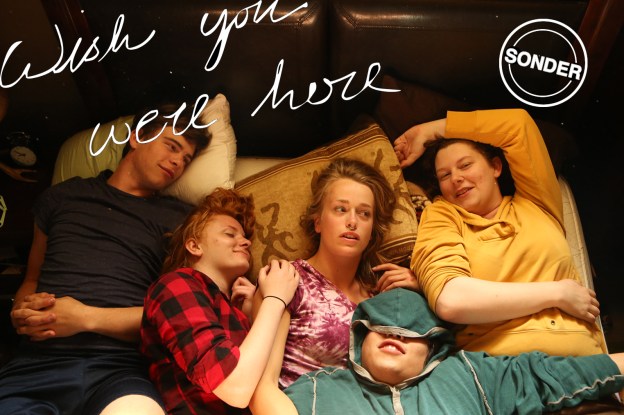
Cast of Sonder, postcard style

Sonder and the Fringe

The Edmonton International Fringe Theatre Festival is my favourite festival.   And counting down to the Fringe is like counting down to Christmas.  When I was a child, I used to ask my parents, Don’t you wish Christmas was tomorrow? Mum would sigh and Dad would grumble in their grownup ways saying that they didn’t wish Christmas was tomorrow because they weren’t ready.  I would explain that if Christmas was tomorrow they would be ready!  They didn’t buy it.

Anyway, every year as soon as Folkfest is over I start getting excited about the Fringe.  I already have my program and some show tickets, and my volunteering schedule for the beer tent.  I drove by the grounds last night and saw the barricades on some of the roads.  I’m clicking Maybe on all the Facebook events and trying to figure out how many I can see.  I’m looking forward to the parade, the food stands (especially Rustixx pizza), the out-of-town visitors, the excitement … but at the same time I’m feeling like one of those grown-ups who has a to-do list that has to happen first.

One of the things on my personal to-do list is to get caught up writing about other performances I’ve seen, so I can start the season fresh.  That will appear here in the next few days.

The other things are about getting everything ready for the new show that I’m producing, Sonder, with our company The ? Collective (you can pronounce that however you want, but we usually say “the question mark collective” – our twitter handle is @theqmcollective).  A friend and I put together a lottery entry last fall and were lucky enough to get selected to perform in a Fringe lottery venue, King Edward School.  That’s Venue 5, the elementary school, the low white building closer to the Fringe grounds, as opposed to the Academy which is the older brick building across the street.  My friend, Jake Tkaczyk, took on the roles of director and creation facilitator, gathering a small group of Red Deer College students to explore themes of interconnectedness and meaningful moments in a collaborative creation process.  The title Sonder came from the tumblr blog Dictionary of Obscure Sorrows, in which the writer, John Koenig, coins many words for interesting concepts – in this case the realization that each random passer-by is living a life as vivid and complex as one’s own.  As the work slowly took shape, Collette Radau contributed as dramaturg, Alex Boldt responded with original music and soundscapes, and all of us told and listened to many stories.

What we’ve come up with uses the techniques of performance art, movement, recitation, and narrative scenes real and surreal to show a series of moments in different people’s lives, from the everyday to the magical, funny and poignant and sometimes disturbing.   We’re excited about showing our creation to the Fringe community, and we’re also excited about experiencing the Fringe from the inside.   I’m the only one who’s been involved with a show in the past (as stage manager for WaMo Productions’ God on God 2013, 3 stars in the VUE and the Journal).  Some of the company members will be attending their first Edmonton Fringe, and I’m almost as excited about showing them the festival that made me fall in love with theatre in the first place.

But as I said at the beginning, I’ve got a to-do list between me and opening night (Thursday Aug 14th at 10 pm by the way).  The rest of our company arrives in town today, and our tech rehearsal is this afternoon.  We have posters to hang, handbills to hand out, programs to print, buttons to sell, and a parade to entertain you in (Thursday Aug 14th, 7:30 pm, Fringe grounds). We have a blog, a website, a Facebook event and page, a twitter account, and an indiegogo campaign (running til the 21st).

And we have tickets at the box offices for all our performances, $11 adult, $9 student/senior.  We’d love to see you there!

  • Thurs Aug 14th, 10 pm (opening)
  • Sun Aug 17th, 9 pm
  • Mon Aug 18th, 12:15 pm
  • Wed Aug 20th, 11:30 pm
  • Thurs Aug 21st, 4:00 pm
  • Sat Aug 23rd, 6:45 pm (closing)
Sonder cast rehearses family scene.  Erin Pettifor as the mother comforts her children (Julia Van Dam, Evan Macleod).

Sonder cast rehearses family scene. Erin Pettifor as the mother comforts her children (Julia Van Dam, Evan Macleod).

Sonder cast creates funeral vignette.  Evan Macleod as Doug the deceased.  Mourners left to right: Julia Van Dam, Emily Cupples, Tyler Johnson, Brittany Martyshuk.

Sonder cast creates funeral vignette. Evan Macleod as Doug the deceased. Mourners left to right: Julia Van Dam, Emily Cupples, Tyler Johnson, Brittany Martyshuk.

A few of the thousand faces

Last night a friend took me along to the Thousand Faces Festival, which explores myths from around the world in a variety of performance media.  We attended two events, a performance of Shakespeare’s Macbeth and a Mythic Poetry Brothel.

Macbeth is a familiar enough story, full of archetypes and supernatural elements and sayings that have entered common use, that it fit easily into the theme of myth.  This production was not the most compelling one I have seen, but it was fast-paced and had some good moments.  Macbeth was played by Elliot James, who I last saw as a worse-than-archetypal asshole cop in Dirt.  He had some of that character’s swagger, and not very much regret.  Bobbi Goddard, a BFA Acting student at U of A, was Lady Macbeth (while also playing in When the Rain Stops Falling this week).   Other familiar local actors were also involved – Oscar Derkx, Mat Simpson, Lianna Makuch – but there were no printed programs and the headshot display in the lobby was incomplete and didn’t identify roles.  I also don’t remember who directed it and can’t find that information anywhere today.

The Mythic Poetry Brothel, a coffee-house style event, started in the beer garden behind the Alberta Avenue community hall but migrated smoothly into the hall when the night got cool.   Local poets (including Colin Matty and Tim Mikula) read or recited their work in character as various deities, and additional entertainment was provided by MC Morgan Smith and an interesting collection of musicians and dancers.  The “Brothel” part of the event title probably referred to the opportunity to get private readings by making a donation to a poet.  Sort of like table dances I guess.

The Thousand Faces festival resumes next Friday evening.  I love living in a city which has such an assortment of arts festivals, including small ones like this with admission by donation.

Sapientia, a disturbing tale of child martyrs and a fascinating portrayal with puppets

The author credited for this play was Roswitha of Gandersheim, a 10th century playwright, poet, and (according to the Canoe Festival program and Wikipedia) secular canoness.  A Wikipedia link explains that this referred to a woman who lived in a monastery but did not take religious vows, so it might have been a handy way for a woman of the aristocracy to pursue a single scholarly life.

This adaptation as object theatre was made by Joseph Shragge of Montreal.  Mia van Leeuwen of out of line theatre was credited with direction and design.  Object theatre is a sort of puppetry using found objects.  The four puppet performers were David Barnet, Kara Chamberlain, Nancy McAlear, and Brendan Nearey.  The objects were simple and ordinary (a kettle for the emperor, teacups of diminishing size for the three little girls, a mirror for the mother), but the small gestures of the puppeteers and their voices made it easy to picture the characters as the story unfolded.

The subject matter of the tale was a Christian woman and her three young daughters, defying the Roman emperor Hadrian to the extent of torture and martyrdom.  It was a classic martyr story, with the satisfying ending being death without surrender leading to frustration and loss of authority of the murderer.  I imagine that in the 10th century it might have been particularly radical to have the woman and her young daughters being strong and determined and logical, while the male emperor and his advisor/executioner appear ineffective, emotional, and flailing.   The stories of my 20th century childhood might have found beauty in sacrifice and justice in choosing the right belief, but the responses from my 21st-century heart as a parent and aunt and leader of young people are so strongly opposed to the idea of encouraging children to die for a belief or ideal that I couldn’t finish this blog post last night.  I can admire the courage and honour the choice of Aitzaz Hasan, the 15-year-old Pakistani who tackled a suicide bomber to save his classmates, but I feel really uncomfortable about the idea of a parent encouraging his or her children to choose a principle or belief over staying alive.   And I don’t think I’m the only modern person who feels this way, or we wouldn’t have discussions about whether Christian-Scientist or Jehovah’s-Witness parents should be prevented by a just society from refusing their children conventional life-saving medical treatments or whether small children are able to make those decisions themselves.  Anyway, it’s upsetting, but the play made me think, and I’m glad of that.

I’ve also been interested to notice how the genre of the storytelling, with the simple symbols representing the characters and their fates, allowed some graphic but elliptical imagery to address the horror of the tortures and deaths more closely than would have been bearable for a more conventional acting genre.  For example, the executioner broke a teacup, or crushed a ripe pomegranate, and the audience gasped in shock for the brutal murder of a child represented.   I won’t record any more of the details because I need to be able to sleep – but it was fascinatingly well-done.

Canoe Festival 2014 continues this week with showings of National Elevator Project Part 2 Tuesday through Sunday, and Tanya Tagaq’s Nanook of the North with one performance Wednesday.   Twitter hashtag #canoe2014 and a series of guest bloggers posting at http://canoetheatrefest.tumblr.com continue the conversations about performances and performers, theatre and life.

Static Electric

I’d seen mention of Mile Zero Dance and Gerry Morita around the Edmonton entertainment scene for some time, but I’d never attended a performance before.  Having now seen Static Electric, the Mile Zero Dance piece at Canoe Festival, I’d definitely seek them out again.

The two dancers, Gerry Morita of Mile Zero and Farley Johansson of Science Friction and Coastal City Ballet in Vancouver, explore a cluttered living space full of lamps, televisions, recordings, transmissions, a piano being played by Viktoria Reiswich-Dapp, a jukebox, and other electric apparatus.  At first, the two characters seem completely unaware of each other, although they overlap in space to the extent of tumbling over and around each other on an easy chair and a carpet.  Later, they come to interact more consciously, but eye contact is fleeting.  Sometimes they have normal-sounding conversation and exchange reminiscences through family-band radio walkie-talkies.  There is also some dialogue in German and, I think, in Russian (though it might have been Ukrainian or another similar-sounding language).  Morita plays with a cassette recorder, speaking into it and then playing it back, and she also disassembles a cassette tape, constructing streamers on a fan and then becoming tangled in a mass of tape.  Lighting designer Patrick Ares-Pilon moves intentionally through the space towing and adjusting carts of electrical gadgets.

The program says that the performance is improvised.  It works fascinatingly well.  Morita and Johansson are both powerfully athletic and expressive artists who are thrilling to watch.   My favourite bits were the ones with “Volare”, “Riders on the Storm”, and hockey play-by-play as the soundtrack.  The last bit of the show sounded as if Johansson was dancing in a box of broken glass, and the sound effects were so disturbing I could hardly bear it.

Their last show is in about half an hour (Saturday afternoon) but there’s lots of other good stuff to see and hear and think about at Canoe Festival.

Testament

Friday night I described the two Canoe Festival performances that evening to a friend as “six naked people, and then Mary the mother of Jesus”.  My friend laughed.

But of course that superficial description didn’t do either of the plays justice.  Body 13 had interesting things to say about sexuality, ethnicity, assumptions, and failed connections.  And Testament was a powerful one-woman show about a determined woman preserving her self and her sanity while surrounded by tragedy, personal danger, and wishful thinking and revisionism.

The story is based on Colm Tóibín’s novella The Testament of Mary, which I have not read yet but now I want to.  (I also left the theatre thinking “I want to read the book!” but I didn’t say that to anyone because I thought they might misunderstand.  I have actually read the, um, more primary source materials, just in English but in more than one translation.)   It was adapted for the stage by Guido Tondino, and this Théâtre Archéologique production is the world premiere.

The actor, Isabelle Rousseau, has a compelling controlled stillness and deliberation to her movements.  Whether she was narrating the story while sitting in a chair, or moving about the set of her house arrest / protection lighting candles while the story continued with her recorded voice playing, I focused mostly on the spoken words.  Interestingly, I found it more difficult to dismiss her or assume she was equivalent to the iconic Mary because the actor did not have long hair.  Her short haircut with bangs was one of the first reminders to hear the story fresh.

The viewpoint ascribed to her by the author and dramaturge is compelling and moving, completely consistent with the sparse written versions provided by the original unreliable narrators.   Referring to the disciples, Mary talks about “the enormity of their actions and the innocence of their belief”.  She also used a concise expression that I didn’t write down for their urge to shrink the story to a more consistent narrative of symbols – and I could see how her version wouldn’t fit with the conventional one.  For example, she tells the audience that she was not present for her son’s death and burial, because she had fled the hill fearing for her safety, and by the time that the play is set (maybe a few months later? years?) the accepted version is that she had been there for all of it.

In the play she alludes to the story of her pregnancy and the one of misplacing her son as a child, but mostly sticks to a few important scenes – the raising of Lazarus, the wedding at Cana, the arrest, the crucifixion, a vision afterwards.  Her stage business with the hammer while narrating the crucifixion was a powerful and disturbing underlining of the horror of the scene she is describing, although I may have been missing some explanation for the details of the symbolism as I was expecting her to do something more obvious (form a cross-shape, lie in the canonical posture herself, etc).

Testament has two more performances in the Canoe Festival, 9 pm on Saturday (today) and 7 pm on Sunday at C103.  Tickets are available from Workshop West or at the door.