Author Archives: Ephemeral Pleasures

Alice Through the Looking Glass, and what I found there

The audience is different at a matinee of a show advertised as suitable for families.  There are a lot more black velvet dresses and pink snow boots.  I overheard a discussion beforehand about how live theatre is different from movies, with an adult explaining that no, it’s not all going to be on that little screen, and I overheard a discussion afterwards with other audience members saying that they didn’t want to go home yet, they wanted to stay and talk to the characters.  It was also clear to me that some young members of the audience were restless during the long poems and songs, and they didn’t conceal that quite as effectively as I like to think that I do nowadays.  All that being said, I did not find any of the audience members badly behaved or disruptive of my enjoyment of the show.  And I did enjoy it.

Lewis Carroll’s story Alice Through the Looking Glass, written in 1873, was adapted for the stage by Jim DeFelice in 1974, with music written by Larry Reese.  The production currently playing at the Red Deer College Arts Centre Mainstage is directed by faculty member Lynda Adams, and the seven performers are all final year students in Theatre Performance and Creation.

Julia Van Dam played the eponymous Alice convincingly as an imaginative Victorian-era child of “seven years and six months”, daydreaming of imaginary worlds and then landing in an unexpected one where things don’t go the way she dreamed.  Her body language, more expressive than an adult’s but still restricted by custom and crinoline, conveys delight, responsibility, frustration, and relief, and her singing voice is up to the material while not seeming inappropriately adult.

The other six cast members all played multiple characters.  The story was simplified a little bit from the original, but they left in all the important characters – TweedleDum and TweedleDee (Jennifer Suter and Jessie Muir), Humpty Dumpty (Dustin Funk), and some of the chess pieces.  As in the original, and in the playing-card symbolism of Alice In Wonderland, it was interesting to see the chess pieces develop distinctive character traits – the Red King (Dustin Funk) is sleepy to the point of narcolepsy, the Red Queen (Jessica Bordley) is a stern parent/teacher figure hectoring Alice about manners and behaviour while the White Queen (Collette Radau) is endearingly gentle and bewildered, and the White King (Jake Tkaczyk) is forgetful and clumsy.  Except for the Red Queen and to some extent Humpty Dumpty, all the characters treat Alice as an adult with agency, and she readily takes on responsibilities of taking care of herself and of them.  This was satisfying to me as a child reader and was still so as an adult playgoer watching the story through her eyes.

I noticed other ways that my old reactions to the story coloured my responses to the play.  I started out scared of the Red Queen, but I think actually that came from being scared of the playing-card characters in Alice in Wonderland.  I thought the Walrus and Carpenter song was both too long and too disturbing, because that is how I felt about it when I first read it.  In this stage production, I really enjoyed the oysters-as-puppets though.  And I still felt impatient during Alice’s encounter with the White Knight (Jen Suter) in the penultimate square.  As in the book, it felt like an irrelevant delay in order to introduce yet another eccentric character and recite yet another poem.  Jen Suter plays the White Knight with a sort of cowboy accent, perhaps of a cowboy whose range extends from Montana to somewhere in the Old South, but her delivery of the repeated line about “it’s my oooown invention” was very funny, and I heard a lot of adult chuckles during that scene.  I loved the expressive movement and feathery menace of the Black Crow (Jessica Bordley) just before and just after intermission, as the White King flails around causing or harnessing a tornado with his queen’s long unmanageable shawl.

It’s not really a story with a conventional plot arc or a lot of continuity, just Alice’s goal of reaching the eighth row of the chessboard as a pawn so that she can become a queen.  One undercurrent of theme is about names and loss of identity, as several characters warn Alice about losing her name or challenge her to replace it.

In a pair of framing scenes at the beginning and end, Alice is a little girl in her own house interacting with her nurse (Collette Radau) and her cat Dinah (Jessie Muir, with amusingly-credible feline physicality).  The “real” world scenes are shown as silhouette shadows on a scrim, with black and white drawing showing a fireplace, mantelpiece mirror, and chessboard.  This created a magical contrast with the colourful three-dimensional Looking-Glass world, similar to the colour film effect in Wizard of Oz, although I did wonder whether it confused the family behind me, in which an adult had just explained that the live actors in the play weren’t going to be on the screen at all.  The initial scene also made very clever use of the optical trick of having one character farther from the light than the other, so that Alice standing up looked about the same height as her seated nurse.

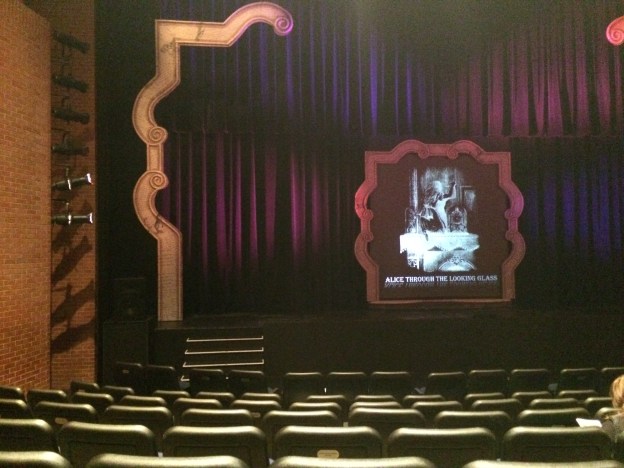
Outside those scenes was a second framing, as the performance started with a single spotlight outside the curtain (and in fact, outside a “second frame” ornate-scrollwork
mirror-frame decoupaged with mirror-image text from the Jabberwock) illuminating a Storyteller (Jake Tkaczyk) in Victorian-period frock coat, top hat, and white gloves and still demeanour, who sings the Prelude song “Child of the pure unclouded brow”.  His well-trained mid-range voice would not be out of place in musical theatre and his changes in delivery for different parts of the song helped make sense of the rather abstract lyrical poetry.  After the ending scene with real-world Alice on the screen talking over the adventures with her cat, Tkaczyk begins to sing again in costume as the White King but with the Storyteller’s voice, and the curtain rises again on the Looking-Glass world as the other performers join in with the choral finale.  Again, this provides a pleasing symmetry while also covering the musical-theatre convention of an all-cast song leading to the curtain calls.

The chess-piece costumes were very clever, with wide padded stiff hoops at the rim of robes suspended from the performers’ shoulders.  Similar stiff hoops could be spotted at the bottom edges of the knights’ horses, at TweedleDum and TweedleDee’s trouser cuffs, and on various sleeve cuffs.  Alice’s costuming, pink white and black with ringlets and a big hairbow, suited the clear simple palette of the show, but drew attention with small patterns and details reminiscent of the little-girl fussiness of the Harajuku Girls (Gwen Stefani’s backup dancers).

The fantasy world’s set used a revolve painted with a chessboard grid, and a pile of different-height boxes consistent with the grid.  Various trees, flowers, and so on continue the theme of coloured squares.  As I had been spending time with a young nephew before the show I was immediately reminded of the video game Minecraft, but that may not have been intentional.  The momentary jarring sensation when I heard the phrase “grassy knoll” on the 50th anniversary of J.F. Kennedy’s death was certainly not intentional.  The backdrop included a whirling Fibonacci-sequence checkerboard cloud formation.  Four stage technicians, students in the Theatre Production program, (Michael Johnson, Jordan Kruithof, Astrid Olivares, Jesse Robbins) contributed visibly to the production, as hands appearing in tables to serve drinks, crew of the Fourth-Square Express train, and especially at discovering Humpty Dumpty after his fall.

In the early performances I saw, there was possibly a little bit of sound balancing inconsistency in the first choral number, “Through the Glass”, and a few places where a performer was not speaking clearly enough to be easily heard from the middle of the big auditorium.  But those are easy details which will likely be corrected before this week’s performances, running Tuesday through Saturday (Nov 26 through 30), with tickets available through Black Knight Ticket Centre as usual.

An audience member studies the set for Through the Looking Glass at intermission.

An audience member studies the set for Through the Looking Glass at intermission.
Another Comedy of Errors

There are lots of Shakespeare plays that I’ve never seen, studied, or read.  I’ve heard of people who make a point of saving one Shakespeare play so they have something to look forward to … but it’s usually Troilus and Cressida or Coriolanus, something after Shakespeare was on the way to jumping the shark.  Anyway, until this year, I hadn’t watched Comedy of Errors at all.  Or studied it, or even read it.  But this summer I enjoyed a production of Comedy of Errors in the tent at Shakespeare on the Saskatchewan in Saskatoon, and then I went to the rap adaptation Bomb-itty of Errors directed by Dave Horak at the Edmonton Fringe.  And then in October I attended a Comedy of Errors production done by Red Deer College Theatre Performance and Creation students and directed by Jeff Page.

The set visible before the play started hinted at a fantasy setting, with playful pastel triangles painted on a city backdrop and courtyard flooring.  Then a drumroll and change in the lightning were followed by solemn standard-bearers and then the solemn entrance of the Duke of Ephesus (Julia van Dam) followed by her frail and bedraggled prisoner, Aegeon (JP Lord).  After the long exposition necessary in the first scene, where Aegeon explains about his wife having been lost at sea with one twin son and one twin slave-companion and the Duke explains that although she feels pity for him, she won’t make an exception to the law banning Syracusians, the action speeds up.  Antipholus of Syracuse (Jake Tkaczyk) and Dromio of Syracuse (Jen Suter), the bewildered travellers, stumble into a cheerful busy marketplace, with bubbly 1960s-inspired pop music in the background.  The costumes too seem to evoke the playful early 1960s, with ice-cream colours, argyle vests, and minidresses.  Soon the play’s theme of mistaken identity becomes clear, as various locals confuse the visiting Antipholus and Dromio for their identical-twin namesakes who live in the town, and the local pair (Richard Leurer as Antipholus of Ephesus and Brittany Martyshuk as Dromio of Ephesus) appear alternately with very similar body language and costuming, making the mix-up credible.  Leurer and Tkaczyk have almost identical jaw-hanging confused expressions.  Adriana, the impatient wife of Antipholus of Ephesus who is waiting the midday meal for her absent husband, is played with irritation and then increasing worry that her husband’s unexplained behaviour might mean that he is unfaithful, by Victoria Day.  Adriana’s unmarried sister Luciana (Constance Isaac) has some amusing stage business with high heeled pumps that hurt her feet.  Other local characters complicating the plot include Angelo (Tyler Johnson) a pompous prosperous goldsmith with tailored Nehru jacket and walking stick, an unnamed courtesan (Megan Einarson) in gogo boots with some outrageously flirtatious audience interaction, the Duke’s overeager executioner (Wayne De Atley) and the soothsayer Doctor Pinch (Jessie Muir), an odd steampunk cross between a psychotherapist and a psychic.  The servant Luce, who horrifies Dromio of Syracuse when she mistakes him for her husband Dromio of Ephesus, is played by Bret Jacobs.  Casting Jacobs was an inspired choice for director Jeff Page, since he plays the bossy cook and affectionate wife with hilarious gusto, but also because Dromio of Syracuse’s speech about her being repulsive because she is fat and dark-skinned is both funnier and more acceptable to my modern ears when the character is played by a man.  Another aspect of Shakespeare’s tale that made me uncomfortable on reading and on viewing of the previous productions was the way that the Dromio characters are treated by the Antipholus characters who own them/employ them and were raised together with them, with physical beating as well as verbal abuse.  Again, a directorial choice in this production made that aspect a little more ridiculous and less disturbing, with most of the beating being done using rolled up newspapers.

The courtesan and her retinue performed an original musical number, Nothing but Love, by Edmonton musician Paul Morgan Donald, in a sort of bubbly sixties pop style.  It was fun to watch and listen to, and it is still stuck in my head more than a month later.  It didn’t really advance the plot, but that didn’t matter.

As things get more and more confused and messed up for the fellows from Syracuse, I noticed that they became more and more disheveled with every entrance, jackets lost, shirttails untucked, bow tie undone and almost falling off.  Their Ephesian twins, more domestic and prosperous, didn’t get quite as unravelled.

And then just before things fall apart completely, the tidy denouement worthy of Gilbert and Sullivan has the twins reuniting, the Abbess (Collette Radau, in full habit and wimple subduing audience and citizens with intimidating facial expressions) declaring herself to be the missing wife of Aegeon, and everyone getting their money and jewellery back.

I was particularly impressed by Julia Van Dam’s performance as the Duke of Ephesus.  Her physicality conveyed the character’s undoubted authority, and it was clear in the first scene that the Duke regretted being unable to pardon Aegeon but was unwilling to break the law.  She didn’t play the part as a man; the Duke was referred to with female pronouns and this worked just fine.

The next play in the Red Deer College performance series, featuring some of these performers, is a musical adaptation of Lewis Carroll’s Alice Through the Looking Glass, adapted by Jim DeFelice with music by Larry Reese.  It opens tomorrow night, Thursday November 21st, at 7:30 pm on the Mainstage at the RDC Arts Centre.

Angels in America, Part 1: Millennium Approaches: from almost 30 years later

Tony Kushner’s play Angels in America, Part 1:  Millennium Approaches is set around 1985, and was written (along with Part 2:  Perestroika) in 1993.  The University of Alberta student-led performance group Abbedam chose this play as their 2013 production, and it opened last night at the Timms Centre Second Playing Space.  The director is Nick Eaton, director and co-creator of the Fringe 2013 show Into Oblivion

I had never seen or read the play before.  Unlike the majority of the opening-night attendees, I remember 1985, although I wasn’t particularly paying attention to American politics then, I wasn’t yet part of queer community, and I was just starting to be aware of AIDS.  Also, I’d never encountered any Mormons and had met very few Jewish people.  So the play has been making me think about changes in those issues and in my life in the last 30 years.  But if I waited ‘til I could say something articulate, I’d miss posting before the end of the run.  And I want to post, because it’s a good show and I think lots of people should go see it.

Knowing a little bit about the milieu of gay men in New York City in 1985 and about Mormon and Jewish attitudes to family and to ethical decision-making helped me appreciate the context of the story.  But I would also have benefited from knowing more about the McCarthy era in American politics, in particular about the lawyer Roy Cohn, who was a character in the play (played by Cristian Badiu, a PhD student).

I found this character one of the most intriguing and complex in the play, although definitely not the most likeable.  Cristian Badiu didn’t attempt one of the stereotypical New York City accents, but his mannerisms and way of speaking certainly pegged him right away as an arrogant NYC lawyer.  I was particularly fascinated by the speech in which he explains to his doctor that the label “homosexual” does not fit him, because although he has sex with men, his power and prestige define him in a way that’s not compatible with being considered homosexual.  His doctor eventually gives up or accepts what he’s saying, and suggests that he can use his White House connections to get into the experimental trials of the new drug AZT for the “liver cancer” that he insists he has rather than AIDS.  I was also fascinated by Cohn’s relationship with Joe Pitt (Roland Meseck) the young law clerk he tries to mentor and manipulate.  His speeches to Joe about choosing father figures were intriguing, as neither character acknowledges a facet of sexuality in their relationship.  It remains unclear to me whether Cohn was just drawn to young men like Joe in a platonic nurturing sense, whether he’s attracted to him and not expressing that openly, or what extent of his interactions with Joe are directed at getting Joe to do favours for him in Washington.

Joe’s wife Harper Pitt (Emily Howard) was charming.  She apparently copes with her emotional troubles by taking a lot of Valium, but she is present enough to be funny and to wish for better things, and brave enough to eventually get her husband to acknowledge that he is “a homo”.

The other two main characters (a cast of 15 played about 20 characters) were Prior Walter (Gabe Richardson) and Louis Ironson (Joshua Edison), a 30ish couple who have been together several years, who are both witty and affectionate and very likeable.  In their first scene, we see Prior supporting Louis at his grandmother’s funeral, teasing him gently about acting butch around his family, but the balance shifts quickly as Prior then rolls up a shirtsleeve to show Louis what looks like a bruise, but in that context is undeniably a Kaposi’s Sarcoma lesion.  Throughout the rest of the play, the two of them go through the range of responses of a dying man and of someone who loves a dying man, together and separately, in compelling convincing anguish.

One of my favourite minor characters was Belize (Matt Ayache) a nurse of colour and sometime drag queen.  Without exaggerating the flamboyant stereotypes, he contrasts with the other characters’ gender presentation and also speaks the most directly about racism, changes in queer culture, and treatment of the dying.  Lauren Derman was also impressive in understated portrayals of a calm accepting hospital caregiver (I wasn’t clear whether she was a nurse or a doctor) and of the ghost of Ethel Rosenberg.

The action took place in a simple set on a revolve.  Actors and additional crew shifted furniture quickly between the many short scenes, and sometimes two scenes would be alternating on different sides of the stage.  There were some eerie and/or amusing special effects, supernatural adventures, and dream sequences, of which my favourite was Harper’s dream of Prior in a sheer négligée and wig cap doing makeup for drag.

The original play was written as a continuous narrative running about 7 hours.  This production of Part 1 ran about 2.5 hours, and ended in a slightly disorienting way.  Wikipedia does not have a very good plot summary (it would be great if someone reading this who has access to the play text could improve it).  At least it could satisfy some of my curiosity about what would happen to these characters in Part 2.  But I wish I could see these actors finish the story.

The production continues until November 17th, Sunday night.  Ticket information is on the show’s Facebook page. 

Sia – painful but not unbearable story of the aftermath of war

Currently playing at the ATB Financial Arts Barns’ black-box theatre space PCL Studio Theatre is Pyretic Productions’ Sia, by Matthew Mackenzie.  There are about 50 seats arranged in two rows along one long side of the room, and the set visible before the play started included a piece of broken concrete-block wall, some debris, and steps up to a platform covered with some malevolently-twisted welded tube and old metal chairs, formed into shapes suggesting a large tree and some roots or vines.  Program notes mentioned a refugee camp in Ghana, Liberian child soldiers, and the Butcher of Liberia’s conviction for multiple war crimes, so I worried for a few minutes that I might find the portrayal too disturbing sitting in the front row.   But I didn’t, quite.

The lights then dimmed and I was swept away into the story, starting as Makambe K Simamba, playing a young girl (I first guessed her age between 9 and 15 but she later said she was eleven), recited a folktale about birds arguing over a mango and the snake advisor who betrays them.  In the next scene, we saw two young men staggering home together from a party.  The white Canadian student Nick Summers (Patrick Lundeen) was very drunk, and his friend Abraham, a black Liberian from the refugee camp where Nick has been volunteering (Thomas Olajide, who played the same part at Factory Theatre in Toronto last year) was helping him home and washing off the magic-marker tattoos he’s been covered with at his departure/birthday party.  We saw quickly that Abraham was sober and had some kind of plan that Nick didn’t know about, and even though they seemed to be friends, this was worrying.  I wasn’t even surprised when Abraham snapped handcuffs onto his half-conscious friend, and then video-recorded him as must be de rigeur for abductors.

Scenes then alternate between the interactions of Nick and Abraham, and interactions between Abraham and Simamba’s character, his well-loved precocious younger sister who is practising what she will say in a presentation she’ll give to some UN peace monitors expected in their village.   She tries out the Liberian Declaration of Independence, the symbolism of a Christian communion service, and a story about Poseidon and Atlantis, while her older brother encourages and teases and critiques her.

Abraham goads Nick about being a typical Canadian refugee-camp tourist, coming to “observe”, and this seems to be a fair accusation.  His attempt to do yoga sun salutations while chained up is classic.  His later behaviour under the influence is particularly amusing, and slightly reminiscent of the last character I’d seen Patrick Lundeen play, the “mildly retarded but it’s just fetal alcohol syndrome, I’m not stupid, eh?” character in Kill Me Now. I was also reminded of the naive missionaries of last year’s U of A Studio Theatre production The Missionary Position, and the jarring disconnect between their Canadian confidence and the setting they didn’t know they didn’t understand.

It all gradually makes sense, and has a sort of hopeful ending, but not without living through and reliving some horrible events consistent with the bigger story of that place and time.  Thomas Olajide’s character is the most developed and complex.  His smooth shifts back and forth between the young patriot teasing his sister and the tormented man using his friend in order to get something he needs desperately made me like and feel sorry for his character.

Sia is playing until Sunday, with tickets available through the Fringe box office.  It’s not for the squeamish or easily upset, but it’s a good story.  I’m glad I saw it.

pool (no water) at the U of A Studio Theatre

The U of A Drama Studio Theatre season started in September with Mark Ravenhill’s pool (no water).  This disturbing story of unspoken resentments within a longtime group of artistic collaborators featured Ainsley Hilliard, Vince Forcier, Brett Dahl, Kristi Hansen, and Gianna Vacirca, who I believe are all recent BFA grads of the department.

Much of the story is told by the five unnamed group members in overlapping monologues, interspersed with scenes where they interact as they re-enact the events they’re recounting.  They tell a story about their dealings with a sixth person, speaking of her as She and often having one of them play Her role in their re-enactments.  It seems that She was originally another participant in their group, but she became more distant as she got more conventionally successful.  They mimic her and make fun of her, talking about her boasts about her commissions and swimming pool, but when she invites them to her poolside home for a visit they all accept.  None of the locations are identified in the not-quite-real storytelling – I was picturing their home as the “bohemian quarter” of some big city, maybe New York or London or even Toronto or Vancouver, and the place where they visit their old friend as some island warm and full of wealthy expats, maybe in the Caribbean or somewhere like Mallorca or the Canary Islands if they’d travelled from London.  The visitors comment on the large beautiful house with several servants, and then describe how they immediately plunge into partying, which leads naturally into all of them getting naked (on stage this was represented with various white undergarments) and preparing to dive into the pool in the dark.

Here I should describe the stage.  It was mostly bare, with a cool blue light and some chrome furniture and gallery displays around the sides.  But projecting out from the apparent front of the stage were five diving boards, with the space between them and under them and out into the audience being the pool.  It was lit with that eerie blue swimming-pool-at-night colour, but when She plunges in, she lands on hard empty concrete and is badly injured.  It was one of those shocks that’s almost a relief, since it was clear from the storytelling that something horrible was going to happen.

As She lies unconscious in hospital, the group still resents her, but overlaid on that is a mix of guilt, of relief that it wasn’t them, of enjoying her beach house without her around, and of a fascination with the whole concept of being comatose, which they express freely in front of each other.  And they start taking pictures of Her when the hospital staff aren’t looking.

Eventually, she begins to recover, and when she finds out about the photos, she plans an exhibition, assuming ownership of the art.  As you can imagine, this makes the group of friends even more resentful.  The whole story is really about undercurrents of resentment in nominal friendships, and the heartless reactions and behaviours were entirely too credible for my comfort.  It was thought-provoking, disturbing in a good way, and occasionally quite funny.  Also, as one could expect from seeing Vince Forcier’s and Ainsley Hillyard’s names in the program, there was some very powerful expressive movement.  It was a good start to the Studio Theatre season that left me wondering what would come next.

Ronnie Burkett’s The Daisy Theatre

Ronnie Burkett’s The Daisy Theatre, playing at the Citadel’s Club cabaret-style space until November 17th, is a sort of revue show with marionettes.  The title is a tribute to a tradition of marionettes in occupied Czechoslovakia during WWII.

I’ve only seen one performance, but I’d love to see it again.  Apparently the performances vary quite a bit, with different puppet characters making an appearance, sometimes chosen spontaneously.  In the one I saw, there was an old-style English Colonel singing a music-hall song to piano accompaniment, a retired diva, and Edna Rural, a determined farm widow finally travelling after her husband’s death.  The puppeteer, Burkett, is completely visible above the puppet stage, but I was surprised at how easily I forgot he was there and just watched the puppets.  He also solicited some audience participation, which was fun.  There were lots of topical and local jokes about politics, theatre, and other Edmonton issues.

I would have described the overall mood of the performance I saw as affectionate and silly, but a friend who saw the same show was struck by recurring sadness, not just in the character Schnitzel (an odd non-human creature who bore some resemblance to the abused-child-in-the-circus narrator of Robertson Davies’ World of Wonder) but in the aging diva and other stories.  Yet others commented that the evening was more light-hearted than some of Burkett’s earlier works.

Tickets are available through the Citadel Box Office for shows until November 17th (a week today).  There’s also a Movember fundraising opportunity to have your picture taken with a character after performances.

“There was no white linen, for my husband.” – People Like Us

“There was no white linen, for my husband.”

That was one of the repeated lines in People Like Us, Sandi Johnson’s new play.  Sarah Louise Turner plays Kate Rourke, wife of a 1991 Gulf War veteran, in an emotionally-evocative solo performance that had me in laughter and in tears.

I saw the first preview of the world premiere last night at the Firehall Arts Centre in Vancouver’s Downtown Eastside.  And if my remaining time in Vancouver wasn’t already booked up with professional commitments, I’d be tempted to see it again.

“He held his cutlery like a prince.”  In another repeated line, she shows us a glimpse of Gerry, the gallant man she married, kind, loyal, honoured to be a soldier – a man who once lifted her off her feet on the way home from a Christmas party in Petawawa to carry her across an intersection in her velvet dress in a snow storm.

Her narrative slips among times, the present (2001), the time before Gerry’s posting to Iraq, while he’s away, and how she copes after he returns home physically and mentally damaged.  But the story’s easy to follow, due to clear writing and Ms Turner’s shifts in voice and body language.  She becomes Gerry’s advocate with the military and the doctors, and gradually she starts helping other veterans conquer their own bureaucratic opponents.  “Helping military veterans apply for medical marijuana – that should be a marketable skill?”  She becomes known as the “Yarmouth (NS) Bulldog” for her tenacity.

She also maintains her love of belly dance, and a few times during the play she puts on scarves, coin belt, and zils to show how the dancing helps her maintain her power and sensuality during difficult times.  The connection between “the Middle East” of the belly-dance culture, and her second-hand experience of Iraq through television and phone calls and Gerry’s flashbacks, is not spelled out at all.  The story unfolds in a subtle way not often seen in short theatre pieces.  A few times I thought I guessed at a disaster to come, and I was always wrong.   The performer carries out various stage business during the narrative (folding laundry, packing a suitcase, making tea and drinking it), but this never distracted me from what she was saying.  Instead it just emphasized her get-on-with-things attitude as a determined mother and military wife.

Firehall Arts Centre is an effective medium-size black box performance space.  The set (designed by Amanda Larder) was fascinating – at first I saw the re-creation of a clean cozy family living room, with flowered upholstery, baskets of laundry, cups of tea, and wide worn floorboards, but gradually I took in the backdrop and ceiling from a different world.  You see, above the white wainscoting, the room had been covered by a military-style canvas tent, only instead of conventional green camouflage or desert camouflage, the dirty stained fabrics included some Laura Ashley style flowered brocades or wallpapers.  And partway through the show, I realised that along the walls of the room were little piles of sand, as if the tent/walls were insufficient to keep out the encroaching desert, just as Kate’s attempts to make a safe familiar home for her husband and children were not sufficient to keep the effects of war away from them.

This production continues at the Firehall Arts Centre in Vancouver until November 16th.  I don’t know if there are any plans for it to travel.  There should be.

2 Pianos, 4 Hands, lots of characters

A trombonist friend told us that anyone who’d ever taken music lessons should try to see 2 Pianos 4 Hands in its run at the Citadel.  I saw it in the first preview Saturday night, and I agree.  Ted Dykstra and Richard Greenblatt wrote the play and perform in it.  This is their last tour with the show.

The stage is empty except for two shiny Yamaha grand pianos, two coatracks, and two large picture frames in which are projected occasional stylized images indicating changes of scene.

The show starts with the two pianists entering in tailcoats, saluting the audience, then sitting down to play a duet.  Then follows a hilarious set of disagreements and negotiations about who gets which piano, who gets which piano bench, and when they start, all conducted completely in silence.

The tailcoats then come off as the performance moves forward in a series of vignettes about the characters growing up playing the piano.  Each actor played the other’s parents and piano teachers, and in a particularly funny scene they addressed the audience as the session chair and adjudicator for a Kiwanis Music Festival session.  The two boys also interacted as duet partners and as competitors in some scenes.  I particularly enjoyed recognising many of the specifics they referred to – Royal Conservatory exams, Kiwanis festival – and even recognised at least two of the lesson books they were using as props.  Illustrations of general music-lesson memories about parents prodding the child to practice and about teachers’ contradictory advice were also amusing.

I admired the way they showed similarities in the two characters’ alternating scenes, but still made them distinctive people.  The characters and the performers had the same names, so one might imagine strong threads of autobiography.  When Richard Greenblatt’s character was being taught by a nun, who used “Father, Son, and Holy Ghost” as a mnemonic for three notes, he corrected her under his breath with a three-word Hebrew phrase.  When the two boys were teenagers, each of them had a teacher who motivated him by telling him that girls would be attracted to a certain style of playing arpeggios (two opposite styles).

The vignettes continue as the two young men explore various ways of using their musicianship, and ends with them putting the tailcoats back on and finishing the duet they started the show with.

At intermission of the performance I saw, theatregoers all around us were talking about their own memories of musical childhoods, and we were too.  Friends who hadn’t taken music lessons as children said that they’d enjoyed the performance but knew they’d missed some of the inside jokes.  2 Pianos 4 Hands plays at the Citadel until November 17th.

Meanwhile, Back on the Couch – enjoyable community theatre comedy with one glaring flaw

The Camrose Morning News is a small printed folder of announcements, ads, and pastimes.  Something interesting caught my eye as I leafed through it at work, an invitation to a play.  The Beaverhill Players, based in Holden AB, were putting on Meanwhile, Back on the Couch, by Jack Sharkey, and touring to Ryley and to the Bailey Theatre in Camrose (Nov 16th) as well as playing in Holden (Nov 2-3).

The tour opened in Ryley last night, as part of a celebration of local businesses.  Nearly 200 people attended and enjoyed a delicious overflowing buffet provided by local caterer Grethe’s Kitchen.  I don’t usually attend dinner theatre by myself (still haven’t made it to the Mayfield) but I enjoyed sitting at a table full of friendly people from all over the region, and I took moderate advantage of the cheapest theatre bar in Central Alberta.  Door prizes, an ice-breaking game, and various business awards added to the fun.

Director Julianne Foster introduced the play, and the traditional stage drapes drew apart to reveal an art-deco-styled office suite with a cleverly-lit New York City skyline out the window.  The skyline art was credited to Inez White.  The main character, psychoanalyst Victor Karleen (Ernie Rudy) wants to publish a memoir of his cases so he can afford a Caribbean honeymoon with his fiancée (Debbie Perkins).  But we soon see that he also wants to be a more successful author than his rival colleague (Ray Leiren).  Add in a sassy nurse-receptionist (Laura Rudy), two quirky patients (Dave Maruszeczka and Inez White), a pompous publisher (Gary Kelly), and a college student neighbour on a scavenger hunt (Crystal Hedeman), and madcap hijinks begin to follow, because it’s that kind of farce.  Hijinks include an eavesdropper falling into the room, someone undressing while someone else is turned away pouring drinks, and an awful lot of kissing.  Jokes about predictable psychotherapists, single people, married people, and Reader’s Digest might have worked a bit better when the play was first performed in the early 1970s, but the audience still enjoyed them.  I laughed a lot, as did the people around me.

Dave Maruszeczka was especially good, portraying Albert with an endearing consistent mixture of bewilderment and insistence.  The pacing was good except for a few places where the script belabours things a bit.  The blocking worked well for the small proscenium stage and everyone was easy to hear.  There were three acts (two intermissions), and there was too much information about the plot in the act synopses in the program.

I would be recommending this whole-heartedly to anyone who likes community theatre and comedy, except for one jarring directorial choice.  Laura Rudy’s nurse-receptionist character Miss Charlotte Hennebon was played in blackface makeup, with red lips, Afro wig, and eye-rolling, and with the exaggerated gestures of a stereotyped sassy African-American woman over 30.  The actor’s impeccable delivery and timing would have made her scenes a lot of fun to watch, except that I was figuratively wincing in embarrassment every time I saw her.  The Samuel French website listing casting requirements for each play they own says that this one has colourblind casting, and there is nothing in the text suggesting that a character of unmarked ethnicity or different ethnicity wouldn’t work.  I believe that gratuitous blackface is inappropriate in 21st century Canada.  The director and actor should rethink this choice before the remainder of the run.

After that warning and disclaimer, I will tell you that more information about acquiring tickets is at the Beaverhill Players website.

Brad Fraser’s Kill Me Now, at Workshop West

KILL ME NOW is the kind of play that wins awards.  The kind of play that deserves to win awards.  I’ve seen it twice so far, because after the first time I saw it I couldn’t stop thinking about it.  It’s written and directed by Brad Fraser (5@50, Unidentified Human Remains and the True Nature of Love / Love and Human Remains, some episodes of Queer as Folk/North America, etc).  If you’ve ever seen or read anything of his, you know to expect blunt, funny, tough, affectionate portrayals of people dealing with hard issues, and possibly naked men.

The Workshop West production of Kill Me Now is the world premiere of the play.  It’s playing until September 22nd at L’UniThéâtre in La Cité Francophone, which is becoming one of my favorite venues in town, with a large flat stage, good acoustics, and comfortable seats on risers and wrap-around balconies.

The main characters are a father and son, played by Dave Horak and Mat Hulshof.  I don’t think I’ve seen Dave Horak on stage before, but I’ve seen plays he directed, including Fatboy (the Ubu Roi-inspired farce at Fringe 2012) and Bombitty of Errors (the rap version of Comedy of Errors  at Fringe 2013).  I saw Mathew Hulshof most recently in The Last Days of Judas Iscariot.  Jake, the dad, seems like an ordinary likeable middle-aged guy, coping as a widowed single parent to Joey, a disabled 17 year old.   The other characters are Twyla, Jake’s younger sister (Melissa Thingelstad, who I remember from An Accident and Fatboy), Joey’s school friend Rowdy (Patrick Lundeen), and Robyn (“with a Y”) (Linda Grass) a long-time lover who meets Jake once a week but isn’t otherwise involved with his life.

At the start of the play, I was afraid that I wouldn’t be able to understand Joey’s slurred speech and I was uncomfortable looking at the actor’s portrayal of his limited mobility and awkward posture.  But I don’t know how much of this was very clever acting and directing, and how much of it was that he really wasn’t hard to understand once I got more used to him.  I wasn’t even aware of the gradual change until we saw Robyn meeting him for the first time, being embarrassed by failing to understand him.  Robyn is so obviously trying to gamely continue the conversation while hiding that she has no idea what he said, and at the same time talking to him like he’s deaf, stupid, and childish.  In both performances that I saw, the audience gasped in exasperation with her and sympathy with Joey at that point, so I guess that like me, they were all understanding him just fine and appreciating him too.

I thought that Dave Horak and Mathew Hulshof were both amazing in their roles.  Mat Hulshof readily expresses the wide range of a 17-year-old’s emotions within the limited palette of his character’s physical limitations.  Dave Horak’s character starts out settled within the fragile balance of the life he’s built for himself and Joey, but unprepared for Joey’s growing need for independence and autonomy, and then everything goes wrong and he has to change his plans and ask for more help.

The two women’s roles were more straightforward, but still not obvious.  I didn’t like Robyn at the beginning, but the way she worked to overcome her initial discomfort with Joey and the whole messy house and uncomfortable situation won me over.  And I liked Melissa Thingelstad in this play more than I liked her in An Accident, as the young aunt who has always helped out and who is frustrated with her own life and who doesn’t always agree with her brother’s decisions.

Patrick Lundeen’s Rowdy was a charmingly earnest young adult who is “mildly retarded, but I’m not stupid, it’s mostly Fetal Alcohol Syndrome, eh?”  He was a valuable comic relief, but I did not feel like his portrayal was mean-spirited or stereotypical.

Parts of the story were excruciatingly intimate.  And while they made me squirm, I did not feel like any of them were gratuitous.  They brought the audience into acknowledging that people who love each other can do awkward and hard things when they need to take care of each other, which is probably the theme of the play.

In the writer’s notes in the program, Brad Fraser explains that he has a family member who is severely disabled, and that he wanted to portray the complexities of everyday life and emotional response for a disabled person.  As far as I can tell, the actors Mathew Hulshof and Patrick Lundeen are not disabled themselves.  And I think I should leave it to people with personal experience of living with disability to comment on whether their portrayals are appropriate and respectful.

In his opening-night welcome words, Workshop West artistic director Michael Clark encouraged people to tweet about the show and tell their friends about it, but not to give away any plot points in their tweets, because the show is better when encountered without expectations.  I’m not sure that’s completely true because I still found it provocative, moving, amusing, and fascinating the second time through, but I’ve tried to respect the spirit of that request in this post anyway.  I liked it as much as I liked Let the Light of Day Through last year, and that one won the 2013 Stirling Award for Outstanding Production of a Play.  Tickets for the remainder of the run are available through Tix on the Square and at the door.  And you might see me there again.