Author Archives: Ephemeral Pleasures

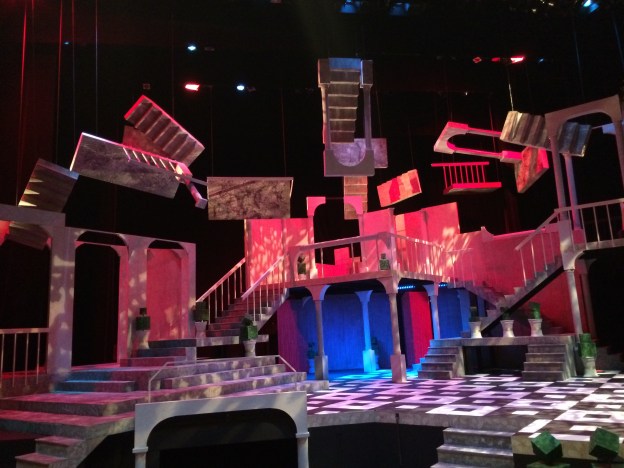
Escher-esque set for Three Musketeers

All for one and one for all, with Red Deer College Three Musketeers

The Red Deer College theatre program’s current production is The Three Musketeers, the 2006 Ken Ludwig adaptation of Alexandre Dumas’s novel, first published as a newspaper serial in 1844.

I did not attempt to read the original, as I could not get through Dumas’s Count of Monte Cristo after I saw a Stratford (Ontario) Festival production about ten years ago.  So my pre-show preparation was limited to reading Wikipedia, looking at the Red Deer College Performing Arts website, and looking at a video clip from this production posted in a newspaper preview.

I was pleasantly surprised at how well the adaptation, and this production directed by Thomas Usher, managed to create for modern audiences a fast-paced, episodic, wish-fulfilling adventure which was probably true to the impression left on contemporary readers of the serial.   D’Artagnan, the young man from the country who travels to Paris with the goal of becoming a Musketeer like his father before him, was played with well-meaning earnestness by Tyler Johnson, like most of the cast a graduating student in Theatre Performance and Creation.   My favourite character in the story was an addition for the modern adaptation, D’Artagnan’s younger sister Sabine (Brittany Martyshuk).   D’Artagnan’s parents ask him to take his sister to Paris and enroll her in a convent school, but it turns out that she actually wants to seek her fortune as a swordfighter and maybe fall in love with a Musketeer.   I found her character both charming and credible.

The three musketeers of the title, whom D’Artagnan is challenged by and then befriended by, are Athos, Porthos, and Aramis.  (The “h”s are silent because they are French – I didn’t know that before.)  Athos is the more serious musketeer whose sad personal backstory comes out later, and he is portrayed by Chase Cownden, a particularly impressive stage fencer.  Porthos (Bret Jacobs) is interested in fashion, and a scene in which he is showing off a new cloak leads to a fight scene with some impressive use of a length of cloth to tangle an opponent.  Aramis (Wayne DeAtley) aspires to religious life, and is the target of Sabine’s crush.

The musketeers’ archenemy is Cardinal Richelieu (Richard Leurer), remote and devious and a little slimy.  Richelieu’s collaborators and allies include Milady (Megan Einarson) and Rochefort (Victoria Day).   Other characters include the King and Queen of France (JP Lord and Taylor Pfeiffer), and Constance the queen’s lady-in-waiting and love-interest for D’Artagnan (Constance Isaacs).  Daniel Vasquez, a recent graduate of the RDC Theatre Performance program, plays Treville the head of the musketeers, Buckingham the Queen’s lover, and a few other minor parts.  Most of the other actors are multiply-cast as well, with some quick costume changes.

The set for the show was strongly reminiscent of the Escher print Relativity, and the similarity was underlined by pieces of staircase and balcony suspended in the air at odd angles. The actual stage was full of entrances and exits, balconies and crossing staircases, and they all got used, with almost no prop movement between scenes.  This helped underline the impressions of fast-paced action with complications and conspiracies.

There was, of course, a lot of stage combat, not just swordfighting but unarmed fighting, knifework, and other tools used as weapons.  At one point, all twelve cast members are engaged in a skirmish all over the stage between musketeers and Richelieu’s guards, with so much going on that it was hard for the audience to keep track of and easy to buy into the illusion of it being a real fight.

One of the things I liked best about this production was the women’s parts and the scope for female actors.  They weren’t just cast as men for fight scenes; the script included three fighters explicitly identified as female, who seemed like distinct interesting characters – Sabine, the young girl who grew up learning fighting with her older brother, Milady, with a dagger in her boot and a secret in her past, whose manipulative sexuality was reminiscent of the courtesan Einarson played in the troupe’s production of Comedy of Errors last year, and the guard captain Rochefort, in eyepatch and scar. Milady is a character in Dumas’ original story, and so is a male version of Rochefort.  I couldn’t tell whether Rochefort had been changed from male to female by the 2006 playwright or by the director of this production, but it didn’t matter and it worked well enough for me to enjoy it.

The production even passed the “Bechdel test” – the criterion expressed by a character in an early edition of Alison Bechdel’s comic strip Dykes to Watch Out For, that she only reads/watches fiction in which two women talk to each other about something other than a man.   I can’t remember what the conversation was about in the second convent scene, when Constance is taking sanctuary and Milady is looking for her, but the scene at the convent school where Sabine has been enrolled definitely passes.

I’m not sure that everything shown on the stage was necessary to the plot – but it was fun and the pace was good and I didn’t mind.  The tavern singing and the masked-ball dancing were fun to watch.   The random musket battle with Huguenots confused me a bit more, because I was wondering whether there was a point to it other than giving Porthos a chance to make some funny comments about religion.

The costuming used a limited but rich palette of colours, allowing the audience to distinguish between the heroes in brown, burgundy, and gold, with Porthos having more dramatic choices, the household of royalty in purple, and the enemies in black and red.  I also noticed red hues in the lighting for Milady’s and Richelieu’s scenes.  And I loved the peacock dress Sabine wore to the masked ball.  There were lots of scruffy whiskers in evidence, with Richelieu’s waxed mustache and groomed-squirrel-tail goatee in sharp contrast.

In the show I saw early in the run, there were a few situations of stilted speech, but for the most part the actors spoke clearly, convincingly, and in character, and they made me care about what happened to the characters.   And the last line made me cry.

Three Musketeers plays Wednesday through Saturday of this week at the Red Deer College mainstage.  Advance tickets are available on line and by phone from the usual outlet.

Clybourne Park: optimal discomfort

Clybourne Park, by Bruce Norris, is a story – or two stories – about racial shifts in neighbourhoods in Chicago.  The concept of this play has two interesting notes.  One is that the two acts are set in the same house in 1959 and in 2009.  The other is that it’s intended to connect with the 1957 play Raisin in the Sun, written by Lorraine Hansberry.

I haven’t watched or read the play Raisin in the Sun, but the movie of the same name, with Sidney Poitier, is conveniently available on iTunes.   That story focuses on an African American family, living together in a small apartment, who use some life-insurance money to buy a house in an all-white neighbourhood.  In one scene, a delegate of a neighbourhood association attempts to buy the house back from them, using the 1959 version of trying to justify the segregated neighbourhood while claiming that they aren’t acting out of race prejudice.  My impression from the movie was that while it was a fascinating portrayal of the lives and limitations of African American people in a northern city in that era, the conflict with the new neighbours was not the main focus of the story.

The first act of Clybourne Park is set the same day as that visit, in the house that the white family has just sold.  And similar to the source material, the fact that the buyers are non-white does not come up until late in the first act and is not even very important to the couple who are selling, Russ and Bev (Doug Mertz and Kerry Sandomirsky).   Their bigger troubles are revealed gradually, as friends and neighbours (Cole Humeny as Jim in clerical collar and hernia truss, Martin Happer and Tracey Power as Karl and Betsy) drop in and awkwardly express concern, and their household help Francine (Sereana Malani) finishes her work for the day and is collected by her husband Albert (Michael Blake) who gets roped in to carry a trunk.   Because the audience is aware that the play focuses on race issues, the details of how the white people treat Francine and Albert are immediately uncomfortable.  A poignant telling example is the way that after Bev makes a little speech about how she and Francine are such close friends, she’d be glad to have Francine and Albert and their two lovely children as neighbours – but the audience already knows that Francine has three children.

However, there are lots of other details about 1959 life and customs that were equally jarring to me.  Tracey Power’s character is Deaf, and the 21st-century audience was frequently gasping about how her friends talked about her and treated her.  And in the initial conversation between Russ and Bev, a long-married couple, there was an accepted dynamic of the husband being the expert and the wife being unaware of geography, politics, or other significant facts – and I never did make up my mind how much of that was put on, Bev kind of choosing to play that role to support her husband.

The story explains why they want to sell the house, and why they’ve been relieved to find a buyer.  We don’t actually meet the buyers, but the first act ends with us feeling glad that Russ and Bev will be able to move on.

While the curtain was down for intermission, the house was aging 50 years and the set underwent an astonishing transformation.  I loved looking at both sets – the fussy details of the well-cared for 1959 living-room covered with moving boxes, and then the graffiti and broken banisters of the living room of the abandoned house in 2009.   The situation of the second act was that a young white couple (Happer and Sandomirsky) are buying the house with plans to fix it up and expand it.  They, their real estate agent (Power), and a lawyer (Humeny) meet with delegates from the current neighbourhood association (Malani and Blake) who have some concerns about the proposed renovations.   But the conversation soon reveals the 2009 versions of condescensions and flawed assumptions, men talking over women and white people patronizing black people, and also the 2009 version of reluctance to talk directly about racial issues – which then descends painfully into some telling jokes full of horrible stereotypes, as the audience winces while anticipating punchlines and then laughs out of sheer awfulness.  Eventually we learn that the real estate agent is the daughter of Karl and Betsy from the first act, and that Malani’s character is the niece (or some kind of relative?) of the first African American woman to own the house in 1959 (she’s not in this play, but in Raisin in the Sun that would be the grandmother Lena who uses her husband’s life-insurance money).  So we see that a circle has been turned, and we also see the similarities between attitudes in the two eras despite surface differences.

There is a short coda with Evan Hall filling in a hinted-at piece of the 1959 story, and then we went home with a lot to think about.   It made me uncomfortable, but it didn’t make me too uncomfortable.  And I liked it that it wasn’t a bigger story – that a lot of it was just about people getting by, with the big family issues and the bigger social issues in the background.  I identified easily with almost everyone in the second act, but the character I liked best was Bev (Sandomirsky) in the first act.

Clybourne Park is playing at the Citadel until February 16th.

Die Fledermaus – a very fun opera!

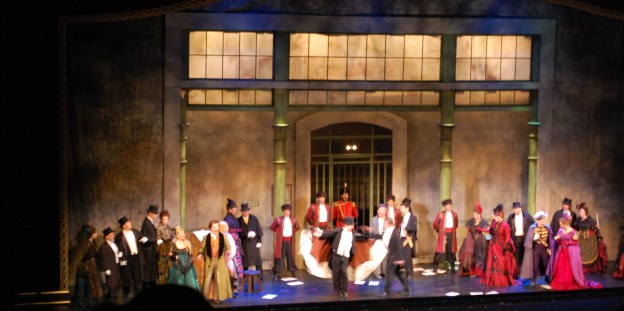
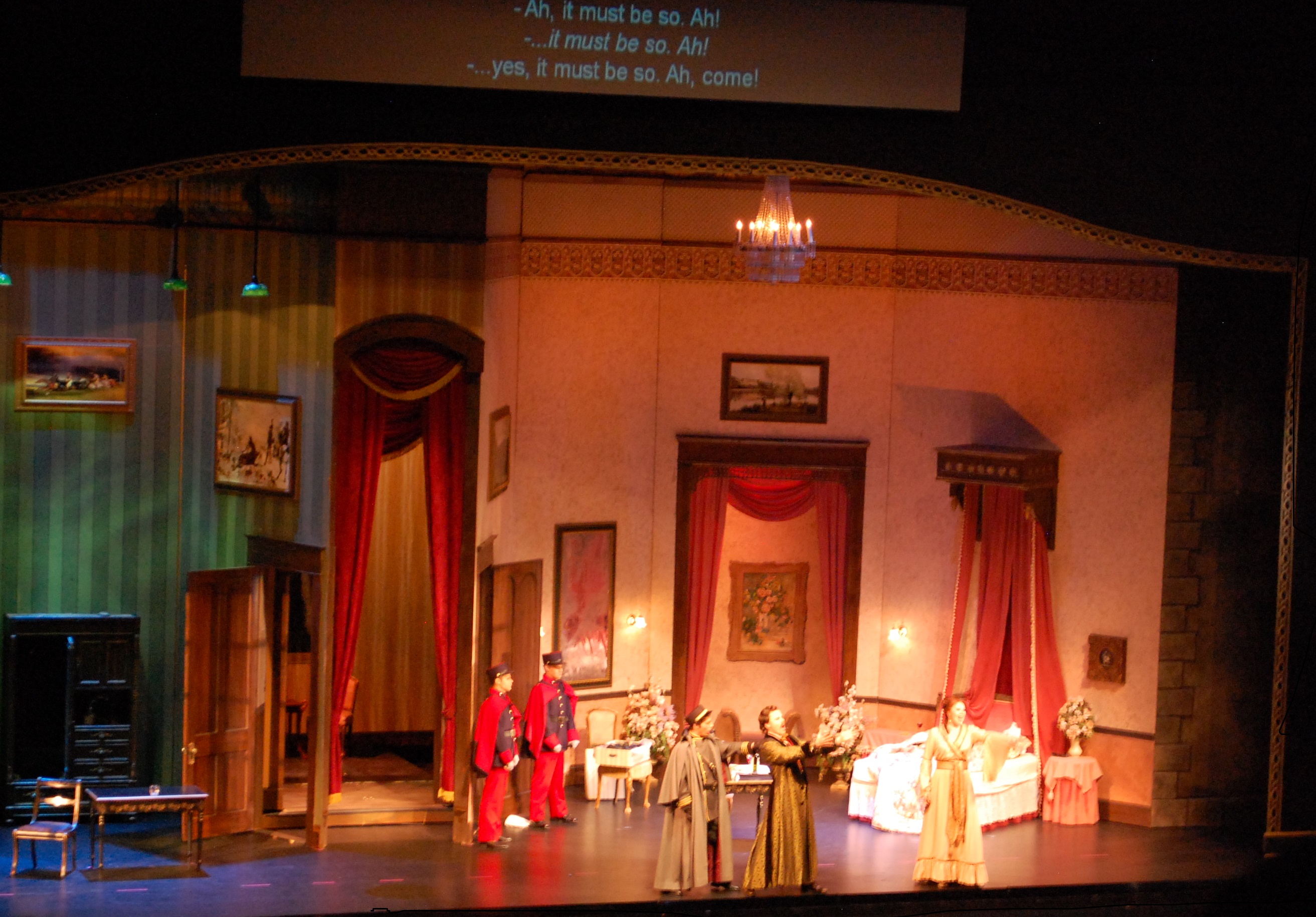
The Edmonton Opera is currently performing Die Fledermaus, the light comedy written by Johann Strauss Jr.  The music is very waltzy with catchy almost-familiar tunes, as you might expect.  The story is silly, the characters are clever, funny, and not too complex, and the sets and costumes are delightful.  In this production, all the singing and spoken dialogue is in English.  The song lyrics are displayed on the supertitles the same way they are for operas in other languages.  All of this makes it a very accessible opera experience.

I was fortunate to be offered a chance to attend a dress rehearsal with members of the media and with a lot of school children.   The children sitting near me seemed to love it, laughing at the physical comedy, cheering at the curtain call, and even making “rock on” signs with their fingers.  There was a lot of snickering when one character sang that she hoped the party would be gay.

The part that had me slapping my thighs and laughing til I had to take my glasses off, though, was something that probably went over the heads of some of the younger attendees at least in part.  See, apparently there’s a tradition that one particular monologue gets enhanced for local audiences from the Strauss book.    In this production, it was written by local playwright Stewart Lemoine, and if I hadn’t known that ahead of time from the press release I think I would have guessed.  It was exactly the same kind of topical humour that makes me laugh at the Varscona Theatre, and I had to fumble with my media package in the dark to see who was performing because it seemed so much like Jeff Haslam lines.  (It wasn’t Jeff Haslam; it was Julien Arnold, another local actor.)

The story is full of complications and cheerful deceits.  It has all the elements of a successful farce – a chambermaid with social and theatrical aspirations (Jacqueline Woodley, whom I saw as Miliça in Svadba last year), a marriage with both partners restless (Gordon Gietz and Betty Waynne Allison), an incompetent lawyer (Aaron Ferguson), a bed to hide under, and lots of doorways to pop in and out of.  It also has lots of music, about equally mixed between catchy singable waltz rhythms and what I think of as classic opera solos without significant rhythm, rhyme, or repetition.  The plot is full of broad dramatic irony and sarcasm.  Count Orlofsky (Gerald Thompson) was a counter-tenor with an astonishing vocal range and spot-on comic timing.

There are two more performances, Tuesday and Thursday evenings this week.  Tickets are available on line, and parking at the Jubilee Auditorium garage is free.

Scene from first act of Die Fledermaus

Scene from first act of Die Fledermaus

Die Fledermaus curtain call

Die Fledermaus curtain call

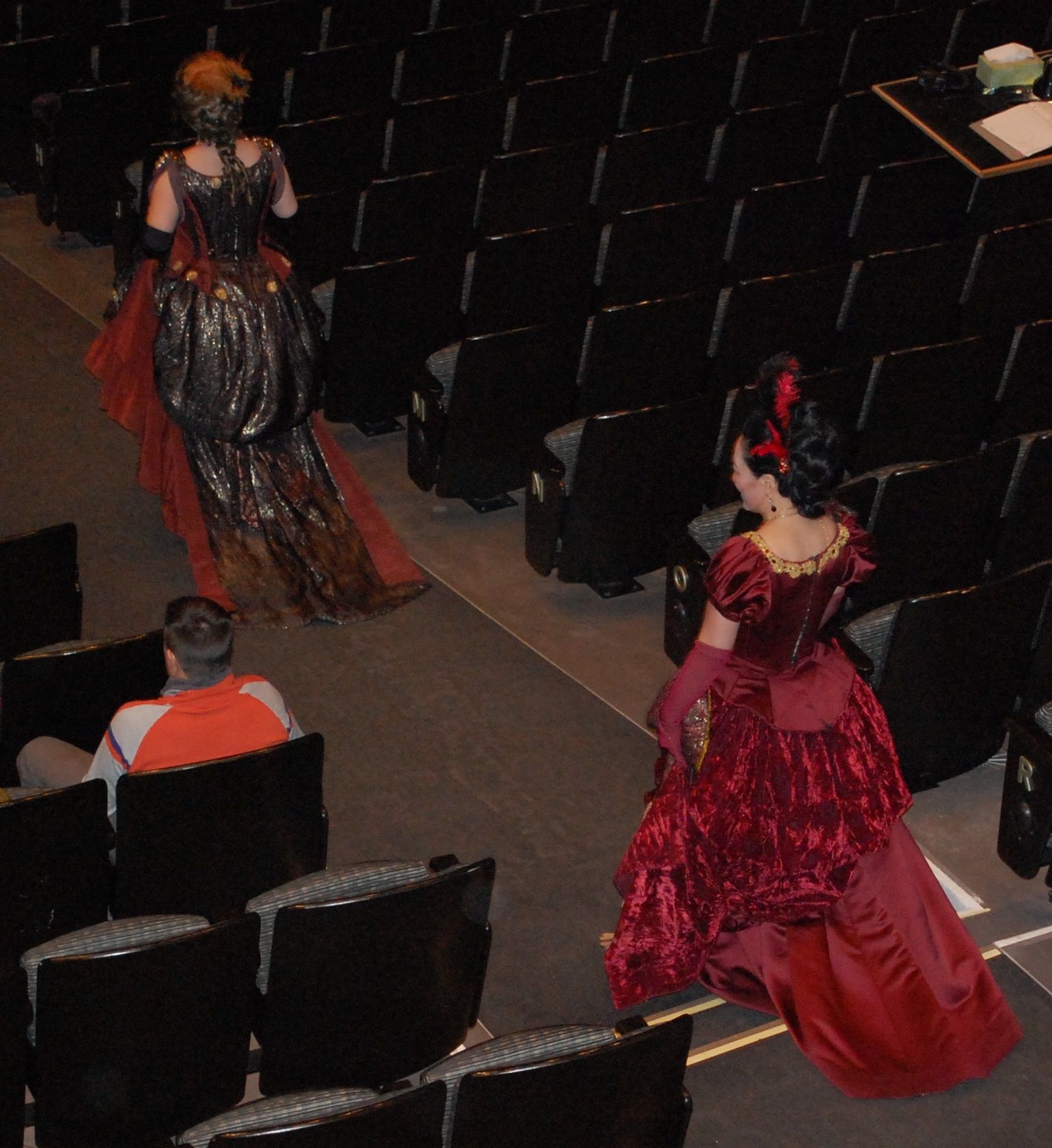
Choris members stroll towards the stage at intermission before party scene.

Choris members stroll towards the stage at intermission before party scene.

Closer

Wednesday night at the Arts Barns PCL Studio I watched K.I.A. Productions’ show Closer, by Patrick Marber.  It was directed by Keltie Brown Forsyth, and featured Andrew Forsyth, Ellie Heath, Kristi Hansen, and Ben McIvor.  I recognized a couple of those names immediately (Forsyth and Brown Forsyth created and performed in 7 Ways to Die, a charming and dark masked piece at the 2012 Fringe) .  I last saw Hansen in pool (no water) at U of A Studio Theatre, and Heath in Soul Collector.   Ben McIvor was new to me.

The play was written in the UK a bit over 15 years ago.  It was set in London of that time period, in several installments over a span of a few years.  At the start, the four characters are all strangers to each other.  Dan (McIvor) and Alice (Heath) meet when he takes care of her after a minor traffic accident, and Larry is a doctor who encounters Alice at the hospital that day.  In the next scene, Anna is a photographer taking publicity photos of Dan for the cover of his first novel.  It turned out that he was living with Alice and had used her as inspiration for the novel, but is now taken with Anna.  Later scenes show Anna married to Larry, Dan living with Alice, Dan and Anna carrying on, Larry and Alice hooking up, etc.  All of them seem unhappy, cynical, and mendacious – but the characters are also quite different from each other.  The two women are particularly distinct characters.  I didn’t feel like the viewer really got to understand the truth about any of them, because they weren’t that kind of people.  One of them in particular was shown as layering lies and secrets on top of lies and secrets, but the other characters were not revealed either.   The next day I got a glimpse of Die Fledermaus at a media/education dress rehearsal, and it struck me how the premise of spouses all cheating on each other felt so light-hearted and balanced in the opera, but in Closer it was all just discouraging and dark.

There were quite a few lines in Closer that made me giggle or guffaw, but the rest of the audience wasn’t always laughing with me.  Maybe I laugh when I’m uncomfortable and trying to connect, or maybe I just have a dirty mind.  My two favourite scenes were interactions between the same-sex pairings – a brief meeting in a park between Anna and Alice where they share complaints about men and about the specific men who have shared both their lives, and a hilarious mid-90s chatroom exchange between Larry, typing while on call in the hospital, and Dan, having a drink at home with his laptop while emulating a female persona on line.

There is one more performance, a Sunday matinee.  Same-day tickets are at the door.  Oh, and yes there is an intermission even though the program doesn’t say.  Some of the audience opening night weren’t sure whether we were at intermission or at a particularly odd ending.

Sapientia, a disturbing tale of child martyrs and a fascinating portrayal with puppets

The author credited for this play was Roswitha of Gandersheim, a 10th century playwright, poet, and (according to the Canoe Festival program and Wikipedia) secular canoness.  A Wikipedia link explains that this referred to a woman who lived in a monastery but did not take religious vows, so it might have been a handy way for a woman of the aristocracy to pursue a single scholarly life.

This adaptation as object theatre was made by Joseph Shragge of Montreal.  Mia van Leeuwen of out of line theatre was credited with direction and design.  Object theatre is a sort of puppetry using found objects.  The four puppet performers were David Barnet, Kara Chamberlain, Nancy McAlear, and Brendan Nearey.  The objects were simple and ordinary (a kettle for the emperor, teacups of diminishing size for the three little girls, a mirror for the mother), but the small gestures of the puppeteers and their voices made it easy to picture the characters as the story unfolded.

The subject matter of the tale was a Christian woman and her three young daughters, defying the Roman emperor Hadrian to the extent of torture and martyrdom.  It was a classic martyr story, with the satisfying ending being death without surrender leading to frustration and loss of authority of the murderer.  I imagine that in the 10th century it might have been particularly radical to have the woman and her young daughters being strong and determined and logical, while the male emperor and his advisor/executioner appear ineffective, emotional, and flailing.   The stories of my 20th century childhood might have found beauty in sacrifice and justice in choosing the right belief, but the responses from my 21st-century heart as a parent and aunt and leader of young people are so strongly opposed to the idea of encouraging children to die for a belief or ideal that I couldn’t finish this blog post last night.  I can admire the courage and honour the choice of Aitzaz Hasan, the 15-year-old Pakistani who tackled a suicide bomber to save his classmates, but I feel really uncomfortable about the idea of a parent encouraging his or her children to choose a principle or belief over staying alive.   And I don’t think I’m the only modern person who feels this way, or we wouldn’t have discussions about whether Christian-Scientist or Jehovah’s-Witness parents should be prevented by a just society from refusing their children conventional life-saving medical treatments or whether small children are able to make those decisions themselves.  Anyway, it’s upsetting, but the play made me think, and I’m glad of that.

I’ve also been interested to notice how the genre of the storytelling, with the simple symbols representing the characters and their fates, allowed some graphic but elliptical imagery to address the horror of the tortures and deaths more closely than would have been bearable for a more conventional acting genre.  For example, the executioner broke a teacup, or crushed a ripe pomegranate, and the audience gasped in shock for the brutal murder of a child represented.   I won’t record any more of the details because I need to be able to sleep – but it was fascinatingly well-done.

Canoe Festival 2014 continues this week with showings of National Elevator Project Part 2 Tuesday through Sunday, and Tanya Tagaq’s Nanook of the North with one performance Wednesday.   Twitter hashtag #canoe2014 and a series of guest bloggers posting at http://canoetheatrefest.tumblr.com continue the conversations about performances and performers, theatre and life.

Static Electric

I’d seen mention of Mile Zero Dance and Gerry Morita around the Edmonton entertainment scene for some time, but I’d never attended a performance before.  Having now seen Static Electric, the Mile Zero Dance piece at Canoe Festival, I’d definitely seek them out again.

The two dancers, Gerry Morita of Mile Zero and Farley Johansson of Science Friction and Coastal City Ballet in Vancouver, explore a cluttered living space full of lamps, televisions, recordings, transmissions, a piano being played by Viktoria Reiswich-Dapp, a jukebox, and other electric apparatus.  At first, the two characters seem completely unaware of each other, although they overlap in space to the extent of tumbling over and around each other on an easy chair and a carpet.  Later, they come to interact more consciously, but eye contact is fleeting.  Sometimes they have normal-sounding conversation and exchange reminiscences through family-band radio walkie-talkies.  There is also some dialogue in German and, I think, in Russian (though it might have been Ukrainian or another similar-sounding language).  Morita plays with a cassette recorder, speaking into it and then playing it back, and she also disassembles a cassette tape, constructing streamers on a fan and then becoming tangled in a mass of tape.  Lighting designer Patrick Ares-Pilon moves intentionally through the space towing and adjusting carts of electrical gadgets.

The program says that the performance is improvised.  It works fascinatingly well.  Morita and Johansson are both powerfully athletic and expressive artists who are thrilling to watch.   My favourite bits were the ones with “Volare”, “Riders on the Storm”, and hockey play-by-play as the soundtrack.  The last bit of the show sounded as if Johansson was dancing in a box of broken glass, and the sound effects were so disturbing I could hardly bear it.

Their last show is in about half an hour (Saturday afternoon) but there’s lots of other good stuff to see and hear and think about at Canoe Festival.

Testament

Friday night I described the two Canoe Festival performances that evening to a friend as “six naked people, and then Mary the mother of Jesus”.  My friend laughed.

But of course that superficial description didn’t do either of the plays justice.  Body 13 had interesting things to say about sexuality, ethnicity, assumptions, and failed connections.  And Testament was a powerful one-woman show about a determined woman preserving her self and her sanity while surrounded by tragedy, personal danger, and wishful thinking and revisionism.

The story is based on Colm Tóibín’s novella The Testament of Mary, which I have not read yet but now I want to.  (I also left the theatre thinking “I want to read the book!” but I didn’t say that to anyone because I thought they might misunderstand.  I have actually read the, um, more primary source materials, just in English but in more than one translation.)   It was adapted for the stage by Guido Tondino, and this Théâtre Archéologique production is the world premiere.

The actor, Isabelle Rousseau, has a compelling controlled stillness and deliberation to her movements.  Whether she was narrating the story while sitting in a chair, or moving about the set of her house arrest / protection lighting candles while the story continued with her recorded voice playing, I focused mostly on the spoken words.  Interestingly, I found it more difficult to dismiss her or assume she was equivalent to the iconic Mary because the actor did not have long hair.  Her short haircut with bangs was one of the first reminders to hear the story fresh.

The viewpoint ascribed to her by the author and dramaturge is compelling and moving, completely consistent with the sparse written versions provided by the original unreliable narrators.   Referring to the disciples, Mary talks about “the enormity of their actions and the innocence of their belief”.  She also used a concise expression that I didn’t write down for their urge to shrink the story to a more consistent narrative of symbols – and I could see how her version wouldn’t fit with the conventional one.  For example, she tells the audience that she was not present for her son’s death and burial, because she had fled the hill fearing for her safety, and by the time that the play is set (maybe a few months later? years?) the accepted version is that she had been there for all of it.

In the play she alludes to the story of her pregnancy and the one of misplacing her son as a child, but mostly sticks to a few important scenes – the raising of Lazarus, the wedding at Cana, the arrest, the crucifixion, a vision afterwards.  Her stage business with the hammer while narrating the crucifixion was a powerful and disturbing underlining of the horror of the scene she is describing, although I may have been missing some explanation for the details of the symbolism as I was expecting her to do something more obvious (form a cross-shape, lie in the canonical posture herself, etc).

Testament has two more performances in the Canoe Festival, 9 pm on Saturday (today) and 7 pm on Sunday at C103.  Tickets are available from Workshop West or at the door.

Body 13 – “One moment you’re waiting, the next you’re 89”

Body 13 is the Canoe Festival offering from the company MT Space (Multicultural Theatre Space), of Kitchener, Ontario.   It was created by the ensemble and director Majdi Bou-Matar, and they started working on it about four years ago.

It’s an intriguing piece that kept shaking up my expectations, about what kind of story it was going to be, how the story was going to be told, and who the characters were.   The seven characters all spend time on a Canadian beach over the course of a cool-weather day, arriving as strangers but gradually interacting and making various connections.  The impression of shared public space is created early on, first in one vignette where all the performers are representing funeral attendees and then in a set of glimpses where the beach seems crowded with different odd solitary people each doing his or her own thing.  Later, the narrative focuses more on one or two people at a time, while one or two others might be still on another part of the stage.  And “doing her own thing” reminds me that one of my favourite characters in the story was Iman, played by Nada Humsi, a middle-aged woman refugee claimant from Syria.  Those phrases might evoke a picture for you, as they did for me, but I was delighted to have my assumptions shattered, as this character took off not only her headscarf (a kerchief like my mother used to wear on windy days) but her red lace brassiere, told funny stories, made fun of Canadian custom (“So we’ll talk of nothing.  Like Canadians”), and was outspoken and determined.  I was delighted by Humsi’s way of acting out her cat.

Jessalyn Broadfoot was Rae, Iman’s immigration officer, caught between her affection for Iman and her professional duty not to get involved.  Her expressions and body language showed a careful self-contained woman uncomfortable with personal disruptions on the quiet day off she’d been anticipating, and the occasional awkward moments of of a self-conscious white person dealing with neighbours of different cultures were endearing, such as her clumsy Namaste gesture at the Gujarati funeral.

While the narrative pacing of the play was fairly linear, it was often interrupted by movement and music.  Rae did a wonderful dance of helpless rage, accompanied by the composers and musicians (Nick Storring, Colin Fisher, Germaine Liu) as she thrashed her blue beach throw in defiance.  Tristan, a young man from Newfoundland, (Trevor Copp) confided that he had been subject to anxiety attacks since he was a boy at hockey camp, and this launched the two most powerful movement portions of the performance, the first an expression of Tristan’s response to a homophobic epithet on the beach, turning into his sense that he is surrounded by people picking at him, prodding him, and pointing at him while he cowers trying to get the lid off his medication.  Lighting changes and music add to the tension and anguish, and on my second viewing I found myself wincing in anticipation.  In a later part of the performance, Tristan’s anxious response first manifests in all the performers playing hockey, and a gradual shift into a set of physically intimate and blatantly-sexual encounters between and among various characters.

Assaf from Lebanon (Badih Abou Chakra), Rita from India (Pam Patel), Thomas a white Canadian (John Havens),  and Ato from Ghana (Tawiah Ben M’Carthy) turn out to be similarly intriguing characters, and not everyone turns out to be likeable.  Quirks of movement and expression – Assaf’s laugh and his wiping-a-tear gesture, Thomas’s slicking his hair back, Rita’s bearing of the chest containing her father’s ashes, Ato’s stylised jogging – helped to distinguish the individuals quickly.  The one who came to annoy me through the course of the story ended up alone, while the rest of them all found some resolution, as predicted by Ato’s early comment to Thomas trying to find a cufflink on the beach “You will find something, but you will not find what you look for.”  And then the rest of them all shed their clothes, ran behind a screen, and were seen and heard giggling and shrieking the way you do when you’re wading into cold water in the dark with your friends.

The musicians played a variety of instruments, also behind the screen, and I could not identify all of them.  Some of the lighting revealed that all the costuming was in hues of solid clear colours, each distinct.  Also, as an easily-distracted mechanical engineer, I was fascinated to observe the pattern formed when the chest of ashes (visually fine sand) was poured slowly onto a smooth surface.  In water that pattern is called “hydraulic jump“, and you can recreate it easily in a flat-bottomed sink like a stainless steel kitchen sink.  I don’t think the sand formation has the same explanation, but I don’t yet know what the explanation is.

Joel Crichton tweeted a challenge to count biblical references in the performance, and I actually didn’t notice any.  So I guess I lose the challenge, but as the character predicted, I found other things in the performance which I didn’t expect and which pleased me a lot.

Body 13 has one more performance at Canoe Festival, 1:30 Sunday at C103.  Tickets are available through Workshop West and at the door.

January speeds up

After the end-of-year break and an unrushed start to the theatre year, the calendar fills up starting this weekend.  In the meantime I’ve enjoyed watching some improv with Rapid Fire Theatre (Fridays and Saturdays at Ziedler Hall) and with Die-Nasty (Monday nights at the Varscona).

Watch this space for more about Canoe Festival:

  •  Body 13, by MT Space from Kitchener
  • Static Electric, by Mile High Dance
  • Sapientia, by out of line theatre
  • Testament, by Théâtre Archéologique
  • and some of the National Elevator Project (Theatre YES)

Also I’ll have some thoughts on Clybourne Park at the Citadel (previews start Saturday), Closer (opens Wednesday), die Fledermaus (opens next Friday), and the Josh Ritter concert next Friday in St. Albert.

And then we get into February, where there’s so much going on that  have some hard decisions of what I most want to see, and I’ll be getting into rehearsals for the Walterdale Theatre show that I’ll be helping out as ASM.  I guess I should probably do my laundry and my dishes and get some rest now!

Silence is powerful

Punctuate! Theatre‘s The Silence Project is an original work of theatre that takes place in almost complete silence.   There was no music before the show started, just the hushed talk of patrons getting seated in the darkened room of the TACOS space.  After a prologue with several characters chattering over top of each other and one playing a singing bowl, there were no sounds at all other than the unavoidable sounds of breathing and movement.  This made me very aware of those incidental sounds.

The five performers and creators, Julie Ferguson, Elizabeth Hobbs, Elliott James, Andréa Jorawsky, and Sheiny Satanove, combined to portray about twelve distinct characters.  The main character was wearing a silver mask with some peripheral decoration which made me think of an alien.  The others appeared with various stylized costume elements (an apron, a raggedy overcoat, a cleanroom suit, a sparkly bra) and props (a hipflask, a twinkly ball, a pocketwatch) allowing them to be distinguished.  There was also some effective use of lengths of shiny fabric to hide faces or turn bodies into non-human shapes.  It was the kind of setup which I would have classified as a modern dance piece if there had been background music … but there wasn’t.  Instead there was the rhythm of breath, and heightened awareness of the main character’s anxious and uncertain body language.

Like a modern dance piece, I started by just enjoying the shapes and wondering what I was missing, but gradually I was able to tell myself a consistent enough story that I felt as if I understood.  The repetition and patterns of encounters helped in this.  The confused isolated traveller is first unable to communicate with each of the strangers she encounters, although they all try to connect with her.  (I say “she” and “her” because the performer appeared to be female, but the character did not seem to be strongly gendered.) After the traveller receives a gift enabling her to share a language of gesture with each stranger, she encounters each of them again, learns from each of them, and communicates using the collection of gestures acquired, moving towards a climax involving the triumph of community over despair or death.

The program notes say

We follow our main character, a traveler, as she enters into a dream world in order to escape the isolation of her everyday life.  Through the use of a dream mask, she enters the world of her imagination.  On her journey she encounters a myriad of characters that represent psyche, her hopes and fears.  What will the outcome of this expedition be?  Will our traveler be able to recognize herself in each character and connect honestly in order [to] return as a whole being to her world of reality?

So I was close.

Since attending this performance, I’ve been interested to see some of its techniques echoed in my Rapid Fire Theatre improvisational theatre workshop, where we worked on the skills needed to create an environment without props, miming objects and maintaining consistency with the definitions created by our fellow players.  Similarly, in my Foote Theatre School acting class this week we produced some tableaux, moments frozen in time that could tell a story to our classmates from our facial expressions, body position, and interactions.  Both classroom experiences made me aware of how effectively the performers and show creators of The Silence Project had communicated their emotions and narrative to the audience, without dialogue, scenery, musical background, or sound effects to help them.  It worked.

One measure of how well it worked was that during the performance, I kept forgetting that the silver-faced character was wearing a neutral-expression mask, and thinking I’d seen changing expressions on a painted face.  But it was a mask, supported by very expressive eyes, head position, shoulder movement, and convincing story.  It really worked.