Author Archives: Ephemeral Pleasures

Mump and Smoot in “Anything”

Since I started paying attention to the breadth of live theatre available in Edmonton, I’ve gradually discovered that Edmonton has an unusually strong tradition of clown and physical theatre, in part due to the teaching and mentoring of master clowns like Jan Henderson and Michael Kennard, at University of Alberta and elsewhere.  I’ve seen many of their students and former students perform, but never had the chance to see either of them on stage.

Mump and Smoot are the creations of Michael Kennard and John Turner.  According to the program for Mump and Smoot in Anything, the artists met at Second City in Toronto, both studied with Richard Pochinko who basically started the Canadian style of clowning, and have been performing Mump and Smoot for twenty-six years.   For those who hadn’t heard of the duo before or who hadn’t noticed that the title on the program cover seemed to be written in dripping blood, the program also helpfully mentioned that they are referred to as “clowns of horror”.   This and their general reputation cued me to expect something a little more gory and gross than a typical clown show – and the hints were welcome.

Like many clowns from the Pochinko tradition, Mump and Smoot vocalize but not always in comprehensible vernacular.  (A show I saw last winter from Calgary’s PIE Factory Collective had the interesting variation of using a gibberish that contained bits of French and bits of English.)  Their unique language, “Ummonian”, contains enough English words and near-English along with gestures and unmistakable facial expressions that after the first framing sequence it was fairly easy to follow the narrative of the three following vignettes and final sequence.  Mump (Michael Kennard) was the taller one, a higher-status older-brother type of role.  Smoot (John Turner) was the one who connected with the audience and drew the audience’s sympathies.  Prop changes and scene introductions were managed by a silent white-faced woman in straggly white draperies with a very Catalyst-Theatre aesthetic, Candace Berlinguette as Knooma.   The three scenes were titled “The Escape”, “The Romp”, and “The Remedy”.  They fit together somewhat but were mostly separate stories.  They were funny and poignant and occasionally really gross and creepy, but in ways that the audience seemed to enjoy sharing.  There was a little bit of audience participation, generally consensual and not too embarrassing.

I laughed a lot and I found the stories satisfying.  Part of why I don’t enjoy clowns from the American circus traditions or a lot of mimes is that I don’t enjoy perpetual-victim stories like RoadRunner and Coyote.  But these two characters Mump and Smoot, for all their weird troubles and disagreements, didn’t seem to be trying to beat each other or trick each other.  They liked each other.  As with the Rocket and SheShells duo (Adam Keefe and Christine Lesiak, seen in Fools for Love and in Sofa So Good) or the Nona and Squee partnership of Life After Breath (Amy Chow and Neelam Chattoo), they argued in ways that were familiar enough to be funny, and came to fair resolutions.   I can see that both performers were very good at what they did, at communicating just enough of their emotions and intentions to captivate the audience and developing a story with just enough unpredictability to delight.  I don’t know how they did it.  I would definitely watch them again.  In anything.  Or, well, in Anything, if my schedule permitted.

Mump and Smoot in Anything is playing at the Roxy Theatre on 124 Street until April 27th.  Tickets are available through Theatre Network.

Romeo and Juliet at the Citadel

The Citadel Theatre’s Citadel/Banff Centre Professional Program takes a cadre of young professional theatre artists every year, and after a period of full-time work together produces one play in the Citadel season.  Last year it was The Penelopiad.  This year it is Romeo and Juliet.  Tom Wood directed the play, and Professional Program participant Andrew Ritchie is credited as Assistant Director.

I’ve read the play through a few times and encountered many adaptations and variations of the star-crossed lovers’ tragedy, from West Side Story to Good Night Desdemona Good Morning Juliet to the Hudson’s Bay Company/Northwest Company concept a friend is working on.  Productions of Romeo and Juliet are used as background in a season of Slings and Arrows, in one of Norma Johnston’s young adult novels, in Mieko Ouchi’s play I Am For You, and in many other stories, so that it’s possible to fake a familiarity with the story without ever reading or seeing it directly.

Last night was my first time ever seeing the play.  After seeing several recent Shakespearean productions in simpler costumes of more recent periods, it was a pleasure to see this production dressed in rich embroidered brocades and heavy fabrics that felt approximately traditional.  The men’s trousers seemed like skinny jeans with goaltender jockstraps on top, but I guess that made sense in a culture that valued decoration but had a lot of swordfighting.  Juliet had about six different outfits.  The costume design also allowed for the audience to enjoy some shirtless fight scenes and some brief appropriate nakedness.

The ensemble includes alternating casting for Romeo and Juliet.  On the night I attended, Romeo was Morgan David Jones, whose bio suggests that his roots are in Australia rather than Wales, and Juliet was Rose Napoli.  Both of them did a good job portraying the adolescent ranges of emotion needed for the characters and were credible as teenagers.  Especially considering that they both die before intermission, Jamie Cavanagh as Mercutio and Nick Abraham as Tybalt both made an impression on me as memorable characters.  Cavanagh, whom I first encountered in David Mamet’s Sexual Perversity in Chicago at Fringe 2012, was perfect for Mercutio’s cocky repartee with the young men of the Montague crowd and lewd asides with the Nurse (Louise Lambert).  Abraham’s Tybalt, presumably nicknamed King of Cats for his swordfighting prowess, tosses his dreadlocks with an aloof confidence and secret pride that in this production arises also out of what appears to be a passionate affair with Lady Capulet (who is his aunt) (Mabelle Carvajal in the production I saw).  Early on Juliet accidentally sees her mother embracing Tybalt, which helps to explain her reluctance to confide in her mother later.

I didn’t find the other characters quite as memorable.  Chris W. Cook was the servant Peter, not as annoyingly foolish as some other Shakespearean message-bearers.  Jamie Williams and Patrick Lundeen were the well-meaning Friar Lawrence and Brother John.

The really sad thing about the story of Romeo and Juliet was not that the deaths were inevitable.  It’s that on the other hand they were so close to a feasible happy ending that just didn’t work out because of miscommunication and their own impatience.  Which left me irritated and not uplifted.   Also, I got thinking of how the trope of using a sleeping potion to feign death was also a plot point in A Funny Thing Happened on the Way to the Forum, which we closed the night before, and how it didn’t work out there either.

Romeo and Juliet continues in the Maclab Theatre at the Citadel until Sunday April 27th.  Tickets are available through the Citadel websiteMary Poppins is upstairs in the Shoctor Theatre until April 20th, and the Citadel season will wrap up with Make Mine Love, May 10th to June 1st.

The Rimers of Eldritch – disturbing glimpse of small town life

There is an improvisational-theatre narrative format known as a Spoon River, in which a set of monologues by residents of a small town tell the story of how an event on the town affected each of them.  The improv performers sit or stand facing the audience, and when it’s done well, the story unfolds with an interesting set of characters showing several viewpoints on an important event.

My first impression of The Rimers of Eldritch, the Lanford Wilson play directed by Jan Selman and performed this weekend by the second-year BFA Acting class at University of Alberta, was that the ensemble taking their places on various levels of risers and chairs, facing the audience without much interaction with each other, was about to perform a Spoon River.

I saw immediately that they were going to be speaking about a significant event, because one of the first identifiable characters was a Judge (Morgan Grau) swearing in a witness to a trial (Celeste Tikal as Nelly Windrod, a woman in work trousers contrasting with the other female performers in skirts and dresses).   Throughout the performance we have occasional glimpses of trial scenes, but we gradually piece together the truth of what happened as we see small-group scenes set before, during, and after the climactic night.

The ensemble of 12 plays about 17 characters.  Working out who they are, how they’re connected, and what’s significant in each of their conversations was like the pleasure of reading a murder mystery, the kind where everything mentioned in passing becomes meaningful.  Martha Truit and Wilma Atkins (Carmen Nieuwenhuis and Sarah Feutl) are a pair of older women discussing everyone and everything as they sew and fold linens, with a judgemental limited view.  Corben Kushneryk is Harry Windrod, a frail old man who insists he saw the crime, but I soon decided that he too was an unreliable narrator.  Kushneryk did a great job of conveying his character’s physical and mental frailties without caricaturing.  Kristen Padayas’s character Eva was a young girl with a physical disability, protected by her religious mother Evelyn (Natasha Napoleao), naive, joyful, and isolated.   Her only friend is Robert (Bradley Doré), a slightly older boy dealing with a family tragedy and some identity issues.   Other inhabitants of the failing US midwest town include café owner Cora (Jessy Ardern), Walter (David Feehan) a young man whose presence in the café leads to gossip, and the Johnson family of farmers, parents Peck and Mavis (Jordan Sabo and Jessy Ardern), restless daughter Patsy (Natasha Napoleao), and her casually cruel older brother Josh (Morgan Grau).  Various other townspeople are added by double-casting and simple costume shifts.  Many of the stories are about an unsavory homeless man, Skelly Mannor (Stuart McDougall), who lurks about the stage as about the town, in a hunched-over unnerving way.  McDougall plays the character with a slight Irish-like accent, which puzzled me a bit but added to the impression of him being a misfit in the town.

Near the end of the performance, I formed the theory that maybe the only reliable narrator in the whole performance was Skelly Mannor, whom most of them are ignoring or vilifying.  And that theory seemed to work.  Nobody else in the town really finds out the truth about what happened the night Skelly Mannor was shot, and mostly they don’t seem to want to.  And there aren’t any obvious positive outcomes or character developments from the set of events either.  People’s lives are just going to go on, messy and unhappy, trying to find comfort and cutting out people who don’t fit in.   It was disturbing and real and I liked it.

The multiple casting gave many of the ensemble members the opportunity to create characters of different ages and viewpoints, which was fascinating to watch.  I look forward to seeing what else this ensemble does over the next few years, together at U of A and separately in local productions.

The Clean House

Sarah Ruhl’s The Clean House played at the Varscona the same week in March as Dirt was playing at TACOS Space across Whyte Ave.  I wasn’t the only reviewer to notice this coincidence, but the other ones all beat me to posting about it.

The Clean House covered some serious topics but with a very light touch.  The cast was all female except for Troy O’Donnell, who played a couple of minor characters.  Elena Porter was enchanting as a housecleaner from Brazil who wants to be a comedian.  Liana Shannon and Coralie Cairns play sisters Lane and Virginia, who have different priorities but who are both fussy and not very happy, making justifications for their unhappy marriages.  Shannon Boyle played a couple of characters who seemed minor at first, but one of them later became very important in the story.  Porter and Boyle both spoke English with accents from South American countries, and also spoke Portuguese sometimes.  I wished my Portuguese-speaking friend could have been there.

The set was mostly white, furniture, window frames, and props, with most of the characters dressed in crisp tidy neutral tones.  The sisters, a surgeon and a full-time homemaker, both had constrained body language and I don’t think they ever touched each other. “Think of her as a patient, not a person” Virginia counsels Lane, who is uncomfortable giving orders to her cleaner.  Elena Porter’s character Mathilde wore comfortable black clothing and seemed much more comfortable with her emotions and her environment.   So by comparison, her emotions seemed much larger than appropriate in the sisters’ world, grieving for her dead parents and celebrating her joyful childhood with parents who were always making each other laugh.  We saw her parents dance and laugh and touch affectionately in memory sequences, as represented by O’Donnell and Boyle.  And Mathilde told the two women of her quest to remember the “perfect joke” that her father had created and told to her mother, leading to her mother’s death from laughing.

Gradually, the controlled lives get out of control, as we find out that Lane’s husband Charles (O’Donnell) is leaving her for Ana, a South American geologist (Boyle), and then that Ana is dying.  Charles’s response to this news is mostly to disappear, ostensibly in search of an obscure cure, while the other women care for Ana.  The ending had me in tears but not completely sad ones.  It was lovely.

The Invention of Romance

Workshop West’s spring production is Conni Massing’s The Invention of Romance, a three-handed story inspired by the playwright’s mother’s late-in-life romance with someone she’d acted in a play with in their youth.

Lora Brovold plays Kathleen (Kate), a jittery anxious museum curator in her “mid 30s”, who starts the story having boyfriend trouble and being fussed about a museum exhibit that she is curating, an exhibit about romance framed around an historical manuscript.  Valerie Ann Pearson plays her mother Louisa, over 70 and I think widowed (or did I just assume that?) with contrasting stillness.  Even when her world gets turned upside down with the possibility of new romance, she isn’t as rattled as her daughter is on a daily basis.

Kate occasionally addresses the audience, or sets up a podium and microphone to speak at a professional meeting.  We see more of her interior life and her professional life than we do of Louisa’s, but the playwright, director (Tracy Carroll), and actors have done a great job of showing that there is more to Louisa’s side of the story that we’re not seeing because Kate isn’t seeing it.  One of my favourite bits was when Louisa was working around to telling her daughter that things have escalated with Cliff, by mentioning the toaster he’d bought her at a auction sale so that she could make two pieces of toast at once, in case she has a guest at breakfast.  Kate of course takes far too long to catch on to what Louisa’s really saying, but the audience completely gets it, especially after Pearson starts rolling her eyes, having lost her initial awkwardness in the conversation in favour of irritation with her self-centred daughter.

The third actor in the play is Mat Busby, credited as Man.  I kept trying to figure out what I’d seen him in before, since he obviously has so many local acting credits that he can’t include all of them in his program bio.  Maybe he was in Die-Nasty last year?  His main role was as James, an awkward cardigan-wearing work collaborator of Kate, but he also played Louisa’s acting colleague in flashback, as well as the various men Kate encounters in her experiments with on-line dating.  We don’t really get to see Cliff, Louisa’s present-day suitor, although we do get a little bit of the humour of an awkward conversation between Kate and her mother’s date in a “talking to invisible man” vignette.

The play evoked thought as well as emotion.  As someone older than Kate and not as old as Louisa, I liked the idea of not being thought past it.  And I liked seeing how Louisa’s anxieties and uncertainties were easier to deal with than Kate’s.  Both of them were appealing characters, but the disagreements and misunderstandings between them were both universally familiar and specific to the characters.  I enjoyed the multiple references to Louisa having consulted with Kate’s older brothers before telling Kate something, and Kate the youngest getting annoyed about that.   I also enjoyed Kate’s line “Is it possible I’m not nearly as mysterious as I thought?” when her mother sees through her.

The simple set was fascinating to look at.  It appeared to be made up completely of IKEA EXPEDIT storage shelves and Staples-brand storage boxes.  The actors would pull props out of boxes or make them into furniture as needed.  And the set made me think about order and tidiness in life and the complications unseen.

The Invention of Romance continues at L’UniThéâtre until Sunday afternoon April 13th (next weekend).  It’s worth seeing.  On-line tickets are here.

Amazing things happened on the way to the Forum

This winter I have been helping with the Walterdale Theatre production of the Stephen Sondheim musical comedy A Funny Thing Happened on the Way to the Forum.  I’d never been involved with a large production or a Walterdale show before, and it’s been an amazingly educational and enriching experience for me.  I watched the directors and actors figure out the character arcs and stakes.  I watched the ensemble learn the choreography and marvelled at how well it fit the characters.   I learned to tape out a floor, to be “on book” for people learning lines, and to work out what props had to be where when.

There are so many aspects that have to fit together – so many skillsets that are all needed – so many creators and crafters and collaborators, all taking their jobs seriously but having a lot of fun making a very funny show.  Director and choreographer Adam Mazerolle-Kuss (current artistic director of the Walterdale) and the actors on the stage (eighteen of them!) have generated a set of appealing interesting characters who go through a funny story full of complicated twists and turns, with lots of opportunities for silliness, choreography, and memorable Sondheim songs.   I can’t pick a favourite character or favourite moment, because there are so many parts that make me laugh or smile every time (I don’t have favourite brothers or favourite students, either.  Even if some of them are reading here.)  Music director Brian Christensen and seven other talented musicians provide accompaniment.

During the rehearsal period, one of my favourite things about being ASM was getting to the theatre early and turning on some lights to see what delightful details had been added by the set builders and painters, designers and props master since the last time I was there.   And then the lighting effects began to be added in, and I don’t even know how that works but it became even more magical.

There is an apocryphal quotation about laws and sausages being products one should avoid seeing the production of.  I can tell you now that based on my experience on the crew of A Funny Thing Happened on the Way to the Forum, theatre is not like that at all.  The more I watched this show being built and helped to contribute to it, the more impressed I was with what we were creating, and the more I fell in love with theatre.  So I have two recommendations for you.  First, buy a ticket to Forum and come watch.  And second, if you like watching theatre, think about getting more involved.  Lots of theatre companies need volunteers for taking tickets and selling Twizzlers.  Community theatres like the Walterdale offer opportunities for involvement with productions.  Every theatre I know of needs money and needs word-of-mouth advertising of shows.  Take improv class! Take acting class! Take singing lessons!  Take dance lessons!  Try stand-up comedy!  Try storytelling!  Write a script and get it workshopped!  Edmonton has opportunities for adult novices to do all of the above.

A Funny Thing Happened on the Way to the Forum opens Wednesday April 2nd and runs until Saturday April 12th, after a free preview for students with student ID on Tuesday April 1st (that’s today!).  Evening shows are at 8 pm, and the Sunday matinee is at 2 pm. You can get to the Walterdale Theatre easily on the #4 bus or park nearby (the pay lot for Strathcona Market always has space, but you might luck out with a nearer parking meter.  You can get tickets at Tix on the Square or at the door.

    20140326-A-Funny-Thing-34  20140326-A-Funny-Thing-20

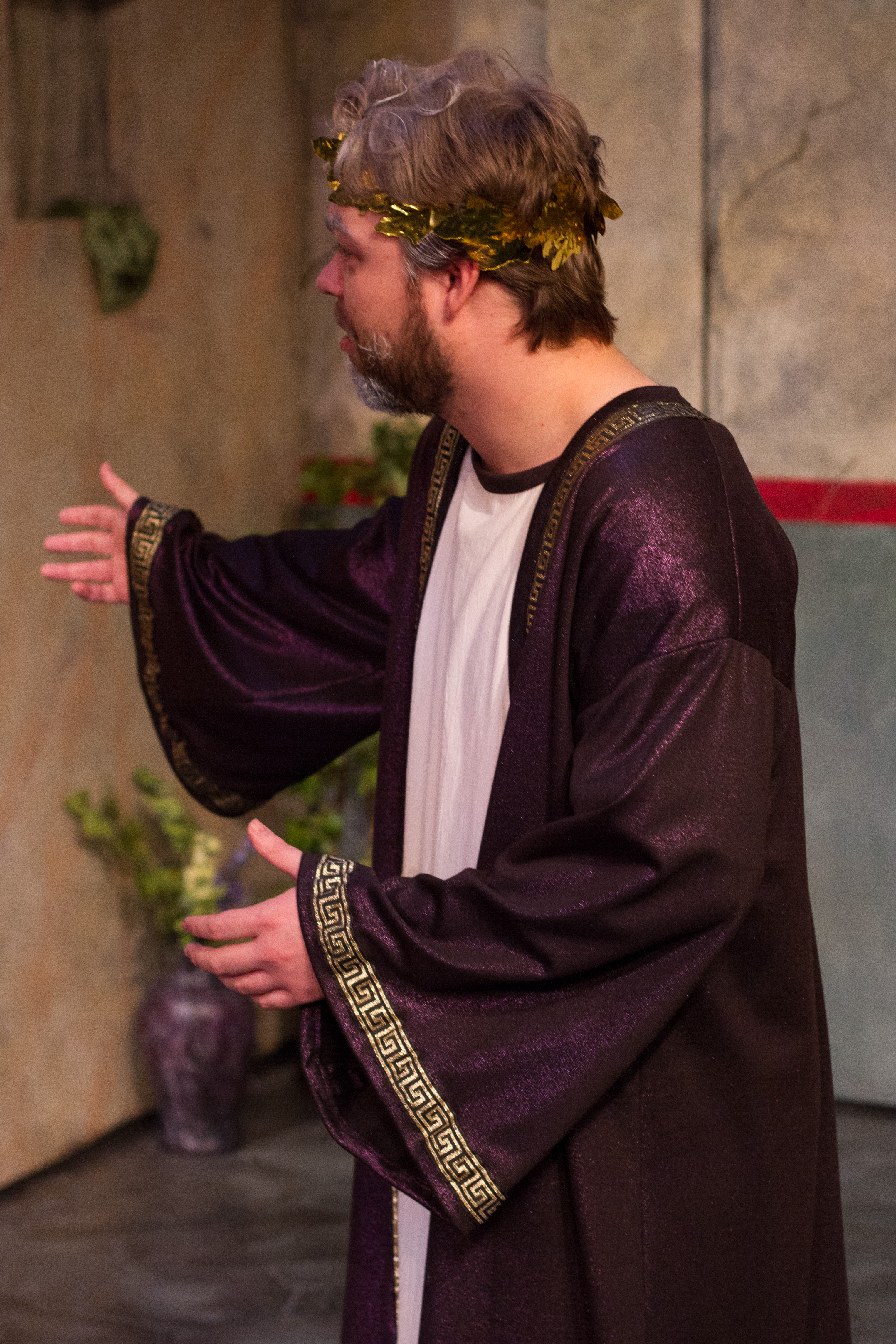
Photo credits to Douglas Stewart.  On the left, Kelsey Visscher as Hysterium and Kyle Thulien as Pseudolus, on the right Jordan Ward as Senex.


Flowers and thorns – the tragedy of Blood Wedding

Federico Garcia Lorca’s compelling tale of dark passions, Blood Wedding, is playing at the U of Alberta Studio Theatre.  The director is Kathleen Weiss and the cast is the 2014 BFA Acting class, in their final large-cast show together.

As in all shows in the Studio Theatre series, the costumes, sets, lighting, and music combine to create a coherent world, in this case a parched and dangerous one.   Before the show starts, we see a few chairs painted with appealing folkloric motifs and a tumble of fancy linens on a table, along with a few set pieces and drapes to create the impression of a harsh landscape against a bloody sun.

The staging starts with a woman in black (Mariann Kirby as Mother) beginning to fold the linens, as a chorus of younger women mimes some physical task while sitting downstage and a chorus of men (Neil Kuefler, Adam Klassen, Oscar Derkx) tumbles, fights, and works with scythes in the background.  When her son (Kristian Stec as Groom) comes to tell his mother that he is heading to the vineyard, we begin to learn of her preoccupations, especially about knives, weapons, and her dead husband and elder son.  When her son tells her he wishes to marry, she is reluctant.  I couldn’t tell whether she already knew who her son was courting and had reservations about that specific young woman’s history and family, or whether her reluctance was all about the prospect of being abandoned.  When she questions him about “your fiancée”, I couldn’t tell whether she wasn’t naming the young woman just because that was the author’s style choice to make them more archetypal, or whether she was pretending not to know her or actually didn’t know who she was.  Eventually Mother gives in and says that she’ll participate in the customs of taking gifts to the bride’s family.   We also learn in that scene that the Bride was previously engaged to Leonardo, who is part of a family that the Mother holds a grudge against, probably due to whatever bloodshed led to her family’s deaths.

Everything is elliptical and not-quite-explained.  The story only makes as much sense as it does because of Zoe Glassman’s character Neighbour, a chatty woman friendly with all the families.  When Mother and Groom arrive at Bride’s family home, we meet the Maid (Cristina Patalas), the bride’s Father (Graham Mothersill), and then the Bride (Merran Carr-Wiggin).   Throughout the story, the Bride seems ambivalent about the Groom and the wedding, fond of him but sometimes flinching from his touch or from more direct mentions of affection to come.  The parents of the young people, both scarred from sad pasts and cautious of each other, gradually come to be allies, talking about prospects for land purchases and cultivation and their wishes for grandchildren.  The Maid ramps up the erotic intensity of the preparations a bit while she helps the Bride dress and do her hair.  And then we see all the characters swept up in wedding celebrations, dancing and singing and playing music.   Several times I was reminded of Svadba, last year’s opera production about a group of friends preparing a young woman for her wedding.

The third family in the story is seen earlier on, first in a sweet domestic scene where a young mother (Andrea Rankin) and her own mother (Georgia Irwin) sing to a baby, and then the baby’s father (Braydon Dowler-Coltman) appears equally devoted to his son.   At some point in there, someone calls Dowler-Coltman’s character Leonardo, so that part begins to fit together.  Leonardo is the former fiancé of Bride, the one who then married Bride’s cousin, and he’s also part of the family who was involved in Groom’s father and brother’s deaths.  The young mother seems worried about her husband taking off on his horse all the time and maybe lying about it.  She doesn’t like the idea of him going to the wedding – especially going on his horse by himself although he protests that he’s not the kind of man to ride passively in a carriage.

The whirling dancing, increasingly frenetic Spanish-guitar-type music, and Bride’s growing distress cue us to an upcoming crisis.  The Bride goes to take a rest, fending off the Groom’s suggestion that they might go to bed together.  While the party continues we see the Maid begin to rush frantically from one side of the stage to the other, eventually crying out that the Bride is missing and so is Leonardo.

A search begins, with ominous music and lighting and threatening scythe-waving.  By this point there was lots of evidence that Leonardo was obsessed with the Bride, but it wasn’t at all clear that the Bride was still stuck on him, so I began wondering how much choice and power she had in the situation.  When they were seen in their flight through the woods, though, she was clearly as drawn to Leonardo as he to her.  As the pursuers approach, I was impressed by Carr-Wiggin’s stage tumbling in a wedding gown, at the same time as being frightened about the outcome.

And the pursuit didn’t end quite as badly as I’d expected in that the Bride didn’t end up dead.  But the show didn’t end with the fight and the other deaths either – then we got to see the Bride abandoned by her new husband’s mother and cast off by her own father, “a fallen woman and a virgin”.  This reminded me of Tess of the D’Urbervilles – well, okay, of the movie Tess because I’ve never actually read the book; the movie was depressing enough in showing a woman trapped in an unfair situation because of the expectations on women in that society.  In Blood Wedding, the deaths themselves aren’t the end of the story. But the Mother comments that she is more at peace now that everyone she loved is dead and no longer at risk, which is a disturbing commentary on the nature of revenge, grudges, and blood-feud.

Nice design touches:  the chenille rivers of blood, the beggar/oracle’s raven’s wings, the Maypole effect dressing the Bride in bright coloured sashes.   I loved the very active staging especially the woodcutters tumbling and scythe work.  And I noticed the repeated metaphor of comparing men and boys to various flowers and to thorns.

Blood Wedding continues at the Timms Centre until April 5th, including a Monday-evening performance and a midweek matinée.  Tickets are at Tix on the Square as well as at the door.

Solo Flight for RDC students

One of the assignments for the graduating students in Red Deer College’s Theatre Performance and Creation program is to develop and perform a solo piece, about 10 minutes long, acting as multiple characters.  The solos were performed this week, some on Thursday and some on Friday.  I attended the Friday show, and afterwards I wished I’d been able to see the other nine performances as well.  The Friday show was MCed by class member Richard Leurer, and other classmates who were not performing managed the tech and front of house duties, creating a friendly relaxed environment in the black-box space of Studio A, where I had seen first seen them perform a first-semester Showcase in December 2012.

The performers all acted as three or more different characters, signaling the shifts clearly to the audiences by changing position, posture, voice, and/or accent.  Most of the female performers played both male and female characters, with the most entertaining and convincing male character being Victoria Day’s crotch-scratching homeless man.  Bret Jacobs’ family story included a kind and entertaining Granny who aged along with the young protagonist.  Both age shifts were communicated effectively and with affection.  Jen Suter, Jessie Muir, Bret Jacobs, and Jake Tkaczyk all incorporated small child characters in their stories.

Jen Suter’s story of an overworked restaurant server, her unappealing co-worker, and her demanding patrons was a good choice to start the show because it was easy to understand and very funny.  Several of the creators/performers ventured away from real-world settings to include elements of adventure-science fiction (J-P Lord’s mismatched crew on a voyage across the galaxy), disturbing encounters with metaphysical powers (Collette Radau’s visits from the fear of death, Jessie Muir’s angelic demon), or an imagined dystopic future (Taylor Pfeifer’s world of addiction to bottled emotions).

Victoria Day and Constance Isaac both told powerful contemporary-world stories of teenagers struggling to cope with difficult family situations.  In Jake Tkaczyk’s piece, a seven-year-old protagonist encounters a couple of differently dangerous adults in a playground, and escapes disaster only because of the hostility between the malefactors, both of whom warn him about the other.

The program finished with Collette Radau’s work about encounters with a personified Fear of Death, but more generally about the experience of moving into an uncertain future.  It made me cry.

The show poster, reproduced above, was designed by Miranda Radau.

The Red Deer College Theatre Performance and Creation class of 2014 has one more set of public performances.  Skin Deep is a site-specific ensemble piece created by the performers.  It will be performed April 20-24 at a site in Red Deer, and more information is at this Facebook page.

Mary Poppins

The first of P.L. Travers’ books about Mary Poppins was published in 1934, and I read some of the books as a child, taking them out from a particular old library branch that my father used to like.  The Walt Disney movie came out in 1965, so I know I didn’t see it then, but I probably saw it at a drive-in theatre in one of the early re-releases, and I think I’ve also seen it as an adult but not recently.   I don’t know which I encountered first, but I don’t remember being bothered by any inconsistencies in the treatments.

I saw an early preview performance of the Citadel Theatre / Theatre Calgary production of the Broadway musical Mary Poppins last week.  Blythe Wilson was in the title role with an appropriate combination of dignity and warmth, and Michael Shamata was the director.  It was a fun large-cast show with a lot of music and with fun things to watch (dancing, kite-flying, various stage-effect magics, and enchanting sets capturing the house and neighbourhood in Edwardian London), so I think it would be a better family outing than Christmas Carol, which is a little scary.  Young performers Zasha Rabie and Jack Forestier were poised and convincing in the roles of Mary Poppins’ charges Jane and Michael Banks.  Kate Ryan and Vincent Gale were the Banks adults whom Mary Poppins also helps to find more balanced happier lives.  Kendra Connor, a local actor who has been a favourite of mine in shows such as Fiorello!, Strike! The Musical, Nutcracker Unhinged, and The Minor Keys, was very funny in several small parts.

Because I’m preoccupied these days with learning the work of stage management, working as ASM on the upcoming Walterdale Theatre production of A Funny Thing Happened on the Way to the Forum, (opens April 2nd, tickets here) I was completely in awe watching the smooth movement of complicated multi-level set pieces, some on a revolve.  Mary Poppins’ dignified descents and ascensions by umbrella had her in a completely upright immobile posture, which also impressed me.  In the early preview I saw, I think I saw one small delay probably due to a slow costume change and one wobble in the stage-magic, but they did not distract me from enjoying the show.

The underlying messages about valuing family life and personal happiness are just as timely today as when the books were written, and the story made me happy.

Mary Poppins continues to play at the Citadel until April 20th, but I hear that some performances are selling out.

Queen Lear – a play about a play

Part of the handful of theatre ticket vouchers that I acquired in the Rapid Fire Theatre Date Night auction in January was a pair of tickets to see Eugene Strickland’s Queen Lear, a Shadow Theatre production at the Varscona Theatre.  John Hudson directed, and the cast included Alison Wells as Jane, Ellie Heath as Heather, and Diana Nuttall as The Cellist.  The Cellist did not have a speaking role, but she was an active contributor to the story, as the music seemed to represent Jane’s inner thoughts and emotions.  Jane could hear the music, and sometimes it was loud enough to distract her or irritate her, even to the point of yelling “shut up!”  The Cellist also had an expressive face, showing what she was thinking about the various conversations and actions on stage.  I really enjoyed what the music and the musician added to the performance.

Jane is an actor in her 70s, who has been cast as Lear in an all-female production and who is anxious about being able to memorize her lines.  Heather is a 15yo family friend whom Jane has hired to run lines with her.  The show in which I’d seen Ellie Heath most recently, KIA Productions’ Closer,  also takes advantage of the actor’s skill at using unguarded facial expressions and casual postures to emphasize her character being younger than the others. As Heather, she’s a likeable young person with good manners but she is blunt, impatient, and uninterested in the problems of her elders.  In each scene, Jane and Heather work through a bit of the script in order, and they gradually get to knowing and trusting each other.  Heather lives with her widowed father.  Jane lives alone and is lonely and sometimes worried about being able to perform adequately in the play.

Costumes and stage dressing make a beautiful warm autumn-colours palette.  In the final scene, we see a small excerpt from the performance of Lear, with Jane in a rich gown too heavy for her and with Heather playing Cordelia, and it is so effective that it made me and my playgoing companion wish to see a whole production of King Lear with the title role being a woman.   Parts of the performance made me think about the third season of Slings and Arrows, and how easy it is to entwine the story of an aging performer with the struggles of playing King Lear.  Having it be a woman made me get it more, I think, too.

The run continues at the Varscona Theatre until March 30th.  More details are here along with a link to Tix on the Square.  It’s worth seeing, and generates lots to talk about.