Tag Archives: tracey power

New productions – reviews of re-viewings?

Team and coach travelling by train, in MacEwan University’s production of Tracey Power’s Glory. Photo by BB Collective.

I’ve been watching entertainment on local stages for more than ten years, so it’s not surprising that sometimes I see new productions of works I’ve already seen. Recently, I’ve seen two performances in this category, but otherwise very different: Glory, by Tracy Power, and Die Fledermaus, by Johann Strauss.

In 2018 I travelled to Calgary to see the world premiere of Tracy Power’s Glory, produced by Alberta Theatre Projects and directed by James MacDonald. I was excited to see that the students of MacEwan University’s Musical Theatre program would be tackling this play, as a story about young people pushing the boundaries of appropriate activities in the turbulent times of 1930s Canada seemed like a great fit. Amber Borotsik was a great choice as director for the movement-forward work. Her choreographic choices for learning to skate, for practising hockey strategies, and for the various important games in the narrative were less stylized and more story-coherent than in the original production, but equally fun to watch.

Izzy Deutscher was great as team captain Hilda Ranscombe, confident in sports but struggling in other parts of life. The other team members portrayed, Nellie Ranscombe (Jaysel Ann Arroyo), Marm Schmuck (Harmony B), and Helen Schmuck (Jenn Houle), were quickly distinguished as individuals, each with her own problems and quirks. The script clearly sets the action in 1930s small-town Canada, with radio news voice-overs, women’s magazine columns, and the teammates’ conversations about work in the shoe factory, missing a chance at university because father and brothers are still out of work, and being denied admission to law school because of being Jewish. Devin Estey plays rink manager and reluctant team coach Herb Fach, managing to conveying a grumpy-old-man vibe despite appearing about the same age as the players. Kevin Thomas, visible in porkpie hat and suit on the theatre’s catwalk, provided colour commentary as radio announcer for the various games.

I was particularly moved by the design feature (Scott Spidell) of having championship banners roll down after the team’s first national title win, then ending the show with the banners scrolling through the many subsequent achievements of the Preston Rivulettes, then the logos of the modern-era national championship, the first women’s world championship in Ottawa in 1990 (I still have a volunteer sweatshirt with that logo), the subsequent world and Olympic titles of Canadian teams, ending with the new logos of the six teams in the Professional Women’s Hockey League, now in their first full season. As a second-wave women’s hockey pioneer and the daughter of another one, I loved the way this tied the history together with my own experience and with current and future women’s hockey players. I was also impressed by the information and fundraising about indigenous hockey opportunities in Alberta.

Die Fledermaus was last produced at Edmonton Opera in 2014. In a conventional staging, it was humorous and enjoyable, with Julian Arnold playing the doctor who is teased about his bat costume. The 2024 production, directed by Joel Ivany, added a layer of meta-, and even more opportunities for accessible silliness, by framing it as a community theatre company rehearsing, performing, and recovering from a performance. So Act 1 is actually the company arriving at rehearsal and rehearsing Act 1, with original dialogue in English for the many interruptions and amusing interactions. I think my favourite bit of Act 1 was watching the Stage Manager (Farren Timoteo) scurrying around to deliver props to the performers just in time and almost invisibly, and crawling around the stage with strips of spike tape laid out on his sweater, so he could mark each performer’s location for delivering songs. In Act 2, at Count Orlovsky’s party, the core cast of 9 is joined by a large chorus of partygoers in masks and various shades of festive black, along with a DJ, a drag queen, and others. Most memorable was the ode to Champagne. Act 3 is called the “After-After-Party”, with the cast members waking up or staggering in, and reminiscing about the performance but actually singing all the songs of the script’s Act 3. This part was kind of confusing but I was still laughing. Soprano Jonelle Sills (Rosalinde) had a particularly impressive voice, and also memorable wigs.
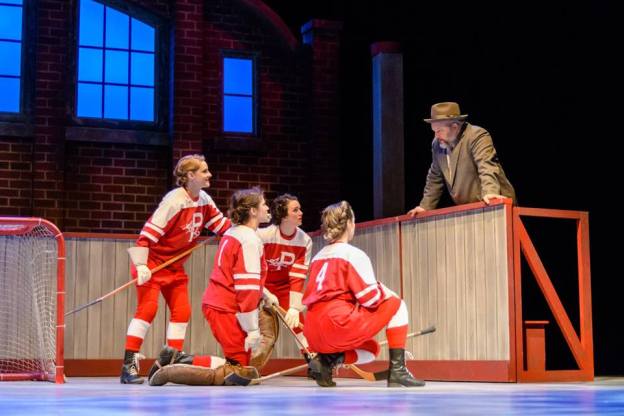
Tracey Power’s Glory!

Kate Dion-Richard, Gili Roskies, Katie Ryerson, Morgan Yamada, and Kevin Corey in GLORY. Photo: Barbara Zimonick. (Set & Lights: Narda McCaroll. Costumes: Cindy Wiebe.)

When I read that Calgary’s ATP would be putting on a new play about women hockey players, and specifically the Preston Rivulettes of the 1930s, I knew I needed to go to Calgary to see it.  And I was right!

I cried a lot during the performance, because the portrayals of the young women and of their community’s responses were so familiar from my own experience of female hockey starting in the 1970s.  I felt represented, understood, and honoured.  “I’ve always wanted to play on a team!” enthuses future captain Hilda Ranscombe (Katie Ryerson).  “Girls don’t play hockey!” retorts reluctant coach Herbert Fach (Kevin Corey).

The playwright Tracey Power (Chelsea Hotel) chose two pairs of sisters, Hilda and Nellie Ranscombe (Ryerson and Edmonton’s Morgan Yamada) and Marm and Helen Schmuck (Gili Roskies and Kate Dion-Richard) to represent the players, and created interesting distinct characters with enough backstory, conflict, and connections to be compelling.  The historical background of the 1930s was essential to the story, filled in by the characters talking about their families and community and by listening to CRBC (later CBC) radio.  One player couldn’t go to university because her father’s business was struggling and her brothers had lost their jobs; another wasn’t admitted to law school because she was Jewish.

Hockey games were represented on stage in stylized choreography (Power), with different movements and music for each game.  Yamada was an agile and stubborn goaltender.  Hard shots (of imaginary pucks) had me ducking in my seat.  Set and lighting (Narda McCarroll) and costumes (Cindy Wiebe) support the storytelling.  I was particularly impressed with the rapid movement of the rink-boards pieces to become changerooms, factory workrooms, and even a baseball park.  Director James McDonald (formerly of the Citadel) and playwright Power paced the action well and kept the human stories to the forefront.

I have known of the Preston Rivulettes since I was a young hockey player and fan, looking at team photos and trophies in the old Preston Arena.  I vaguely remember meeting Hilda and Nellie much later in their lives, at a Preston Trianglettes game, and finding it hard to comprehend that forty years earlier, they had played for provincial and national championships.  In the 1970s there was no provincial or national governing body or championship for female hockey – but in the 1930s there was.   The play Glory included enough of the documented facts to make me happy as a scholar, but more importantly captured perfectly what it is like for women to play the game they love despite many obstacles.   I hope to tell some of the second-wave women’s-hockey stories on stage myself someday, and this play affirms my sense that they are worth telling.

“When we fight to win, we have a whole lot more at stake”, one of the characters in Glory says, explaining why fans find their matches exciting.  And Hilda Ranscombe finishes with a monologue daydreaming about what will happen someday, despite the loss of competitions and opponents on the eve of war.  Someday, she says to her teammates, there will be so many teams we won’t be able to play them all.  And there will be women coaches.  And women referees.  And women announcers.  And Olympic medals.

There are, Hilda, there are.  Thank you.

Glory is playing at Alberta Theatre Projects in Calgary until April 21st.


Memories of Leonard Cohen

When I was in Grade 9, our English teacher played us some vinyl records with some Canadian poet/songwriters singing their stuff.  Buffy Sainte-Marie.  Leonard Cohen.  I didn’t like either of them as singers and I thought only teachers and other grownups would like that kind of music.

When I was taking Grade 12 English, we did a unit on Canadian poets and each group had to do a presentation on a modern Canadian poet.  My group studied James Reaney, who is clever but not especially accessible.  (Local theatre-connections:  he’s also a playwright, having written a trilogy about the infamous Donnelly family also featured in Jonathan Christensen’s Vigilante, and the writer of the Alice Through the Looking Glass adaptation that’s coming to the Citadel this spring.)  Another group studied Leonard Cohen.  Their presentation included one of his more sexually-themed works, which led our English teacher to a passionate defence of the subject matter as both appropriate subject for poetic celebration and a joyful part of an intimate relationship.  This was probably the best sex-ed lesson I had in school ever.

I really don’t know how I learned the tune for Cohen’s “Hey that’s no way to say goodbye” (it’s easy to learn because it’s very repetitive).  I used to sing it, mostly to myself, when I was an undergrad, and I had the words written up on my bedroom wall.

And then Cohen wrote for Jennifer Warnes (Famous Blue Raincoat, First We Take Manhattan), and sang with Suzanne Vega (whose own lyrics spoke to me with painful poetic truth in the late 80s), and then the Jeff Buckley Hallelujah turned out to be actually a Leonard Cohen song which everyone seemed to know and love and argue about, and I have no idea when it happened, but Leonard Cohen was actually cool.

So cool that now there’s a theatrical staging of his words and music, created by Tracey Power for Firehall Arts Centre in Vancouver and now touring to the Citadel Theatre in Edmonton, Chelsea Hotel.  The seven performers all sang and played instruments.  Jonathan Gould seemed to be playing Cohen, and the others (Rachel Aberle, Steve Charles, Sean Cronin, Christina Cuglietta, Benjamin Elliott, Tracey Power) seemed to be the voices in his head, the women in his memory, and his alter-egos.  I particularly enjoyed the performance of Suzanne, and the two versions of Hallelujah.

Other performances this season (Back to the 80s at the Mayfield, BOOM at the Citadel) have celebrated the music and pop culture of my lifetime, but tonight’s encounter withe Leonard Cohen’s music brought back different memories, because at the time I didn’t think the music was popular or know it was going to be important.

Chelsea Hotel continues at the Citadel to February 13th.

Clybourne Park: optimal discomfort

Clybourne Park, by Bruce Norris, is a story – or two stories – about racial shifts in neighbourhoods in Chicago.  The concept of this play has two interesting notes.  One is that the two acts are set in the same house in 1959 and in 2009.  The other is that it’s intended to connect with the 1957 play Raisin in the Sun, written by Lorraine Hansberry.

I haven’t watched or read the play Raisin in the Sun, but the movie of the same name, with Sidney Poitier, is conveniently available on iTunes.   That story focuses on an African American family, living together in a small apartment, who use some life-insurance money to buy a house in an all-white neighbourhood.  In one scene, a delegate of a neighbourhood association attempts to buy the house back from them, using the 1959 version of trying to justify the segregated neighbourhood while claiming that they aren’t acting out of race prejudice.  My impression from the movie was that while it was a fascinating portrayal of the lives and limitations of African American people in a northern city in that era, the conflict with the new neighbours was not the main focus of the story.

The first act of Clybourne Park is set the same day as that visit, in the house that the white family has just sold.  And similar to the source material, the fact that the buyers are non-white does not come up until late in the first act and is not even very important to the couple who are selling, Russ and Bev (Doug Mertz and Kerry Sandomirsky).   Their bigger troubles are revealed gradually, as friends and neighbours (Cole Humeny as Jim in clerical collar and hernia truss, Martin Happer and Tracey Power as Karl and Betsy) drop in and awkwardly express concern, and their household help Francine (Sereana Malani) finishes her work for the day and is collected by her husband Albert (Michael Blake) who gets roped in to carry a trunk.   Because the audience is aware that the play focuses on race issues, the details of how the white people treat Francine and Albert are immediately uncomfortable.  A poignant telling example is the way that after Bev makes a little speech about how she and Francine are such close friends, she’d be glad to have Francine and Albert and their two lovely children as neighbours – but the audience already knows that Francine has three children.

However, there are lots of other details about 1959 life and customs that were equally jarring to me.  Tracey Power’s character is Deaf, and the 21st-century audience was frequently gasping about how her friends talked about her and treated her.  And in the initial conversation between Russ and Bev, a long-married couple, there was an accepted dynamic of the husband being the expert and the wife being unaware of geography, politics, or other significant facts – and I never did make up my mind how much of that was put on, Bev kind of choosing to play that role to support her husband.

The story explains why they want to sell the house, and why they’ve been relieved to find a buyer.  We don’t actually meet the buyers, but the first act ends with us feeling glad that Russ and Bev will be able to move on.

While the curtain was down for intermission, the house was aging 50 years and the set underwent an astonishing transformation.  I loved looking at both sets – the fussy details of the well-cared for 1959 living-room covered with moving boxes, and then the graffiti and broken banisters of the living room of the abandoned house in 2009.   The situation of the second act was that a young white couple (Happer and Sandomirsky) are buying the house with plans to fix it up and expand it.  They, their real estate agent (Power), and a lawyer (Humeny) meet with delegates from the current neighbourhood association (Malani and Blake) who have some concerns about the proposed renovations.   But the conversation soon reveals the 2009 versions of condescensions and flawed assumptions, men talking over women and white people patronizing black people, and also the 2009 version of reluctance to talk directly about racial issues – which then descends painfully into some telling jokes full of horrible stereotypes, as the audience winces while anticipating punchlines and then laughs out of sheer awfulness.  Eventually we learn that the real estate agent is the daughter of Karl and Betsy from the first act, and that Malani’s character is the niece (or some kind of relative?) of the first African American woman to own the house in 1959 (she’s not in this play, but in Raisin in the Sun that would be the grandmother Lena who uses her husband’s life-insurance money).  So we see that a circle has been turned, and we also see the similarities between attitudes in the two eras despite surface differences.

There is a short coda with Evan Hall filling in a hinted-at piece of the 1959 story, and then we went home with a lot to think about.   It made me uncomfortable, but it didn’t make me too uncomfortable.  And I liked it that it wasn’t a bigger story – that a lot of it was just about people getting by, with the big family issues and the bigger social issues in the background.  I identified easily with almost everyone in the second act, but the character I liked best was Bev (Sandomirsky) in the first act.

Clybourne Park is playing at the Citadel until February 16th.