Tag Archives: theatre

Little One at Theatre Network. Wow.

The last time I saw Jesse Gervais on stage with Theatre Network he and Lora Brovold were making me cry in Let the Light of Day Through, as directed by Bradley Moss.  This week I saw him and Amber Borotsik in the Theatre Network production of Hannah Moskovitch’s Little One, also directed by Bradley Moss.  And I did tear up a bit again, but mostly I just found it so gripping that I kind of forgot to breathe and completely lost awareness of the passage of time.  One of my theatregoing companions said that his foot fell asleep and he didn’t want to move.

The character telling the story, Aaron (Gervais), is a doctor, a surgical resident about 30 years old.  He spends most of the play talking to the audience or maybe his off-stage colleagues about his memories of life with his troubled younger sister.  His narrative is interspersed with scenes where he and his sister Claire (Borotsik) are children and young teenagers. With subtle shifts in body and voice and credible dialogue, Gervais made a convincing child of eight to fourteen years old, the older brother who is trying to be the good kid, who cares about his sister but is frustrated and sometimes angry or frightened or resentful at her behaviour and her effect on the family.  It was very clear that Borotsik was portraying a child a couple of years younger than Aaron in each scene, but also that something was a little off about her affect.

The other people recurring in the stories, Mum and Dad and the neighbours Kim-Lee and Roger, are not represented directly, and the story feels sufficient with just the two characters, through the past and in the present.  In the present, the siblings are not interacting face-to-face.  It seems that they have been out of touch for some time, but Aaron receives a cassette tape letter in the mail from his sister and plays it, as we see Claire telling the story on the tape.   Basically everything on stage is storytelling, either acting out in flashback, Aaron’s direct narrative, or Claire’s story on tape – but the performance is still very intense.  The audience was very quiet on the preview night, chuckling nervously at a few appropriate places but otherwise I think other people were as gripped by the story as I was.

And what was the story?  Part of why it was so effective for me was that I didn’t know much about it ahead of time, so I think I won’t recount the narrative here.  It’s got some elements of awfulness, but every time I thought, I see where this is going, I know what all these stories mean, I was not quite right.  My companions agreed with me that the writing was very clever, with some plot elements being surprising when they happened and then making such complete sense afterwards that we felt as if we should have guessed but didn’t.

One of the most effective things in the way this story was told was Aaron’s way of hinting at things he couldn’t bear to say.  He’d use circumlocutions “that day” “the … incident …” but he’d also start lots of sentences that he couldn’t finish, sometimes trying two or three times before finding a way in to a painful story.  Gervais as the adult Aaron seemed to have a very tense jawline, as he struggled to tell things that the character said he didn’t often talk about.  And you could see that the careful, self-controlled surgical resident was who the younger Aaron had turned into, the little boy who lost two families and the teenager whose parents needed him to be an adult too young.

I’m writing a lot more about Gervais’s character than about Borotsik’s, because part of her effective portrayal was showing that Claire did not have normal attachment to her family or others, and she basically didn’t seem to make eye contact with the audience either.  She was heartbreaking and frightening and occasionally funny.

I don’t actually remember if there were any stage-manager warnings about content posted at the box office.  There isn’t an intermission, which is how I prefer it for an emotionally intense show.  There is some swearing.  And there are some disturbing concepts.

Can I say I liked it?  It’s not that simple.  I’m very glad I went, I’d go again if I had time, and I bet it will be nominated for more than one Sterling Award category.  You should see it too, if you can tolerate some painful subject matter in a good story well done.  Tickets are here. 
Punctuate! Theatre’s Dirt

When I was in Grade 9, our English teacher Mr. Hillen handed out six or seven books at the start of the year.  (Merchant of Venice, an Agatha Christie mystery, Geoffrey Trease’s Cue for Treason, anthologies of short stories, poetry, and plays, and maybe something else I can’t remember. )  Being introduced to Shakespeare made a difference to my life in the long run, but the immediate change came from the implied permission to start reading my parents’ collection of murder mysteries.  Mr. Hillen told us the order that we’d encounter the works on the curriculum, and said we could feel free to read ahead in any of them, except that we should not read the last play in the anthology because he wanted us to encounter it fresh in class.  That of course was an irresistible briar patch to an enthusiastic reader, even one who already loved the English teacher, so over the year I would sneak glances at different bits of that last play, and I never did encounter it fresh and all of a piece.  As it turned out, we didn’t get around to reading it in class anyway, so I never got to discuss it, but Shirley Jackson’s The Lottery stuck in my head as a very strange dangerous world, that sounded normal until it suddenly didn’t.

That was a very long time ago, and it hasn’t been a foundation of my literary framework in the meantime either.  But partway through watching the opening-night performance of Punctuate! Theatre’s production of Ron Chambers’ Dirt, I thought, Ooh, this scapegoating is working like The Lottery.  Whether that shows the benefit of English class or the more devious benefit of telling kids not to read something, I’ll leave for the, ahem, reader.

Anyway.  Dirt is directed by Liz Hobbs, and performed by Elliott James, Cliff Kelly, Andréa Jorawsky, Jeff Page, and Rebecca Starr.  It starts out with a familiar-seeming setting and characters – police investigating a murder, a suspect living on the margins of society.  But it gets odd, a little bit at a time.   The pair of investigating officers were immediately identifiable as the conscientious anxious young one (Cliff Kelly), and the confident preeningly-masculine and politically-right-wing more experienced officer (Elliott James).   When the performance started, the two officers were standing in front of a rough burlap-bag curtain, which they then opened to reveal the home of their chief suspect, where the rest of the story was set.  Murphy (Jeff Page) was under suspicion because he was the boyfriend of the murdered woman, and because he was a foulmouthed dirty loner on welfare.

The senior officer Falkin bullies Murphy and threatens him with the death penalty.  When Murphy protests that we don’t have the death penalty any more, Falkin goes off on a rant about how it might be reinstated and would be cheaper than keeping people in prison.  He then says that as a cheaper alternative to keeping him in custody while the case is investigated, he is leaving Murphy under house arrest with an armed guard, Greta (Andréa Jaworsky).   The fifth character in the story, a local woman making deliveries of homemade food to Murphy, is played by Rebecca Starr. She was playing a very familiar kind of character that I recognized from life and she was doing it in a very funny way.  I really enjoyed her.

The story progresses with Murphy and Greta clashing in predictable ways and starting to get to know each other.  He doesn’t like having a fussy outsider in his house, and complains about the police sealing up the window in his unventilated bathroom.  She thinks his house is dirty and doesn’t want him to keep his “long gonch” (long underwear, for those not familiar with the regionalism) on the kitchen table.  But gradually he begins telling her some of his hard-luck stories, and she gets won over along with the audience (or at least me!).  I could see why his projects never worked out, but at the same time I liked him for trying and felt sorry for him for not being able to think them through.

Yet every time Falkin burst back in to the house, he seemed more offensive.  It took me a long time to decide that he was objectively out-of-line, because he was a classic example of that trope of bigoted bullying cop.   By the end of it, I was completely on the side of Murphy and/or of Greta.  And around about then, I started thinking in a horrified way about planned scapegoating.

Dirt was an interesting, thought-provoking contribution to the Punctuate! Theatre season.  Upcoming they have a dance show and then Hannah Moskovitch’s East of Berlin.

Love’s Labours Lost, at the Studio Theatre

One thing all the U of Alberta Studio Theatre series productions have in common is interesting set and costume design with satisfying attention to detail.  Earlier this season I enjoyed the stark spareness setting the mood for pool (no water), and then the period costumes of Pains of Youth and Bloody Poetry.

The designs for Love’s Labours Lost were playful and full of joy, with bright colours and silliness conveying the frivolous not-quite-real background for this comedy, set by the text in the Kingdom of Navarre.  Apparently there was a real place by this name, located on the French border of Spain.   Visitors to the kingdom included a “fantastical” Spaniard, Don Armando (Oscar Derkx), with exaggerated and very funny Hispano-Quixotic gestures and accent,  and the daughter of the King of France (Mariann Kirby) and some members of her court (Merran Carr-Wiggin, Zoe Glassman, Cristina Patalastc, Braydon Dowler-Coltman, Sarah Ormandy).   Georgia Irwin plays the clown Costard with a consistent Scottish burr, for no explainable reason other than to make her character distinct from the local noblemen – but it’s funny.

The premise of the main plot is that the young King of France (Adam Klassen) convinces his male courtiers to join him for three years of studying, following a near-monastic rule with restrictions on food and sleep and a proscription on contact with women.  Berowne (Neil Kuefler) is particularly reluctant to sign on to this plan, although he eventually agrees along with the characters played by Kristian Stec and Graham Mothersill.  But almost immediately after they agree, they find out that the Princess of France and her attendants are on their way for a visit.  So they decide to keep the letter of the agreement by meeting the visitors in a park rather than in the palace.   And of course as soon as they meet, the men of Navarre are immediately struck with admiration for the women of France, conveniently aligned in non-conflicting pairs.

Meanwhile, bits of broader comedy (i.e. wacky hijinks) keep intervening, with the random cocky Spaniard and his saxophone-playing page (Andrea Rankin),  a country girl (Braydon Dowler-Coltman), the aforementioned clown Costard carrying messages and mixing them up, a constable (Brandon Nearey), a schoolmaster (Merran Carr-Wiggin), and a curate (Mark Vetsch).

The play runs almost two and a half hours (not counting the intermission) but I found that the time just flew by.

The story suits modern sensibilities and recent trends in popular culture by showing the Princess as competent with an air of authority, speaking mostly in prose, and in one scene hunting a deer with a bow and arrows.  I was most intrigued by the characters of the Princess and of Berowne, the courtier most willing to dispute with the King and then to declare his affection to Rosaline.  Berowne is also a leader in some affectionate trash-talking competition.

Love’s Labours Lost is directed by Kevin Sutley.  It is playing at the Timms Centre until Saturday, including a 2-for-1 ticket deal Monday (tomorrow).   If you click here on the Department of Drama website within the next few weeks, you can see a gallery of photos from the production showing the colourful costumes (the academic gowns and hoods are University of Alberta doctoral/faculty style).   And I’ll also offer you one more related link to click, the indiegogo crowdfunding campaign to help the young performers of this BFA Acting class take a modest audition tour together after they graduate in the spring.

Escher-esque set for Three Musketeers

All for one and one for all, with Red Deer College Three Musketeers

The Red Deer College theatre program’s current production is The Three Musketeers, the 2006 Ken Ludwig adaptation of Alexandre Dumas’s novel, first published as a newspaper serial in 1844.

I did not attempt to read the original, as I could not get through Dumas’s Count of Monte Cristo after I saw a Stratford (Ontario) Festival production about ten years ago.  So my pre-show preparation was limited to reading Wikipedia, looking at the Red Deer College Performing Arts website, and looking at a video clip from this production posted in a newspaper preview.

I was pleasantly surprised at how well the adaptation, and this production directed by Thomas Usher, managed to create for modern audiences a fast-paced, episodic, wish-fulfilling adventure which was probably true to the impression left on contemporary readers of the serial.   D’Artagnan, the young man from the country who travels to Paris with the goal of becoming a Musketeer like his father before him, was played with well-meaning earnestness by Tyler Johnson, like most of the cast a graduating student in Theatre Performance and Creation.   My favourite character in the story was an addition for the modern adaptation, D’Artagnan’s younger sister Sabine (Brittany Martyshuk).   D’Artagnan’s parents ask him to take his sister to Paris and enroll her in a convent school, but it turns out that she actually wants to seek her fortune as a swordfighter and maybe fall in love with a Musketeer.   I found her character both charming and credible.

The three musketeers of the title, whom D’Artagnan is challenged by and then befriended by, are Athos, Porthos, and Aramis.  (The “h”s are silent because they are French – I didn’t know that before.)  Athos is the more serious musketeer whose sad personal backstory comes out later, and he is portrayed by Chase Cownden, a particularly impressive stage fencer.  Porthos (Bret Jacobs) is interested in fashion, and a scene in which he is showing off a new cloak leads to a fight scene with some impressive use of a length of cloth to tangle an opponent.  Aramis (Wayne DeAtley) aspires to religious life, and is the target of Sabine’s crush.

The musketeers’ archenemy is Cardinal Richelieu (Richard Leurer), remote and devious and a little slimy.  Richelieu’s collaborators and allies include Milady (Megan Einarson) and Rochefort (Victoria Day).   Other characters include the King and Queen of France (JP Lord and Taylor Pfeiffer), and Constance the queen’s lady-in-waiting and love-interest for D’Artagnan (Constance Isaacs).  Daniel Vasquez, a recent graduate of the RDC Theatre Performance program, plays Treville the head of the musketeers, Buckingham the Queen’s lover, and a few other minor parts.  Most of the other actors are multiply-cast as well, with some quick costume changes.

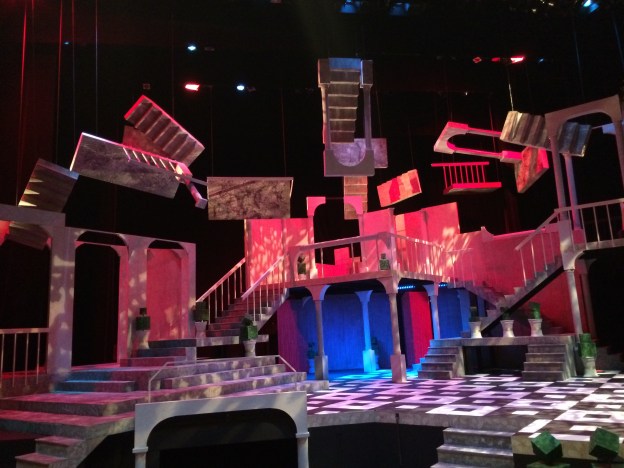
The set for the show was strongly reminiscent of the Escher print Relativity, and the similarity was underlined by pieces of staircase and balcony suspended in the air at odd angles. The actual stage was full of entrances and exits, balconies and crossing staircases, and they all got used, with almost no prop movement between scenes.  This helped underline the impressions of fast-paced action with complications and conspiracies.

There was, of course, a lot of stage combat, not just swordfighting but unarmed fighting, knifework, and other tools used as weapons.  At one point, all twelve cast members are engaged in a skirmish all over the stage between musketeers and Richelieu’s guards, with so much going on that it was hard for the audience to keep track of and easy to buy into the illusion of it being a real fight.

One of the things I liked best about this production was the women’s parts and the scope for female actors.  They weren’t just cast as men for fight scenes; the script included three fighters explicitly identified as female, who seemed like distinct interesting characters – Sabine, the young girl who grew up learning fighting with her older brother, Milady, with a dagger in her boot and a secret in her past, whose manipulative sexuality was reminiscent of the courtesan Einarson played in the troupe’s production of Comedy of Errors last year, and the guard captain Rochefort, in eyepatch and scar. Milady is a character in Dumas’ original story, and so is a male version of Rochefort.  I couldn’t tell whether Rochefort had been changed from male to female by the 2006 playwright or by the director of this production, but it didn’t matter and it worked well enough for me to enjoy it.

The production even passed the “Bechdel test” – the criterion expressed by a character in an early edition of Alison Bechdel’s comic strip Dykes to Watch Out For, that she only reads/watches fiction in which two women talk to each other about something other than a man.   I can’t remember what the conversation was about in the second convent scene, when Constance is taking sanctuary and Milady is looking for her, but the scene at the convent school where Sabine has been enrolled definitely passes.

I’m not sure that everything shown on the stage was necessary to the plot – but it was fun and the pace was good and I didn’t mind.  The tavern singing and the masked-ball dancing were fun to watch.   The random musket battle with Huguenots confused me a bit more, because I was wondering whether there was a point to it other than giving Porthos a chance to make some funny comments about religion.

The costuming used a limited but rich palette of colours, allowing the audience to distinguish between the heroes in brown, burgundy, and gold, with Porthos having more dramatic choices, the household of royalty in purple, and the enemies in black and red.  I also noticed red hues in the lighting for Milady’s and Richelieu’s scenes.  And I loved the peacock dress Sabine wore to the masked ball.  There were lots of scruffy whiskers in evidence, with Richelieu’s waxed mustache and groomed-squirrel-tail goatee in sharp contrast.

In the show I saw early in the run, there were a few situations of stilted speech, but for the most part the actors spoke clearly, convincingly, and in character, and they made me care about what happened to the characters.   And the last line made me cry.

Three Musketeers plays Wednesday through Saturday of this week at the Red Deer College mainstage.  Advance tickets are available on line and by phone from the usual outlet.

Clybourne Park: optimal discomfort

Clybourne Park, by Bruce Norris, is a story – or two stories – about racial shifts in neighbourhoods in Chicago.  The concept of this play has two interesting notes.  One is that the two acts are set in the same house in 1959 and in 2009.  The other is that it’s intended to connect with the 1957 play Raisin in the Sun, written by Lorraine Hansberry.

I haven’t watched or read the play Raisin in the Sun, but the movie of the same name, with Sidney Poitier, is conveniently available on iTunes.   That story focuses on an African American family, living together in a small apartment, who use some life-insurance money to buy a house in an all-white neighbourhood.  In one scene, a delegate of a neighbourhood association attempts to buy the house back from them, using the 1959 version of trying to justify the segregated neighbourhood while claiming that they aren’t acting out of race prejudice.  My impression from the movie was that while it was a fascinating portrayal of the lives and limitations of African American people in a northern city in that era, the conflict with the new neighbours was not the main focus of the story.

The first act of Clybourne Park is set the same day as that visit, in the house that the white family has just sold.  And similar to the source material, the fact that the buyers are non-white does not come up until late in the first act and is not even very important to the couple who are selling, Russ and Bev (Doug Mertz and Kerry Sandomirsky).   Their bigger troubles are revealed gradually, as friends and neighbours (Cole Humeny as Jim in clerical collar and hernia truss, Martin Happer and Tracey Power as Karl and Betsy) drop in and awkwardly express concern, and their household help Francine (Sereana Malani) finishes her work for the day and is collected by her husband Albert (Michael Blake) who gets roped in to carry a trunk.   Because the audience is aware that the play focuses on race issues, the details of how the white people treat Francine and Albert are immediately uncomfortable.  A poignant telling example is the way that after Bev makes a little speech about how she and Francine are such close friends, she’d be glad to have Francine and Albert and their two lovely children as neighbours – but the audience already knows that Francine has three children.

However, there are lots of other details about 1959 life and customs that were equally jarring to me.  Tracey Power’s character is Deaf, and the 21st-century audience was frequently gasping about how her friends talked about her and treated her.  And in the initial conversation between Russ and Bev, a long-married couple, there was an accepted dynamic of the husband being the expert and the wife being unaware of geography, politics, or other significant facts – and I never did make up my mind how much of that was put on, Bev kind of choosing to play that role to support her husband.

The story explains why they want to sell the house, and why they’ve been relieved to find a buyer.  We don’t actually meet the buyers, but the first act ends with us feeling glad that Russ and Bev will be able to move on.

While the curtain was down for intermission, the house was aging 50 years and the set underwent an astonishing transformation.  I loved looking at both sets – the fussy details of the well-cared for 1959 living-room covered with moving boxes, and then the graffiti and broken banisters of the living room of the abandoned house in 2009.   The situation of the second act was that a young white couple (Happer and Sandomirsky) are buying the house with plans to fix it up and expand it.  They, their real estate agent (Power), and a lawyer (Humeny) meet with delegates from the current neighbourhood association (Malani and Blake) who have some concerns about the proposed renovations.   But the conversation soon reveals the 2009 versions of condescensions and flawed assumptions, men talking over women and white people patronizing black people, and also the 2009 version of reluctance to talk directly about racial issues – which then descends painfully into some telling jokes full of horrible stereotypes, as the audience winces while anticipating punchlines and then laughs out of sheer awfulness.  Eventually we learn that the real estate agent is the daughter of Karl and Betsy from the first act, and that Malani’s character is the niece (or some kind of relative?) of the first African American woman to own the house in 1959 (she’s not in this play, but in Raisin in the Sun that would be the grandmother Lena who uses her husband’s life-insurance money).  So we see that a circle has been turned, and we also see the similarities between attitudes in the two eras despite surface differences.

There is a short coda with Evan Hall filling in a hinted-at piece of the 1959 story, and then we went home with a lot to think about.   It made me uncomfortable, but it didn’t make me too uncomfortable.  And I liked it that it wasn’t a bigger story – that a lot of it was just about people getting by, with the big family issues and the bigger social issues in the background.  I identified easily with almost everyone in the second act, but the character I liked best was Bev (Sandomirsky) in the first act.

Clybourne Park is playing at the Citadel until February 16th.

Sapientia, a disturbing tale of child martyrs and a fascinating portrayal with puppets

The author credited for this play was Roswitha of Gandersheim, a 10th century playwright, poet, and (according to the Canoe Festival program and Wikipedia) secular canoness.  A Wikipedia link explains that this referred to a woman who lived in a monastery but did not take religious vows, so it might have been a handy way for a woman of the aristocracy to pursue a single scholarly life.

This adaptation as object theatre was made by Joseph Shragge of Montreal.  Mia van Leeuwen of out of line theatre was credited with direction and design.  Object theatre is a sort of puppetry using found objects.  The four puppet performers were David Barnet, Kara Chamberlain, Nancy McAlear, and Brendan Nearey.  The objects were simple and ordinary (a kettle for the emperor, teacups of diminishing size for the three little girls, a mirror for the mother), but the small gestures of the puppeteers and their voices made it easy to picture the characters as the story unfolded.

The subject matter of the tale was a Christian woman and her three young daughters, defying the Roman emperor Hadrian to the extent of torture and martyrdom.  It was a classic martyr story, with the satisfying ending being death without surrender leading to frustration and loss of authority of the murderer.  I imagine that in the 10th century it might have been particularly radical to have the woman and her young daughters being strong and determined and logical, while the male emperor and his advisor/executioner appear ineffective, emotional, and flailing.   The stories of my 20th century childhood might have found beauty in sacrifice and justice in choosing the right belief, but the responses from my 21st-century heart as a parent and aunt and leader of young people are so strongly opposed to the idea of encouraging children to die for a belief or ideal that I couldn’t finish this blog post last night.  I can admire the courage and honour the choice of Aitzaz Hasan, the 15-year-old Pakistani who tackled a suicide bomber to save his classmates, but I feel really uncomfortable about the idea of a parent encouraging his or her children to choose a principle or belief over staying alive.   And I don’t think I’m the only modern person who feels this way, or we wouldn’t have discussions about whether Christian-Scientist or Jehovah’s-Witness parents should be prevented by a just society from refusing their children conventional life-saving medical treatments or whether small children are able to make those decisions themselves.  Anyway, it’s upsetting, but the play made me think, and I’m glad of that.

I’ve also been interested to notice how the genre of the storytelling, with the simple symbols representing the characters and their fates, allowed some graphic but elliptical imagery to address the horror of the tortures and deaths more closely than would have been bearable for a more conventional acting genre.  For example, the executioner broke a teacup, or crushed a ripe pomegranate, and the audience gasped in shock for the brutal murder of a child represented.   I won’t record any more of the details because I need to be able to sleep – but it was fascinatingly well-done.

Canoe Festival 2014 continues this week with showings of National Elevator Project Part 2 Tuesday through Sunday, and Tanya Tagaq’s Nanook of the North with one performance Wednesday.   Twitter hashtag #canoe2014 and a series of guest bloggers posting at http://canoetheatrefest.tumblr.com continue the conversations about performances and performers, theatre and life.

Static Electric

I’d seen mention of Mile Zero Dance and Gerry Morita around the Edmonton entertainment scene for some time, but I’d never attended a performance before.  Having now seen Static Electric, the Mile Zero Dance piece at Canoe Festival, I’d definitely seek them out again.

The two dancers, Gerry Morita of Mile Zero and Farley Johansson of Science Friction and Coastal City Ballet in Vancouver, explore a cluttered living space full of lamps, televisions, recordings, transmissions, a piano being played by Viktoria Reiswich-Dapp, a jukebox, and other electric apparatus.  At first, the two characters seem completely unaware of each other, although they overlap in space to the extent of tumbling over and around each other on an easy chair and a carpet.  Later, they come to interact more consciously, but eye contact is fleeting.  Sometimes they have normal-sounding conversation and exchange reminiscences through family-band radio walkie-talkies.  There is also some dialogue in German and, I think, in Russian (though it might have been Ukrainian or another similar-sounding language).  Morita plays with a cassette recorder, speaking into it and then playing it back, and she also disassembles a cassette tape, constructing streamers on a fan and then becoming tangled in a mass of tape.  Lighting designer Patrick Ares-Pilon moves intentionally through the space towing and adjusting carts of electrical gadgets.

The program says that the performance is improvised.  It works fascinatingly well.  Morita and Johansson are both powerfully athletic and expressive artists who are thrilling to watch.   My favourite bits were the ones with “Volare”, “Riders on the Storm”, and hockey play-by-play as the soundtrack.  The last bit of the show sounded as if Johansson was dancing in a box of broken glass, and the sound effects were so disturbing I could hardly bear it.

Their last show is in about half an hour (Saturday afternoon) but there’s lots of other good stuff to see and hear and think about at Canoe Festival.

Body 13 – “One moment you’re waiting, the next you’re 89”

Body 13 is the Canoe Festival offering from the company MT Space (Multicultural Theatre Space), of Kitchener, Ontario.   It was created by the ensemble and director Majdi Bou-Matar, and they started working on it about four years ago.

It’s an intriguing piece that kept shaking up my expectations, about what kind of story it was going to be, how the story was going to be told, and who the characters were.   The seven characters all spend time on a Canadian beach over the course of a cool-weather day, arriving as strangers but gradually interacting and making various connections.  The impression of shared public space is created early on, first in one vignette where all the performers are representing funeral attendees and then in a set of glimpses where the beach seems crowded with different odd solitary people each doing his or her own thing.  Later, the narrative focuses more on one or two people at a time, while one or two others might be still on another part of the stage.  And “doing her own thing” reminds me that one of my favourite characters in the story was Iman, played by Nada Humsi, a middle-aged woman refugee claimant from Syria.  Those phrases might evoke a picture for you, as they did for me, but I was delighted to have my assumptions shattered, as this character took off not only her headscarf (a kerchief like my mother used to wear on windy days) but her red lace brassiere, told funny stories, made fun of Canadian custom (“So we’ll talk of nothing.  Like Canadians”), and was outspoken and determined.  I was delighted by Humsi’s way of acting out her cat.

Jessalyn Broadfoot was Rae, Iman’s immigration officer, caught between her affection for Iman and her professional duty not to get involved.  Her expressions and body language showed a careful self-contained woman uncomfortable with personal disruptions on the quiet day off she’d been anticipating, and the occasional awkward moments of of a self-conscious white person dealing with neighbours of different cultures were endearing, such as her clumsy Namaste gesture at the Gujarati funeral.

While the narrative pacing of the play was fairly linear, it was often interrupted by movement and music.  Rae did a wonderful dance of helpless rage, accompanied by the composers and musicians (Nick Storring, Colin Fisher, Germaine Liu) as she thrashed her blue beach throw in defiance.  Tristan, a young man from Newfoundland, (Trevor Copp) confided that he had been subject to anxiety attacks since he was a boy at hockey camp, and this launched the two most powerful movement portions of the performance, the first an expression of Tristan’s response to a homophobic epithet on the beach, turning into his sense that he is surrounded by people picking at him, prodding him, and pointing at him while he cowers trying to get the lid off his medication.  Lighting changes and music add to the tension and anguish, and on my second viewing I found myself wincing in anticipation.  In a later part of the performance, Tristan’s anxious response first manifests in all the performers playing hockey, and a gradual shift into a set of physically intimate and blatantly-sexual encounters between and among various characters.

Assaf from Lebanon (Badih Abou Chakra), Rita from India (Pam Patel), Thomas a white Canadian (John Havens),  and Ato from Ghana (Tawiah Ben M’Carthy) turn out to be similarly intriguing characters, and not everyone turns out to be likeable.  Quirks of movement and expression – Assaf’s laugh and his wiping-a-tear gesture, Thomas’s slicking his hair back, Rita’s bearing of the chest containing her father’s ashes, Ato’s stylised jogging – helped to distinguish the individuals quickly.  The one who came to annoy me through the course of the story ended up alone, while the rest of them all found some resolution, as predicted by Ato’s early comment to Thomas trying to find a cufflink on the beach “You will find something, but you will not find what you look for.”  And then the rest of them all shed their clothes, ran behind a screen, and were seen and heard giggling and shrieking the way you do when you’re wading into cold water in the dark with your friends.

The musicians played a variety of instruments, also behind the screen, and I could not identify all of them.  Some of the lighting revealed that all the costuming was in hues of solid clear colours, each distinct.  Also, as an easily-distracted mechanical engineer, I was fascinated to observe the pattern formed when the chest of ashes (visually fine sand) was poured slowly onto a smooth surface.  In water that pattern is called “hydraulic jump“, and you can recreate it easily in a flat-bottomed sink like a stainless steel kitchen sink.  I don’t think the sand formation has the same explanation, but I don’t yet know what the explanation is.

Joel Crichton tweeted a challenge to count biblical references in the performance, and I actually didn’t notice any.  So I guess I lose the challenge, but as the character predicted, I found other things in the performance which I didn’t expect and which pleased me a lot.

Body 13 has one more performance at Canoe Festival, 1:30 Sunday at C103.  Tickets are available through Workshop West and at the door.

Silence is powerful

Punctuate! Theatre‘s The Silence Project is an original work of theatre that takes place in almost complete silence.   There was no music before the show started, just the hushed talk of patrons getting seated in the darkened room of the TACOS space.  After a prologue with several characters chattering over top of each other and one playing a singing bowl, there were no sounds at all other than the unavoidable sounds of breathing and movement.  This made me very aware of those incidental sounds.

The five performers and creators, Julie Ferguson, Elizabeth Hobbs, Elliott James, Andréa Jorawsky, and Sheiny Satanove, combined to portray about twelve distinct characters.  The main character was wearing a silver mask with some peripheral decoration which made me think of an alien.  The others appeared with various stylized costume elements (an apron, a raggedy overcoat, a cleanroom suit, a sparkly bra) and props (a hipflask, a twinkly ball, a pocketwatch) allowing them to be distinguished.  There was also some effective use of lengths of shiny fabric to hide faces or turn bodies into non-human shapes.  It was the kind of setup which I would have classified as a modern dance piece if there had been background music … but there wasn’t.  Instead there was the rhythm of breath, and heightened awareness of the main character’s anxious and uncertain body language.

Like a modern dance piece, I started by just enjoying the shapes and wondering what I was missing, but gradually I was able to tell myself a consistent enough story that I felt as if I understood.  The repetition and patterns of encounters helped in this.  The confused isolated traveller is first unable to communicate with each of the strangers she encounters, although they all try to connect with her.  (I say “she” and “her” because the performer appeared to be female, but the character did not seem to be strongly gendered.) After the traveller receives a gift enabling her to share a language of gesture with each stranger, she encounters each of them again, learns from each of them, and communicates using the collection of gestures acquired, moving towards a climax involving the triumph of community over despair or death.

The program notes say

We follow our main character, a traveler, as she enters into a dream world in order to escape the isolation of her everyday life.  Through the use of a dream mask, she enters the world of her imagination.  On her journey she encounters a myriad of characters that represent psyche, her hopes and fears.  What will the outcome of this expedition be?  Will our traveler be able to recognize herself in each character and connect honestly in order [to] return as a whole being to her world of reality?

So I was close.

Since attending this performance, I’ve been interested to see some of its techniques echoed in my Rapid Fire Theatre improvisational theatre workshop, where we worked on the skills needed to create an environment without props, miming objects and maintaining consistency with the definitions created by our fellow players.  Similarly, in my Foote Theatre School acting class this week we produced some tableaux, moments frozen in time that could tell a story to our classmates from our facial expressions, body position, and interactions.  Both classroom experiences made me aware of how effectively the performers and show creators of The Silence Project had communicated their emotions and narrative to the audience, without dialogue, scenery, musical background, or sound effects to help them.  It worked.

One measure of how well it worked was that during the performance, I kept forgetting that the silver-faced character was wearing a neutral-expression mask, and thinking I’d seen changing expressions on a painted face.  But it was a mask, supported by very expressive eyes, head position, shoulder movement, and convincing story.  It really worked.

Edmonton Theatre 2013 – what I remember

I saw 104 theatre performances this year, counting repeats but not counting improv shows I volunteered at (about 43 of them I think).  Most of them were in Edmonton (although I also travelled to Toronto, Vancouver, Saskatoon, Red Deer, and Ryley and saw shows in all those places).  And that wasn’t even half of the available theatre here.

The best shows I saw in 2013 were Brad Fraser’s Kill Me Now, at Workshop West in September, and Collin Doyle’s Let the Light of Day Shine Through, directed by Bradley Moss at Theatre Network in the spring.   Honourable mentions would start with The Kite Runner at the Citadel.

The best student shows I saw in 2013 were The Missionary Position, the show written for the University of Alberta graduating BFA class by playwright-in-residence Greg MacArthur, Charles Mee’s Summertime done by Theatre Performance and Creation students at Red Deer College, and the Abbedam (University of Alberta student-led company) production of Tony Kushner’s Angels in America Part 1: Millennium Approaches.

The best musicals I saw locally were The Full Monty (Two One Way Tickets to Broadway) and Ride the Cyclone (Citadel).  I also enjoyed the Broadway touring production Book of Mormon in Toronto.

As for Fringe choices … I’m looking at my lists again and I loved so much of what I saw.  Grim & Fischer Rocket Sugar FactoryRiderGirl.  Dykeopolis.  Nashville Hurricane.  ScratchRent. 

My personal theatre accomplishments in 2013

  • kept studying improv with Rapid Fire Theatre
  • started studying acting at Foote Theatre School
  • competed at the Blue Chair Cafe’s Story Slam
  • served a lot of drinks and red licorice
  • stage managed a Fringe show
  • joined Theatre Alberta and started borrowing books from their amazing library
  • joined Walterdale Theatre Associates
  • was inspired by a lot of performers, directors, playwrights, arts administrators, reviewers, production crews, designers, teachers, and bigger fans than I am.

Finster Finds’ 2013 theatre retrospective is here.  I didn’t peek until after I wrote mine – it’s interesting to see where our favourites overlap, and it’s also amazing to me that there were so many good shows that she saw and I didn’t manage to get to.

What were your favourites this year?