Tag Archives: sam jeffery

Summer theatre events – ephemeral and done

In July I attended two great local theatre events that I meant to post about. But in both cases, I thought … oh, I still have one more performance to see later, I can wait until I see that one last thing. And then the event was over so my recommendations wouldn’t have any immediate value, and the summer rushed on with other adventures – a trip to Jasper just before the evacuations, rehearsals for a new Fringe musical – and I haven’t written about any of the performances. So here’s a quick overview.

Found Festival, the small festival of “art in unexpected places” again included an interesting collection of hard-to-classify experiences, in corners of the neighbourhood and city that I don’t always pay attention to.

Madness and other Ghost Stories was an eerie and yet affirming evening of spooky and spirit-infused stories involving mental illness, neurodiversity, and the unexplored territory of inside one’s head. Philip Hackborn curated and hosted, in ways that clearly supported their artists’ safety and comfort. I found Calla Wright’s poetic tale particularly effective.

The Nature of Us was an installation in Queen Elizabeth Park, with sounds playing from unseen speakers, while people used the park paths on foot, on bicycles, on scooters, etc. Kevin Jesuino, Cass Bessette, and Jean Louis Bleau were the credited artists.

Lucky Charm was a progress showing for the FreshAiR artist Louise Casemore’s ongoing project, an invitation to a small audience group to attend a seance led by Harry Houdini’s widow (Casemore) and hosted by her friend/promoter (Jake Tkaczyk). I’m looking forward to seeing the full version next year.

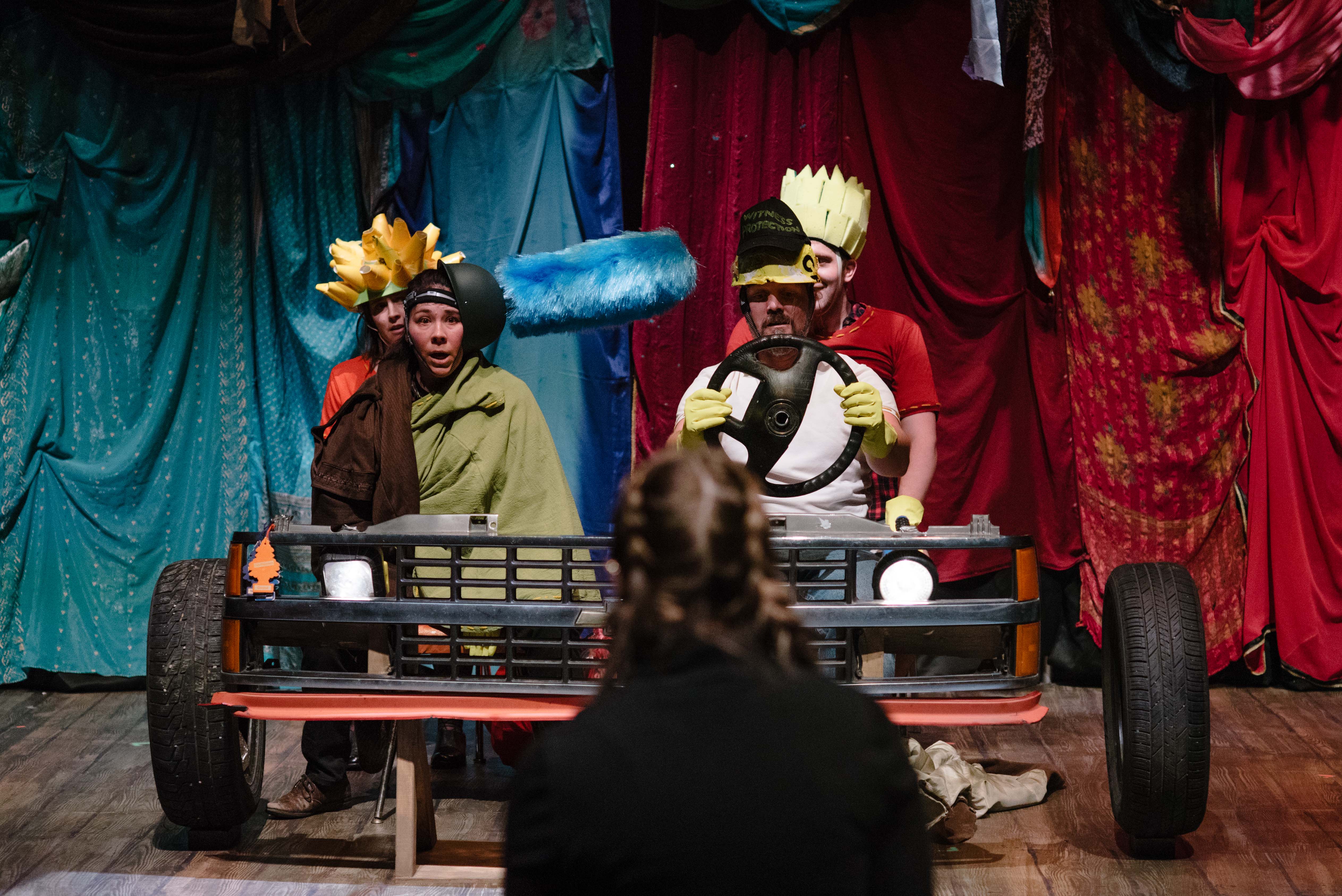
Brick Shithouse was as close as Found Festival gets to a “mainstage” theatre presentation. It was held in a perfect space for this story, a dingy warehouse with a few rows of audience seats along one long wall, and the rest of the space configured as a rough fighting gym with camera/recording setup. Ashleigh Hicks was the author, Sarah J Culkin directed, and the performers were a stellar lineup of Mohamed Ahmed, Geoffrey Simon Brown, Alexandra Dawkins, Sophie May Healey, Jasmine Hopfe, Moses Kouyaté, and Gabriel Richardson. I loved the high energy of the piece and the way in which it quickly set up the scenario of this group of friends streaming their bouts to make money. Sam Jeffery was credited with the fight direction and intimacy direction, both of which were essential to create the intense-feeling experience for audiences while keeping the performers safe. The performances easily convinced me of the premise that the characters of various genders and sizes could fight each other effectively. And like the characters in Liam Salmon’s Subscribe or Like (WWPT, 2023), it was easy to see how they didn’t/couldn’t anticipate some of the things that might go wrong. Alex Dawkins was particularly effective and heartbreaking as a character without much to lose. In the high-energy loud performance, there were several times where I couldn’t see/hear all of the conversations and I felt like I was missing important information. Was that intentional? Maybe, but I wanted to know more. I wanted to see it again, but it was such a hot ticket I was lucky to see it once.

The other event I was looking forward to this July was Thou Art Here Theatre’s site-specific performance Civil Blood: A Treaty Story at the old fort at Fort Edmonton Park. Playwright Josh Languedoc, Thou Art Here principal Neil Kuefler, and others have been developing this concept since 2016 – telling the story of the Treaty 6 peoples through the lens of a Romeo&Juliet narrative. At Found Festival 2021, I heard a staged reading of a previous version at the River Lot 11 Indigenous Art Park off Queen Elizabeth Park Drive, and I was fascinated. This year’s production is told in and around the old fort. The company struggled with smoke and heat during rehearsal and ended up cancelling several performances. I count myself very lucky to have been able to see it twice, so I got to follow both “tracks” of the intertwining roving performance. I am always impressed when multiple-tracked roving shows are done with smooth timing and seamless stage management (Everyone We Know Will Be There: A House Party in One Act, Queen Lear is Dead), so I’m applauding stage managers Andrea Murphy and Isabelle Martinez. The audience was divided into two groups, one to follow the European characters and particularly the governor’s daughter Lily (Christina Nguyen), while the other followed the indigenous characters, especially hunter Ekah (Emily Berard). In each track, there was one character who acknowledged the presence of the audience, narrated to us, and directed us – Elena Porter as the governor’s wife Agatha Sampson, and Maria Buffalo as Takaw, an ancestor and possibly the chief’s grandmother. Eventually I realized that both these intercessors were no longer alive in the story’s timeline, so the choice made a lot of sense and also allowed smooth navigation, with the main characters never needing to cue the audience to follow.

Other performers in the 11-person company included Rebecca Bissonnette, Ivy Degagné (who was great as the young settler embracing the local culture and language – one glimpse of hope and how things could be), Doug Mertz, Cody Porter, Colby Stockdale, and Dylan Thomas-Bouchier.

The details of Civil Blood don’t match exactly with the details of Romeo and Juliet – they did match more in the 2021 version. The general concept of two houses alike in dignity, escalating tensions leading to tragedy and worse outcomes, and the passionate young person torn between the expected/appropriate romantic match and a more complicated attachment (Gabriel Richardson), were still there. I saw the two tracks more than a week apart, and I was intensely curious about the parts of the story that hadn’t been sufficiently explained on first viewing. When I attended the second time, I picked up a program and read the directors’ notes (Neil Kuefler and Mark Vetsch are credited as co-Directors this time), in which they encourage viewers to meet up at the community gathering/market after the performance and compare notes with people who saw the other track, since you can’t get the whole story from hearing one side. And – of course – what a brilliant illustration of how key this understanding is to working towards reconciliation, particularly in our Treaty relationships.

And now it’s August, and Fringe is starting in a few days. I’m stage managing the new satirical musical Regression, at the Playhouse performance space on 80th Avenue. And I’ll be volunteering in the beer tents, hosting visiting artists, and watching lots of performances. Watch this blog for notes on what I’ve seen!
The unseen Mob

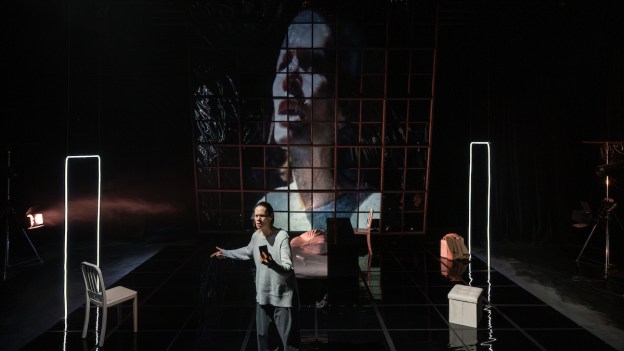
Kristin Johnson in Mob. Photo credit Marc J Chalifoux Photography and Video.

I liked seeing Mob, currently on stage at Workshop West Playwrights’ Theatre’s Gateway Theatre, without knowing much about what to expect. Afterwards, I wanted to talk about it, but I also wanted to give more people the chance to see it similarly unspoiled.

So, if you don’t want to know what it’s about or what happens, I can still give you several reasons to see it, and then you can stop reading. Starting with the names in the credits:

  • Heather Inglis, artistic producer of Workshop West as well as director of this play, has created a coherent season of challenging work, loosely categorized under the theme Borderlands.
  • Three good performers familiar to local audiences: Kristin Johnston, and Graham Mothersill, and Davina Stewart. Each of them portrays a fascinating complex character, not entirely likeable but sometimes funny and often relatable.
  • Designers include Darrin Hagen (eerie atmospheric soundscapes and original music), Beyata Hackborn (a set that starts out with an Instagram-perfect look and turns out to be both functional and symbolic), Alison Yanota (unusual lighting that escalates the tension), and Sarah Karpyshin (iconic costume design).
  • Program credits for Jason Hardwick (choreography) and Sam Jeffery (fight and intimacy direction) provide additional clues to the content in the show and the skill level with which it will be executed.

The action starts with projections, conveying a woman, Sophie, (Johnston) driving feverishly while voices overlap and reverberate in her head. As she arrives with her suitcase at a remote bed-and-breakfast, she is greeted by Martin (Mothersill), cringingly clumsy and twitchy as he over-explains that he’s at home this time of day because he’s lost his job. The visitor stands immobile on the threshold holding her suitcase, responding to his questions but not progressing the conversation. Is she exhausted? Is she hesitant to enter? Why is she there? She’s not giving anything away. Soon Martin’s aunt Louise (Stewart) bustles in with a limp, all aging-hippie style and colourful cane, to smooth over the conversational awkwardness and remind Martin how to behave with guests. The show is described as a thriller – at first I wasn’t sure whether the characters would be realistic or more gothic, whether there would be overt or psychological violence in the isolated-country-house trope or what. I’ve also seen Johnston play a lot of disturbed and disturbing characters on stage in the past few years, from Death Trap to Destination Wedding, Baroness Bianka’s Bloodsongs to We Had a Girl Before You. But the fears explored in Mob are completely realistic and timely. Which is much scarier.

Mothersill’s portrayal of Martin often made me want to laugh – but the menace conveyed by the soundscape and the unfolding story made me feel uncomfortable about laughing – not so much that I was pitying him, but that it might be dangerous to provoke him.

The performance is a bit over an hour and a half long, with no intermission. The script (written in French by Catherine-Anne Toupin and translated by Chris Campbell) has a compelling directness with no unnecessary dialogue.

Beforehand, I wondered why a three-hander would be called Mob. Isn’t a mob a larger angry group? Then I realized that the three people on stage were not the only ones involved – that the internet posters Sophie quotes, in overlapping overwhelming torrents of abuse, are in some ways present throughout, ubiquitous and inescapable.

Mob has a short performance run, ending next Sunday afternoon, November 12th. Get your tickets soon!

Mr Burns: a post electric play

Patrick Howarth as storyteller Gibson, Jake Tkaczyk as Sam listening. Photo provided by production. Set &  costume design Brianna Kolybaba, lighting design Tessa Stamp.

It’s hard to tell you about Mr Burns: A Post Electric Play because you haven’t seen it yet.  What I really want is to talk to someone else who’s seen it about all the cool things I noticed and figured out, and hear what they figured out that I missed.  And I want people to go see it – but to go see it without knowing any of the surprises ahead of time, because for me the surprises and the figuring-outs were part of the fun.  Anne Washburn wrote it, Andrew Ritchie directed it here as a co-production of Blarney Productions and You Are Here Theatre, and it’s playing at the Arts Barns Westbury Theatre until December 7th.

So, what can I say that will reinforce my memory, but not give everything away?

Everything means something.  Even the audience seating.  There are two intermissions, but I chose to stay immersed in the realities of the worlds we were visiting rather than make my way out to the lobby.

Communal storytelling and retelling matters.  The first act is set in the plausibly-near future, with a small group of survivors after a disaster entertaining themselves around a fire by collaborating on retellings of shared stories, especially the 1993 Simpsons episode Cape Feare.  There are lots of cultural allusions that I recognized, and some that I didn’t  but it didn’t matter.  Lots of the hints of the first act get mentioned later – which makes sense in the story and is also helpful for audience members.   It felt very natural, since I’ve been in lots of campfire conversations re-telling favourite movies and TV shows or trying to figure out the lyrics of popular songs without internet.  Many current plays and movies are successful partly because the audience already has some expectations of and history with the story.  So many seasonal adaptations of A Christmas Carol (and I have my ticket for the new David Van Belle Citadel version tonight).  The star-crossed lovers from warring factions of Romeo and Juliet, West Side Story, Shakespeare’s R & J, and whatever Shakespeare’s own story sources were.  The “Hallmark Christmas movie” trope.  Every Christmas pageant ever.  And the Simpsons itself is full of cultural callbacks and pastiche – I never think of 2001: A Space Odyssey without the image of Homer floating through a spaceship cabin chomping potato chips in Deep Space Homer.

Understated ritual is effective. Mr Burns is a post-disaster or post-apocalypse story, but it doesn’t wallow in the horror like Walking Dead or prolong the despair like Susan Beth Pfeffer’s Life As We Knew It series of young adult novels.  But there is one custom of the post-disaster world, after many deaths and the loss of mass communication, that portrays the essence of unlikely hope and longing of that time – and it too is seen in the later acts.

The Simpsons matter.   Some audience members I talked to afterwards – possibly even a few members of the company or production team – said things like “I’ve actually never seen an episode of the Simpsons” or “I’ve seen a few, but I was never a regular watcher”.  But the characters and routines of the series (1989-present) were familiar enough that everyone in the audience was laughing with recognition.   When the cartoon series first came out, I was a graduate student without cable at home.  I heard that children were prohibited from wearing Bart t-shirts to school because he modelled disrespect and intentional under-achievement – but when I was able to watch a few episodes, I thought it was wholesome and funny, just very satirical.  In the program Director’s Notes, Ritchie notes that the taboo around the show was part of what originally attracted him to it.  In the second act, set seven years after the first, the characters are rehearsing to perform escapist re-creations of pre-disaster culture that their audiences will remember and want to see – and the narrative confirms that The Simpsons is more popular/enduring material in that situation than Shakespeare.

burns2

Paula Humby, Nadien Chu, Madelaine Knight, Murray Farnell, Jake Tkaczyk. Photo provided by production. Set & costume design Brianna Kolybaba, lighting design Tessa Stamp.

Design and collaboration build the world.  Actors and directors bring it to life.  Watch for these names again.  Megan Koshka did some fabulous mask creation.  Ainsley Hillyard choreographed.  Brianna Kolybaba created brilliant sets and costumes that highlighted what found materials might have been available to the characters in those three settings, one of them reminding me subversively of the set for a particular Edmonton Opera production…  Lana Michelle Hughes provided sound design for moments of terror and humour.  Mhairi Berg’s musical direction and composition.  Sam Jeffery’s fight direction.  Tessa Stamp’s lighting design (and whoever created and executed the perfect glimpse at the very end explaining how they even had those lighting effects, just in case we got caught up in the story and forgot that there hadn’t been an electrical power grid for 80+ years by that point.)

And I haven’t even mentioned the actors yet! They are a strong ensemble of ten performers:  Nadien Chu, Murray Farnell, Kristi Hansen, Patrick Howarth, Madelaine Knight, Jenny McKillop, Paula Humby, Elena Porter, Rebecca Sadowski, Jake Tkaczyk.  I’ve seen them all on stage before – but when I was watching Mr Burns, I kept forgetting who they were, because I was so caught up in the layers of storytelling – this one’s an actor who is rehearsing as Homer, this one’s a director, now this is an actor of a later generation playing Bart as a hero in a tragic opera … Director Andrew Ritchie and Assistant Director Morgan Henderson made it work.  They all made me laugh, think, appreciate the need for art in terrible times, and leave feeling hopeful.  Which is probably their intent.

burns3

Patrick Howarth as Mr Burns / or maybe Sideshow Bob / or Archetypical Villain. Photo provided by production. Set & costume design Brianna Kolybaba, lighting design Tessa Stamp.

Advance tickets available through the Fringe, accessibility considerations including a relaxed performance on Tuesday and pay-what-you-will arrangements.  I’m definitely going back.

Have you seen it?  What did you notice that I missed?