Tag Archives: rory turner

The 39 Steps – a new Teatro classic!

Priya Narine as Annabella Schmidt and Geoffrey Simon Brown as Richard Hannay, in The 39 Steps.

Photo Marc Chalifoux, costumes Brian Bast, set Chantel Fortin, lighting Rory Turner

The first play in the new Teatro Live! season, Farren Timoteo’s first as artistic director, is the hilarious, fast-moving, and farfetched The 39 Steps.

The 39 Steps was first a 1915 adventure novel / melodramatic thriller by John Buchan, who later served as the 15th Governor-General of Canada. I read the novel as a teenager, along with Buchan’s other works Greenmantle and Prester John, because my father had kept his childhood copies. It was adapted into a spy-thriller movie by Alfred Hitchcock in 1935, and had a few later film adaptations as well. In 2005, Patrick Barlow wrote this stage-play based on the earlier versions, but dialing everything up to the point of parody for 21st-century audiences.

The curtains open on emo-self-absorbed Richard Hannay, slouching in an armchair in his half-unpacked London flat, explaining that all his friends have moved away or died and he is bored. In this production Hannay is played by Geoffrey Simon Brown, who brings an amusing mix of bravado and bewilderment to the role.

Fortunately for the audience, his state of ennui doesn’t last long! A trip to the (vaudeville) theatre brings him an encounter with a mysterious woman (Priya Narine), who demands sanctuary in his apartment but ends up being murdered after entrusting him with vague secrets and missions.

Many many minor characters in the story of Hannay’s flight across England and Scotland are portrayed by two ensemble members (billed as Clown 1 and Clown 2), Michael Watt and Katie Yoner. Watt and Yoner are both noted physical-comedy performers in their own work as well as BFA-educated actors, and they were perfect for these roles, in which the quick-changes are acknowledged and sometimes flawed. Edmonton audiences rarely applaud transitions, but there was one shift that had Yoner’s character grabbing the four chairs and a table that had been representing a vehicle, and striking all of them in one trip, ending with crashing and banging in the wings.

Michael Watt, Katie Yoner, and Geoffrey Simon Brown in The 39 Steps. Lighting Rory Turner, Costumes, Brian Bast, Set Chantel Fortin. Photos Marc Chalifoux Photography.

Narine also portrays some other characters encountered by Hannay – an indignant rail passenger who reports him to the police, a lonely young Scottish crofter – sending up various tropes of women in early-20th-century thrillers.

I recalled a previous production of 39 Steps that I saw in the intimate space of Walterdale Theatre in 2022, where I kept swivelling my head back and forth to follow the fast-paced action of a train across the Forth Rail Bridge, a manhunt by air, a flight across misty sheep-pasture, and a final showdown back in a London theatre. I wondered how Timoteo’s direction in the larger traditional proscenium-stage auditorium would evoke the urgency and immersive nature of the script. And I was pleasantly surprised! Some of the action had me gasping and laughing because even with my vague memories of the story I hadn’t predicted what was going to happen next and how.

Design choices for this production all supported the action which was central to the play. Many set pieces (Chantel Fortin) were used in different creative ways. Lighting (Rory Turner), fog, sound, and Brian Bast’s costuming added atmosphere and affirmed the familiar tropes.

I found some of the dialogue hard to hear or understand, particularly when they were speaking quickly in unfamiliar accents over background sounds of trains or gunshots. But it wasn’t hard to follow. The plot was both farfetched and satisfying, and it was a great night out.

The 39 Steps is playing at the Varscona Theatre until November 30th, with tickets available here and at the door.

Next on my theatregoing calendar are two shows next weekend:

Guys and Dolls, the Loesser/Swerling/Burrows 1950 musical, a Foote in the Door production at La Cité Francophone / Théâtre Servus Credit Union, running Nov 21-Nov 30. Tickets here!

PepperMUNT, the bi-munt-ly late cabaret, will be on Saturday November 22nd, this time in the Old Strathcona Farmers’ Market. Tickets here!

Carousel: a musical to think about

Foote in the Door Productions has taken another big step with their latest production, Rodgers and Hammerstein’s 1945 classic Carousel.  Their first mainstage show was She Loves Me, a light workplace romance with a spunky determined shopgirl heroine.  Their second mainstage show was How to Succeed in Business Without Really Trying last fall, a lighthearted 1960s look at corporate-workplace problems such as sexual harassment, nepotism, and the Peter principle, with the spunky determined officegirl’s happy ending being the suburban-homemaking wife to her upwardly-mobile sweetheart Ponty.

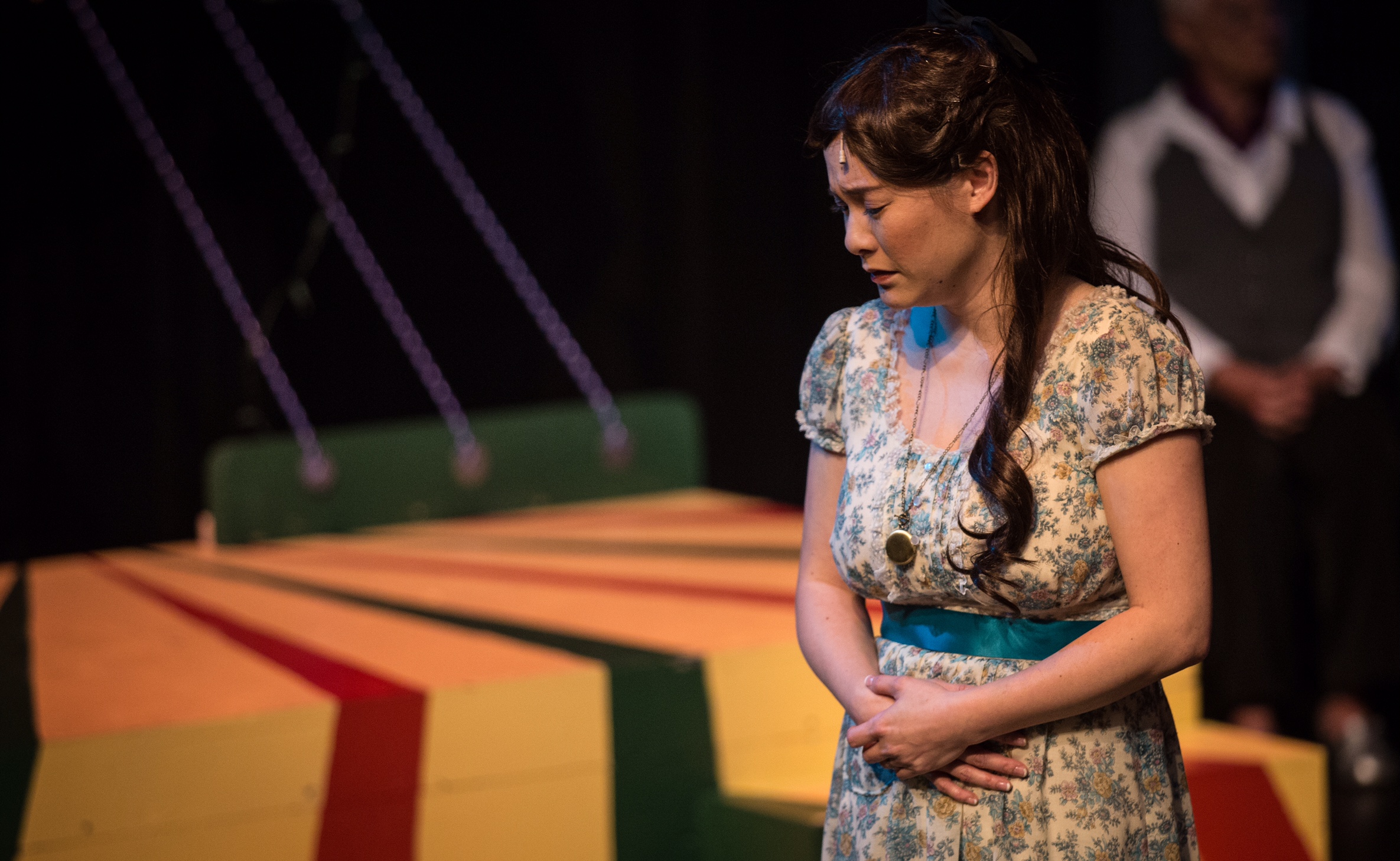
But Carousel covers tougher material, and includes some bits that are harder for modern audiences to deal with.  This post contains spoilers.  It’s mostly set in 1917, in a small town in Maine where the men mostly fish for a living and the women have jobs too, like working in a textile mill, or working at the inn owned by Nettie (Carolyn Ware).  Protagonist Julie Jordan (Ruth Wong-Miller) and her friend Carrie Pipperidge (Natasha Mason) are millworkers, constrained to live in the millgirls’ dorm and follow chaperonage and curfew rules to keep their jobs.

Julie1ftd

Ruth Wong-Miller, as Julie Jordan, in Foote in the Door’s production of Carousel. (Nanc Price Photography)

Contrasting with this orderly and rigid culture is the carnival life, with manager Mrs Mullin (Rebecca Bissonette), carousel barker Billy Bigelow (Russ Farmer) and assorted non-speaking midway performers.  Billy and Julie meet each other, and then linger chatting on a bench despite both of them losing their jobs for the dalliance.  The speed and inevitability of these consequences seemed unconvincing to me as a modern audience member accustomed to more workplace rights.   Julie is fired because she defies the mill owner’s offer to drive her back to the dorm before curfew and Billy is fired by the carnival manager who is jealous of whatever unspecified relationship she has with him.  Both of these firings seemed to happen before either character knew the other one well enough to judge beyond some degree of attraction – and both of them have attitudes of “nobody tells me what to do!” that cause them trouble.   And that sets in motion one of those tragic unstoppable trajectories – they’re stuck together because of losing their livelihoods and accommodations, he is unsuccessful getting work, she gets pregnant, he gets drawn into a criminal plan in order to provide for his family, etc.  Farmer’s Billy is not a classic hero at all – he’s shortsighted (gambling away the criminal takings before they even do the crime), cocky with women, and stubborn (unwilling to take work on a fishing boat), still defiant after death as a soul in the afterlife.  He’s ill-equipped for adult life, his schemes don’t work, and he kills himself rather than go to jail.  His own outcome follows directly from his bad qualities and the culture he’s in, and his afterlife redemption only comes after his second attempt to give his daughter Louise (Megan Beaupre) a better chance than he had.

The part that was most uncomfortable for me was that Billy hits Julie, and she excuses or accepts it.  The hitting took place off stage.  We learn when Julie confides in her friend, and then the other women overhear and make sure everyone knows.  Everyone who responds to Julie lets her know it’s not appropriate and she didn’t deserve it, and Carrie challenges her when she makes excuses for Billy.  So after Billy dies and we see Julie carrying on, working with her cousin Nettie to run the former inn as a boarding house and raising her daughter, I’m thinking this is the best possible solution in fiction, anyway, because I don’t want to see her getting abused on an ongoing basis and I don’t believe he could reform.  But then when the heavenly powers (Pauline Farmer and Shauna Rebus) give Billy a day on earth to take care of “unfinished business” his first attempt to reach his daughter and inspire her ends in him losing his temper and slapping her hand.  The audience, like Louise, is horrified.  Perhaps she has not been raised with violence and the cycle has been broken.  However, when Louise tells her mother about the slap that “felt like a kiss”, Julie, reminiscing, says “It is possible, dear, for someone to hit you, hit you hard and have it not hurt at all.”  Does Louise take this as her mother’s encouragement to accept relationship violence?  Is Julie at risk of accepting abuse in a future relationship?  Is the pattern doomed to continue?  I desperately want to believe all the answers are no. but after the performance ended I had to go walking in the rain by myself instead of standing around in opening-night crowds in the lobby, so I could think.  I thought about how hard it is to change abusive patterns of behaviour, and I thought about what a good job director Mary-Ellen Perley and her cast and team had done, to make me that disturbed.

More subtle commentaries on the prevailing attitudes and the patriarchal culture come from Julie’s friend Carrie.  It’s clear that she’s marrying for love as well as marrying up, when she introduces her fiance Mr. Enoch Snow (Rory Turner).  He’s full of plans for expanding his fleet of fishing boats and expanding his household to include a wife and many children.  She’s thrilled with her handsome beau, but he’s quick to judge her as unvirtuous when he surprises her with scoundrel Jigger Craigin (Morgan Smith), without hearing her side or considering her character of naive kind enthusiasm.  And in the 1945 scenes at the end, she tells Julie “If I had more sense I wouldn’t have had nine children.”  Natasha Mason’s Carrie is a gentle reminder that the “proper” path for women in that town was also lacking in autonomy and flawed by modern ideals.

Carrie ftd

Natasha Mason, as Carrie, in Foote in the Door’s production of Carousel (Nanc Price Photography)

Foote in the Door is partnering with WIN House, the local domestic abuse shelter.  Brochures with information on the issue and the organization are available at the show, and donations are solicited from the audience afterwards.

My favourite songs in this production were Nettie singing “You’ll Never Walk Alone”, and Billy’s “The Highest Judge of All” which had a particularly interesting orchestral accompaniment.

Foote in the Door has also taken a practical step with this production, across the street from the auditorium of Faculté St-Jean to the bigger stage of L’UniThéâtre at La Cité.  This facility gives them better lighting options, and the space for a fifteen piece orchestra as well as a large active ensemble.  Carousel runs this weekend and next week, closing Saturday June 24th.  Advance tickets are available through Tix on the Square, same-day and weekend tickets at the door until they sell out.


How to Succeed in Show Business …

Once again, I’ve been too busy watching theatre and helping to make theatre to write about theatre.  But I want to tell you about this one (which I’m working on) in time for you to go see it.

How to Succeed in Business Without Really Trying is a musical by Frank Loesser first produced in 1961, and based on the satirical book of business advice written by Shepherd Mead a decade earlier.  Whether or not you’ve seen the musical or movie or read the book, you’ve probably seen lots of copycat titles, because it’s a memorable turn of phrase.

How to Succeed in Business Without Really Trying is the latest production from local independent theatre group Foote in the Door Productions.  The company name is a tribute to Foote Theatre School at the Citadel, where company principals Ruth Wong-Miller and Russ Farmer met in a musical-theatre class.  The company began producing musicals at Fringe 2014.  How to Succeed is their second mainstage production, after She Loves Me, in November 2015.

How to Succeed in Business Without Really Trying is set in the head office of a big company in the 1960s.  The setting reminds me of Mad Men and of Bewitched, and also of some places I’ve worked in the past.  The protagonist, J Pierrepont Finch (Frank Keller, previously seen in Who’s Afraid of Virginia Woolf) has an unexpectedly-endearing mix of enthusiasm, kindness, and self-involved ambition.  From his initial hiring as a junior in the mailroom, he plays everyone he encounters to bounce upwards and upwards and … to bounce.

I’ve been pleasantly surprised by how this production (directed by Adam Kuss) illustrates and comments on the status of women in early-1960s office life.  “I’m no Cinderella!  I have eighty-five dollars in the bank, AND a savings bond!” declares determined and daydreamy Rosemary Pilkington (Ruth Wong-Miller) to her office-pal Smitty (Caitlin Tazzer) who wants a fairy-tale ending for Rosemary and J Pierrepont.   In one scene, men waiting for an elevator discuss projects and promotions, while the women discuss needing to reject sexual advances in the office – and that was written around 1961 (by three men, Abe Burrows, Jack Weinstock, and Willie Gilbert).  Executive secretary Miss Jones (Carolyn Waye, who has a joy-filled solo late in the show) wields some real power, and the naive-sexy character Hedy Larue (Kathleen Cera, also the show’s costume designer) also exhibits self-determination and solidarity with other women.

Company president J.B. Biggley is played by Russ Farmer (recently seen in Chess and in She Loves Me).  Farmer, a management consultant, gives a disturbingly-convincing portrayal of an executive who is not as competent as he thinks he is, stuck with a lazy sassy nephew Bud (Rory Turner).

The organization chart of this company is filled in by a strong ensemble (Trish van Doornum, Trevor J, Melanie Lafleur, Gerald Mason, Natasha Mason, Mike McDevitt, Levy Poppins, Emily Smith, Morgan Smith), creating recognizable and entertaining characters and providing the audience with delightful singing and dancing and snappy dialogue.  Choreography was done by Adam Kuss, and live music is provided by an ensemble of 8 led by music director Daniel Belland on piano.

Ruth Wong-Miller took time in a busy tech week to answer a few questions about the show and company, starting with how they find the musicals they produce:  “I am a huge musical theatre nerd. I’ve been obsessed with shows since I was a young girl, when I listened to Les Miz and Phantom on cassette (yes I’m that old). My sister and I used to watch all of the old classic movie musicals and see every show that came to town – it’s hard to stump me on musical theatre trivia!”  On people who have led and supported Foote in the Door so far:”We have had so many wonderful supporters including Adam Kuss who has been involved in our fringe show each year as a director (2014) and choreographer (2015 and 2016). I’d also like to name Barbara Mah as well; she directed our first mainstage She Loves Me last fall and she’s been a great resource for our company.  On this show we have an amazing group, from the cast, production team, and orchestra. The talent level is super impressive, the commitment is incredible and it feels like such a warm family.”

And what’s next for Foote in the Door?  “Carousel (May 2017) is a complete 180 from How to Succeed. It is a dramatic musical with some serious subject matter backed up with some seriously lush and classic music by the legends: Rodgers and Hammerstein! Performers will experience the opportunity to work with an amazing production team including Mary-Ellen Perley as Director, Stuart Sladden as Music Director and Sterling winner Ainsley Hillyard doing choreography. Audiences will enjoy it just as much as How to Succeed as they will travel with the characters on their journeys of romance and self discovery-and there are beautiful songs such as “You’ll Never Walk Alone!”

How to Succeed in Business Without Really Trying opens tonight in the main auditorium at Faculté St-Jean, 8406 91 Street (rue Marie-Anne Gaboury).   Tickets for future shows are available through tix on the square, but not for same-day/weekend shows.  Cash tickets will be available at the door  for tonight’s show, $25 adult, $21 student/senior.  Show time is 7:30.  On Sunday Nov 13th there’s a matinee at 2 pm, and the run continues Wednesday Nov 16th through Saturday Nov 19th.  There will be snacks and drinks for sale, including the obligatory red licorice.  In tribute to one of the songs in the show, there may also be Coffee Crisp.  If you’re coming tonight (Remembrance Day) the campus might look closed, but we will definitely be there!


succeed-ensemble

Co-workers advising Rosemary on her romance: Natasha Mason, Emily Smith, Ruth Wong-Miller as Rosemary, Trish Van Doornum, Caitlin Tazzer, Melanie Lafleur (Nanc Price Photography)