Tag Archives: mhairi berg

A lovely musical about memories: Morningside Road

[Posted without imagery due to web-host issue]

Last night I was able to attend the preview performance of Morningside Road, the musical created by Mhairi Berg and Simon Abbott. It’s the first production of Shadow Theatre’s new season, and it was directed by incoming artistic director Lana Hughes.

I was enchanted. Right from entering the auditorium and seeing the set – I thought to myself, I bet that’s a Daniel van Heyst design, and I was right. The set includes a realistic homey kitchen nook with tea things and a collection of family photos, but also a more abstract area with bits of low stone wall, which becomes various outdoor city locations.

I stayed caught up in the story with three likeable characters, Elaine (contemporary Elaine was played by Maureen Rooney and Elaine of memory was played by Mhairi Berg), the Girl (Elaine’s grand-daughter, Mhairi Berg), and the Lad (Cameron Kneteman). It wasn’t the first “how my grandparents met” play that I’ve seen – Megan and Beth Dart’s Ursa Major was another memorable one – but the story was engaging and the structure worked very well, shifting between now and back-then, between a kitchen in Canada and a city street in Edinburgh. The pacing was appropriate – I never felt like a scene or a song was too long, and I appreciated the various musical callbacks and familiar riffs adding to the continuity. Partway through, I realized that part of what I was admiring was deft lighting design (Liekke den Bakker), with smooth shifts between times/locations/moods and no heavy-handed dimming of areas I was looking at. Costuming (Kat Evans) was that kind of deceptively-simple that perfectly suited the characters and setting but didn’t distract. Of course practical-grandmother Elaine would be wearing slacks and long cardigans and the same comfortable shoes that my own mother wore for years, rather than more old-fashioned housedresses and aprons, and the other performers wore vaguely-timeless outfits that weren’t out of place in 1940s Edinburgh or in the more modern scenes.

The live musical ensemble of Simon Abbott, Curtis den Otter, and Viktoria Grynenko is located upstage centre behind a screen, which worked very well for sound balance and also allowed for the actors to include them in some scenes more actively. One of the songs, That Blessèd Wedding Day, was a lively catchy community-storytelling piece with dancing, in a folk-song idiom like Great Big Sea.

Rooney’s Elaine has clearly been telling stories about her life to her granddaughter for many years. The two of them are allies, more strongly connected than the offstage daughter/mother in between. I was reminded of my own late (great-)Aunt Elaine, who came to Canada from Scotland as a war bride and remained a daily crossword-puzzle fiend well into her 90s. The motif of one person’s story becoming common property, so that the younger generation might object or correct when the grandparent tries telling the story differently (“that’s not right!”) was also familiar and fascinating. Suggestions of Elaine beginning to lose her memory / memories and executive functioning were also done with a light touch.

The music was lovely and it contributed to the storytelling and the character portrayals. I had not heard Rooney sing before, but I was very impressed.

I wasn’t able to see the version of this musical that Berg and Abbott presented at last year’s Fringe festival, so I can’t tell you how the Shadow Theatre production differs. But I was very pleased with this one – it is nuanced, affectionate, and wistful.

Running time is a bit under 2 hours – and just the length it needs to be. Tickets are available here, for the run continuing until November 6th.
Mr Burns: a post electric play

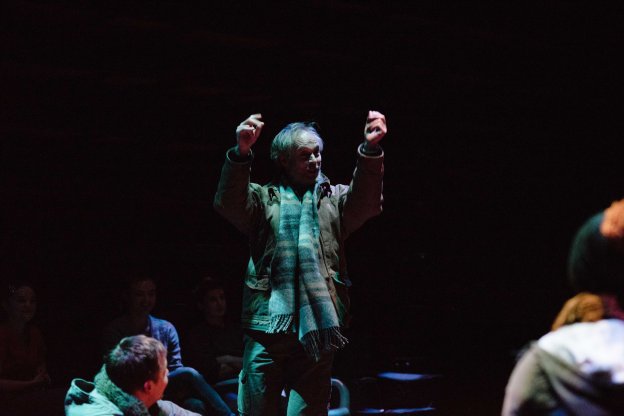
Patrick Howarth as storyteller Gibson, Jake Tkaczyk as Sam listening. Photo provided by production. Set &  costume design Brianna Kolybaba, lighting design Tessa Stamp.

It’s hard to tell you about Mr Burns: A Post Electric Play because you haven’t seen it yet.  What I really want is to talk to someone else who’s seen it about all the cool things I noticed and figured out, and hear what they figured out that I missed.  And I want people to go see it – but to go see it without knowing any of the surprises ahead of time, because for me the surprises and the figuring-outs were part of the fun.  Anne Washburn wrote it, Andrew Ritchie directed it here as a co-production of Blarney Productions and You Are Here Theatre, and it’s playing at the Arts Barns Westbury Theatre until December 7th.

So, what can I say that will reinforce my memory, but not give everything away?

Everything means something.  Even the audience seating.  There are two intermissions, but I chose to stay immersed in the realities of the worlds we were visiting rather than make my way out to the lobby.

Communal storytelling and retelling matters.  The first act is set in the plausibly-near future, with a small group of survivors after a disaster entertaining themselves around a fire by collaborating on retellings of shared stories, especially the 1993 Simpsons episode Cape Feare.  There are lots of cultural allusions that I recognized, and some that I didn’t  but it didn’t matter.  Lots of the hints of the first act get mentioned later – which makes sense in the story and is also helpful for audience members.   It felt very natural, since I’ve been in lots of campfire conversations re-telling favourite movies and TV shows or trying to figure out the lyrics of popular songs without internet.  Many current plays and movies are successful partly because the audience already has some expectations of and history with the story.  So many seasonal adaptations of A Christmas Carol (and I have my ticket for the new David Van Belle Citadel version tonight).  The star-crossed lovers from warring factions of Romeo and Juliet, West Side Story, Shakespeare’s R & J, and whatever Shakespeare’s own story sources were.  The “Hallmark Christmas movie” trope.  Every Christmas pageant ever.  And the Simpsons itself is full of cultural callbacks and pastiche – I never think of 2001: A Space Odyssey without the image of Homer floating through a spaceship cabin chomping potato chips in Deep Space Homer.

Understated ritual is effective. Mr Burns is a post-disaster or post-apocalypse story, but it doesn’t wallow in the horror like Walking Dead or prolong the despair like Susan Beth Pfeffer’s Life As We Knew It series of young adult novels.  But there is one custom of the post-disaster world, after many deaths and the loss of mass communication, that portrays the essence of unlikely hope and longing of that time – and it too is seen in the later acts.

The Simpsons matter.   Some audience members I talked to afterwards – possibly even a few members of the company or production team – said things like “I’ve actually never seen an episode of the Simpsons” or “I’ve seen a few, but I was never a regular watcher”.  But the characters and routines of the series (1989-present) were familiar enough that everyone in the audience was laughing with recognition.   When the cartoon series first came out, I was a graduate student without cable at home.  I heard that children were prohibited from wearing Bart t-shirts to school because he modelled disrespect and intentional under-achievement – but when I was able to watch a few episodes, I thought it was wholesome and funny, just very satirical.  In the program Director’s Notes, Ritchie notes that the taboo around the show was part of what originally attracted him to it.  In the second act, set seven years after the first, the characters are rehearsing to perform escapist re-creations of pre-disaster culture that their audiences will remember and want to see – and the narrative confirms that The Simpsons is more popular/enduring material in that situation than Shakespeare.

burns2

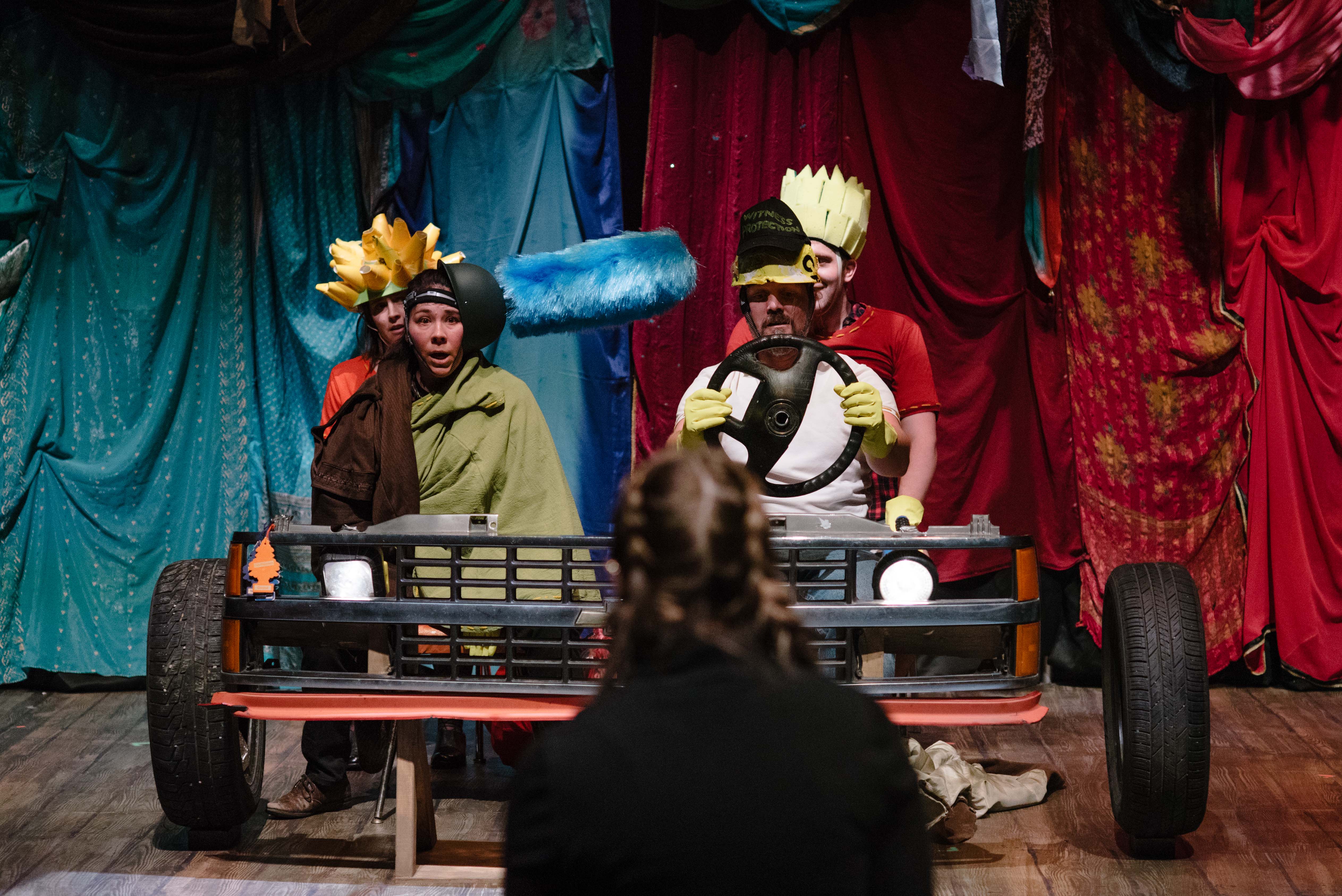
Paula Humby, Nadien Chu, Madelaine Knight, Murray Farnell, Jake Tkaczyk. Photo provided by production. Set & costume design Brianna Kolybaba, lighting design Tessa Stamp.

Design and collaboration build the world.  Actors and directors bring it to life.  Watch for these names again.  Megan Koshka did some fabulous mask creation.  Ainsley Hillyard choreographed.  Brianna Kolybaba created brilliant sets and costumes that highlighted what found materials might have been available to the characters in those three settings, one of them reminding me subversively of the set for a particular Edmonton Opera production…  Lana Michelle Hughes provided sound design for moments of terror and humour.  Mhairi Berg’s musical direction and composition.  Sam Jeffery’s fight direction.  Tessa Stamp’s lighting design (and whoever created and executed the perfect glimpse at the very end explaining how they even had those lighting effects, just in case we got caught up in the story and forgot that there hadn’t been an electrical power grid for 80+ years by that point.)

And I haven’t even mentioned the actors yet! They are a strong ensemble of ten performers:  Nadien Chu, Murray Farnell, Kristi Hansen, Patrick Howarth, Madelaine Knight, Jenny McKillop, Paula Humby, Elena Porter, Rebecca Sadowski, Jake Tkaczyk.  I’ve seen them all on stage before – but when I was watching Mr Burns, I kept forgetting who they were, because I was so caught up in the layers of storytelling – this one’s an actor who is rehearsing as Homer, this one’s a director, now this is an actor of a later generation playing Bart as a hero in a tragic opera … Director Andrew Ritchie and Assistant Director Morgan Henderson made it work.  They all made me laugh, think, appreciate the need for art in terrible times, and leave feeling hopeful.  Which is probably their intent.

burns3

Patrick Howarth as Mr Burns / or maybe Sideshow Bob / or Archetypical Villain. Photo provided by production. Set & costume design Brianna Kolybaba, lighting design Tessa Stamp.

Advance tickets available through the Fringe, accessibility considerations including a relaxed performance on Tuesday and pay-what-you-will arrangements.  I’m definitely going back.

Have you seen it?  What did you notice that I missed?