Tag Archives: larissa poho

Northern Light’s The Pink Unicorn: hopeful and loving

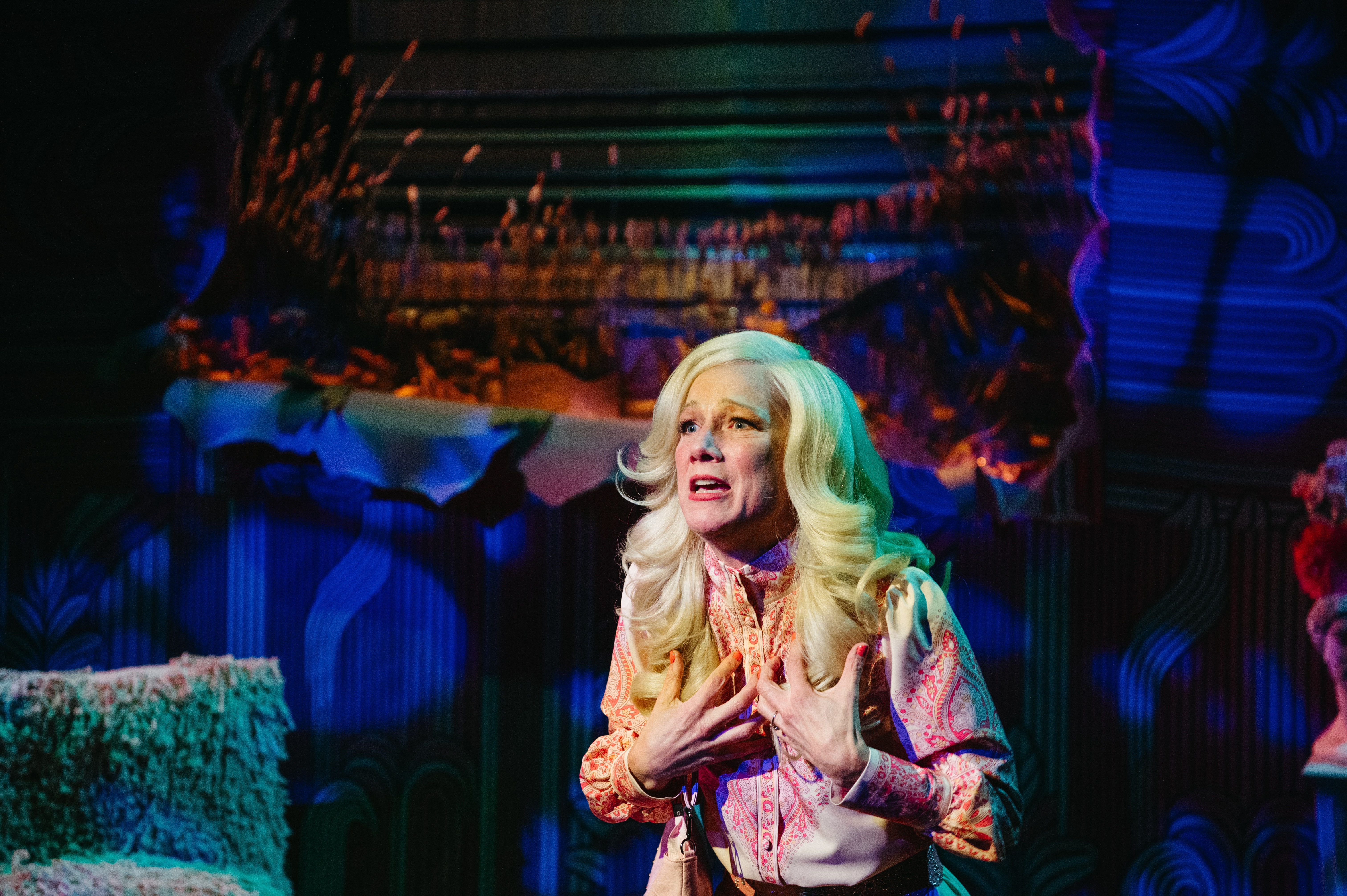
Patricia Zentilli as Trisha Lee in The Pink Unicorn. Images Brianne Jang BB Photographic. Set and costume Trevor Schmidt, lighting Larissa Poho.

The first production in Northern Light Theatre’s 50th-anniversary season is The Pink Unicorn, by Elise Forier Edie, directed and designed by Trevor Schmidt. I meant to tell you about it last week, but for some reason my blog host wasn’t letting me post pictures. So I waited, since I love the promo photos of Trisha telling her story.

And it’s so good! Patricia Zentilli plays small-town Texas mom Trisha Lee. Trisha’s been raising her only child Jolene alone since her husband Earl died when Jolene was six. Various details show that she’s always been proud of her daughter and supported her in being her unique creative self. So when Jolene tells her mom that she’s going to start high school as an agender and pansexual person, named Jo, Trisha responds as well as she can manage – helping to shop for a leather jacket, and looking up the unfamiliar terms on the internet at work. She worries a bit about whether the other kids will mistreat Jo, but reassures herself and the audience that Jo looks “real cute” in her buzzed hair and black boots. By this point I realize that it’s not just me – that the whole audience is clearly on Trisha’s side here. We might feel superior from our 2025 perspective, already knowing the vocabulary – but Trisha Lee is so easy to relate to, a loving parent trying to support and protect her kid, who’s living a life Trisha doesn’t understand.

You might remember that Northern Light produced this solo play in 2015, with Louise Lambert performing, and with Trevor Schmidt directing and designing. I think the current production brings us a more nuanced portrayal of Trisha. I was struck by her bravery, in the way she did uncomfortable things because she needed to – from her history of getting a job and carrying on as a single parent after her husband died, to her steps into activism on Jo’s behalf.

Trisha also tells the audience parts of the story that don’t reflect well on her, acknowledging that some of the thoughts are things you aren’t supposed to say. But the comments she makes without apologizing help to remind the audience that she’s still part of that particular culture, where “Latino, Hispanic, and Chicano” are all still used, and in the inner monologue we’re privy to, she always refers to Jo as “she”, not as Jo’s requested pronoun of “they”. That particular point reminded me that maybe I’m making judgements based on superficialities too. Trisha is doing so much to support her daughter and the rest of the unofficial GSA, why do I even notice the pronouns detail?

Patricia Zentilli as Trisha Lee in The Pink Unicorn. Images Brianne Jang BB Photographic. Set and costume Trevor Schmidt, lighting Larissa Poho.

The set design (Schmidt) creates the sense of a feminine living-room – even a jug of pink lemonade on the coffee table – in front of a fascinating background with dainty pink wallpaper torn open to reveal a sculptured rural landscape. Lighting (Larissa Poho) and sound (Darrin Hagen) enhance the shifts in storytelling tone and location, through a church service, a downmarket bar, and a protest in the rain. Trisha’s outfit includes boots and a silver-medallions belt over a pink patterned dress and large hair, but it feels contextual rather than caricaturistic (I’m doing a rewatch of the small-town-Texas TV show Friday Night Lights, and she’d fit in there if she wanted to).

Also – parts of it are hilarious! Zentilli is great at delivering funny lines that the character doesn’t see as funny, or doesn’t stop to enjoy. This is no surprise to anyone who’s seen her in various big-stage musicals at the Citadel or the Mayfield,

The Pink Unicorn is both provocative and hopeful. In the author interview in the show program, Forier Edie says that if she were writing it today, she might write a “scarier” version. But I loved the reminder that people’s minds can be changed, one at a time, by really listening to the people they care about. And I appreciated the call-to-action at the end, where Trisha points out to us that doing the hard thing isn’t just for people who are already good at it. I know there are lots of Jos around here, and lots of Elijah Breakenridges. And I know that not all of them have a Trisha in their corner. But Trisha’s story shows that you don’t have to be an experienced advocate to start doing the right thing for someone you care about – just do it.

The Pink Unicorn is playing at the ATB Arts Barns Studio Theatre until October 11th. Tickets are here.

Radiant Vermin, hilarious and uncomfortable

Rain Matkin and Eli Yaschuk as Jill and Ollie, and Holly Turner as Miss Dee, in Radiant Vermin. Photo by Brianne Jang, BB Collective Photography.

Northern Light Theatre’s theme for their 2024-2025 season was Making a Monster. The first two plays were Trevor Schmidt’s Monstress (a gothic horror in which a Frankenstein-like scientist attempts to reanimate a dead girl but gradually appears to be more monstrous herself) and Penelope Skinner’s Angry Alan, a disturbingly-realistic portrayal of a lonely man drawn into the “men’s rights” misogynistic culture with horrifying consequences.

I was apprehensive but intrigued, to find out how the third play in the season, Philip Ridley’s Radiant Vermin, would fit into this theme. I had some guesses, but they were all wrong. And I loved being surprised. What surprised me most was that it was funny. Very funny.

An exceedingly wholesome-looking young couple, Jill and Ollie (Rain Matkin and Eli Yaschuk), address the audience with their baby, to explain about how they got their dream home and what happened there. When Jill was pregnant, they were living in a dingy flat in a crime-ridden neighbourhood, dreaming of better things for themselves and their little one. Until they get a mysterious letter and an even more mysterious visitor, Miss Dee (Holly Turner), who tells them they’ve been selected by a government department to get a free house. It’s a fixer-upper, but by renovating it they’ll start turning things around for the whole neighbourhood, and everyone will benefit. They see the house and ask about details, and a mythologically-long contract tumbles out of Miss Dee’s handbag. Everything about this screams BAD IDEA to me, from the twinkle in Miss Dee’s eye to the long golden scroll of clauses on the contract, but as soon as they sign, movers are dispatched to their old home and they move in, even before the electricity or hot water are working.

Ollie starts out confident that he can DIY the necessary renovations, but heavily-pregnant Jill is impatient. They’re both unsettled by living in an un-gentrified area. If they can see campfires of homeless people from their bare windows, can the homeless people see their vulnerable candles? Jill explains to us that she has experience of helping her mother provide charity to homeless people – that she and Ollie are good people. But they are still fearful of being targets in their good fortune. Her othering language is a little disturbing, but very familiar. But when an accident happens to a vagrant on their property, they benefit in an unexpected way. And they begin to justify it – their gain helps the neighbourhood, and nobody who mattered was hurt. By this time the characters are fully drawn – Jill’s earnestness and obliviousness, Ollie’s awkwardness and willingness to please his wife – and I felt almost complicit as they wonder about what else they could benefit from. The script builds this complicity in some direct address to the audience on benign topics, such as inviting input on whether to renovate the bathroom or the garage first.

Rain Matkin and Eli Yaschuk as Jill and Ollie, reading the letter offering them a house. Photo by Brianne Jang, BB Collective Photography.

Jill and Ollie’s house gradually gets renovated, according to the wish-list that Jill collects from magazines and catalogues. Upwardly-mobile neighbours gradually move in to the cul-de-sac, and we hear that ground’s been broken for the Never-Enough shopping mall nearby. Once all the houses are occupied, Jill and Ollie throw a garden party to mark their little son’s first birthday, with all the neighbours in attendance – and their facade of contentment and competence begins to fray, in a hilarious recounting.

I was thinking, this can’t end well. But I didn’t predict how!

The empty set (Schmidt) has a nearly-flat backdrop of a white-on-white house outline, with some harshly-shadowing sidelights. Its cleverness isn’t apparent until the show lighting (Larissa Poho) and projections (Matt Schuurman) begin to enhance it. I was fascinated about how the simple “porch” framing was used, along with shifts in light and soundscape (Chris Scott), to represent stepping from an upstairs bedroom into a staircase leading to potential danger.

The script of Radiant Vermin does have some important messages/themes, about envy and about buying in to materialistic wanting-more and about dehumanizing the have-nots, but the messages land with bouffon-esque discomfort at our own complicity. Schmidt’s production is perfectly cast. Holly Turner, most memorable as the eponymous Mary in The Testament of Mary, is hypnotically fascinating here, as the character Miss Dee needs to be, and Matkin and Yaschuk are well-matched, allowing some outrageous events to be natural character choices.

This was one of Northern Light Theatre’s most successful thematic season groupings in my memory, partly because the plays were so different. Each illuminated some facet of the question of how ordinary humans can do evil things. Each left me uncomfortable and wanting to discuss my experience with others. And each made me grateful for the community of theatregoers with whom I can share, both the roomful of audience members laughing and sighing and gasping in the moment, and the ongoing conversations like this.

Before today’s matinee, Trevor Schmidt is hosting a Director’s Circle at 1 pm. At these events, he typically discusses the motivation for choosing the play and some of the design challenges, without giving away anything about the ending. And on Thursday there’s a moderated talkback after the show – more opportunities to join in the conversation.

Trevor Schmidt and Holly Turner in a candid moment at the opening-night reception for Radiant Vermin.

Radiant Vermin continues at the Arts Barns Studio until May 3, with tickets here. Be disturbed and be delighted!