

Image Marc J Chalifoux Photography.
Stewart Lemoine, the Resident Playwright of Teatro Live!, is one of the most prolific Canadian playwrights. But all of his works I’ve seen performed have surprised me, because of the wide range of mood and subject matter. Sometimes they have delightfully specific settings (contemporary St. Albert, Grand Rapids Michigan, 1950s New York City high society). Sometimes the plot goes past rom-com coincidence into magical realism (For the Love of Cynthia). Sometimes the comedy is poignant, and comes from flawed characters doing their best (the late Julien Arnold in Happy Toes).
But last night it occurred to me that one consistent description of Stewart Lemoine’s oeuvre is “whimsical”.
Last night Teatro Live! opened the world premiere of the newest Stewart Lemoine play, I Meant What I Said. (Lemoine also directed.) It started with a young woman (Bella King as Dinah) striding to the front of the stage and addressing the audience – or maybe letting us listen to her interior monologue? She demonstrates how her thoughts jump around without follow-through, and this makes it unclear what’s real and what’s just a thought. Dinah’s 30th birthday is approaching, so she’s thinking about changes she might make and projects she might take on, for this momentous change.
There’s her old friend Helen (Jayce McKenzie) – well, not really a friend, more of an acquaintance she runs into every now and then – someone she played ringette with as a teenager – so an old acquaintance? This of course reminds Dinah of Auld Lang Syne, so she adapts a few lines of the song to fit the story she’s telling, and then carries on. I was fascinated by Helen, whom Dinah describes as having “been 35 since we were 23”. McKenzie’s portrayal of a high-status formal adult, complemented by severe-cut hair, fur-trimmed cape, and high boots (costume designer Leona Brausen), contrasted strongly with the uncertain and casual Dinah.
There’s a young man walking by (Sam Free) – he looks familiar – is he an actor? or have they been dating, and he’s in a different line of work? Lighting and sound shifts add to the shimmery uncertainty. I didn’t know how much of this was in Dinah’s mind, but I found her narrative more and more entertaining.
There’s a cafe. And there’s a server (Eli Yaschuk as Juris). Dinah’s conversation with Juris is a little more real-feeling than the previous vignettes. He’s from Riga, Latvia. He struggles a bit with figurative expressions in English, and Dinah agrees to help him. But he draws a clear boundary when she asks why he left Latvia. I was intrigued at the way they made this both a Stewart-Lemoine-mystery to note for the plot, and a realistic cringe-inducing portrayal of well meaning thoughtless locals inadvertently evoking trauma.
The narrative generally becomes more coherent. Shifts in location are handled smoothly, bringing on some simple pieces of furniture and creating backdrops with projections on various set pieces (Chantel Fortin, set design). In one scene, several characters attend an orchestra concert. They’re portrayed sitting in chairs in front of the main theatre curtain, looking towards the audience, and I was reminded of the opera-box scenes in Evelyn Strange.
Neda Vanderham, last seen at Teatro in/as The Noon Witch, plays a variety of small amusing parts, but my favourite was her bit at the end of the orchestra concert, when she appears as an usher, collecting discarded programs and encouraging patrons to clear the house, while attempting not to show impatience. As an occasional theatre usher myself, I felt so seen!
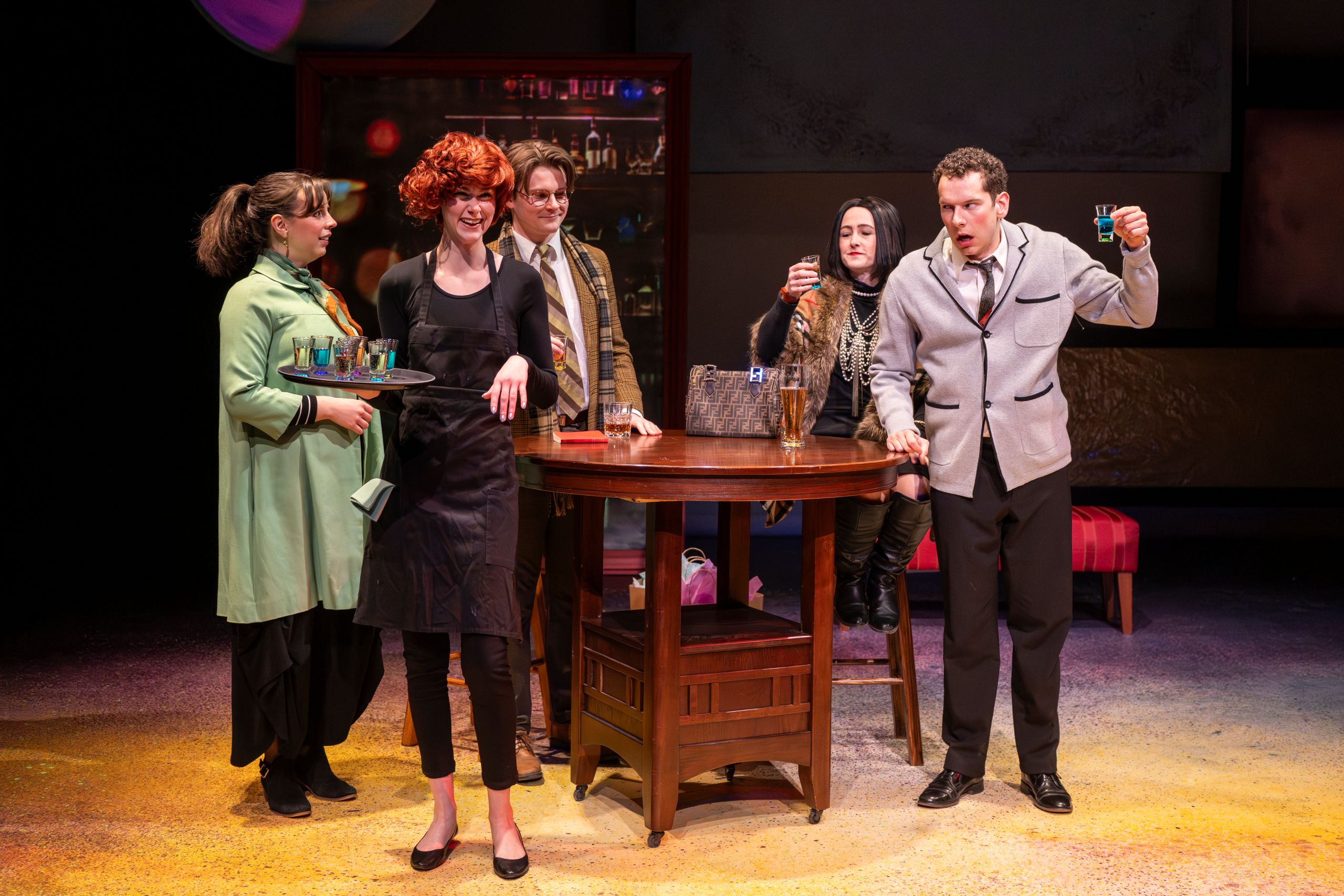
Image Marc J Chalifoux Photography.
Like many of Stewart Lemoine’s plays, this one has a gentle satisfying ending in which not all ends are tied up, but many of the hints dropped early end up fitting together. It’s a small affectionate tale, unusual in the use of interior monologue and imaginings and manifestation. And the cast does a great job. I was riveted by Jayce McKenzie’s portrayal of Helen, starting as an intimidating Glenn-Close-in-Damages or Helen-Mirren-in-Paramount-Plus-ad figure and then becoming a bit more vulnerable. I’ve so often seen McKenzie play awkward young girls, tomboys, tough kids, (Robot Girls, Candy and the Beast, Supine Cobbler) that it was fascinating to see her as such a different character. And Bella King is just great as a viewpoint character, not entirely reliable as a narrator but likeable and open.
The performance runs about 80 minutes with no intermission, and works well at that length. Dinah’s first monologue explains the title – what she thinks keeps changing, but what she says out loud is real. I Meant What I Said plays at the Varscona Theatre until March 8th, with tickets here.

 Ephemeral Pleasures