Tag Archives: jacquelin walters

The Revolutionists: ridiculous and pointed

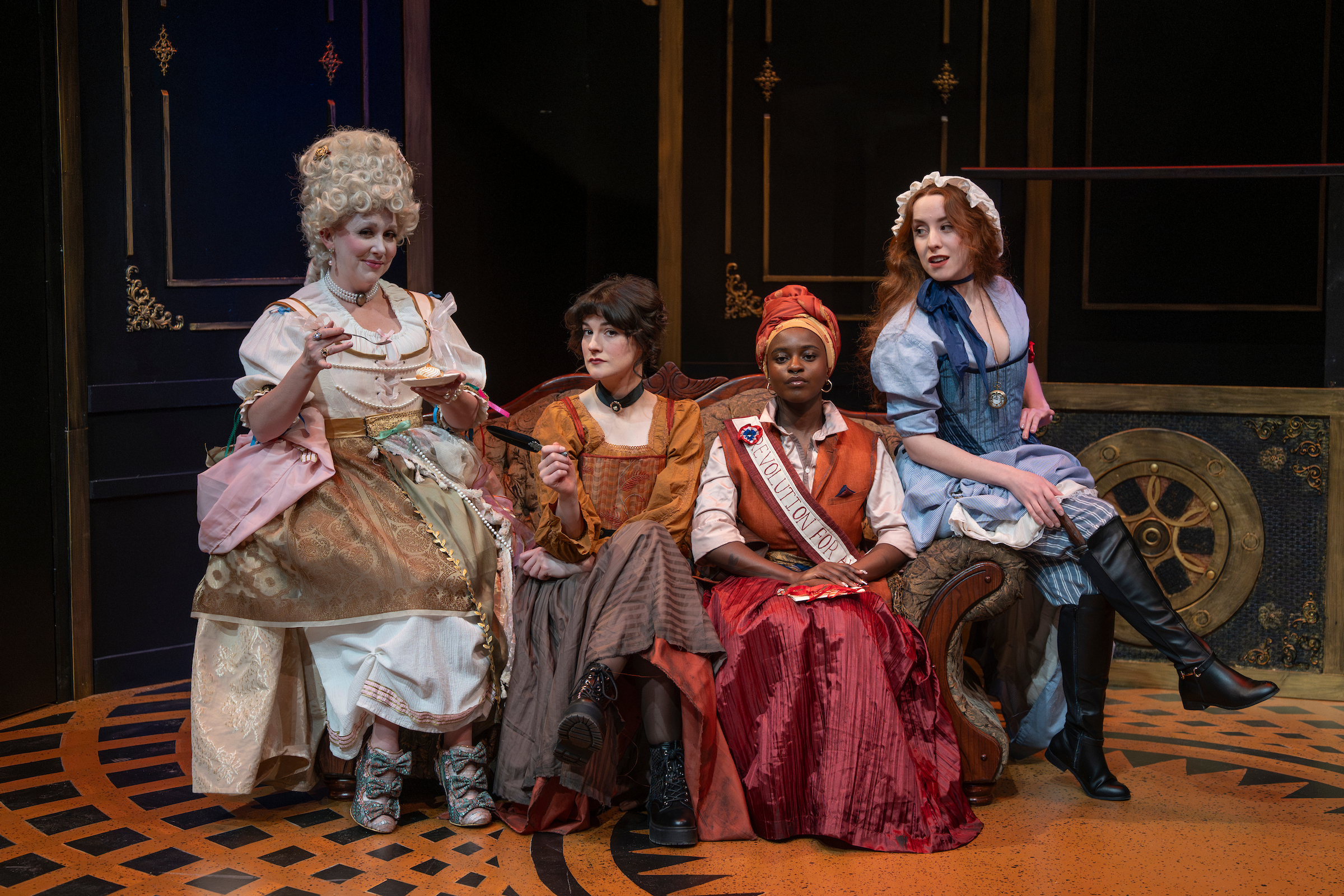
Aimee Beaudoin (Marie Antoinette), Alex Dawkins (Olympe de Gouges), Kijo Gatama (Marianne Angelle), and Jacquelin Walters (Charlotte Corday) in The Revolutionists.
Costumes Rebecca Cypher, set Cindi Zuby, lights Ken Matthews.
Images Marc J Chalifoux Photography.

My previous knowledge of contemporary American playwright Lauren Gunderson suggested that The Revolutionists would be an inspiring feminist story based on real women in the French Revolution. It was. But it was also hilarious, absurd, fourth-wall-breaking, and full of self-referential mockery about playwrights, theatre, and the ridiculous concept of writing a musical about the French Revolution …

John Hudson directed The Revolutionists for Shadow Theatre – the founding artistic director’s last directing project before Lana Michelle Hughes takes over as Artistic Director.

The action takes place in 1793, after Marie’s husband, King Louis XVI was guillotined in January and before she met Madame Guillotine herself in the fall of that year.

The performance starts with Olympe de Gouges (Alex Dawkins), the only feminist playwright left in Paris, in her apartment, struggling to write her next play, and posturing for the audience about the hardships of being an artist and living through a revolution. Dawkins’ neo-bouffon skills serve her well in portraying a character who is not quite as important as she thinks she is, but who is very aware of her own voice.

Her first two visitors are more down-to-earth. Marianne Angelle (Kijo Gatama), activist and spy, is motivated to use the turbulent times to free her homeland of Saint Domingue (now Haiti) from the French Empire and end slavery. She wants Olympe to help her by writing pamphlets and declarations instead of plays. “What about a monologue?” negotiates Olympe. Charlotte Corday (Jacquelin Walters), younger than the others, is planning to take more specific action – she is going to assassinate the radical journalist Marat, hoping this will correct the course of the Revolution away from the Reign of Terror. And she wants Olympe to script her Last Words that she’ll be allowed to give from the scaffold before her inevitable execution.

Absurdity escalates when the next knock on the door is actually the infamous former Queen of France, Marie Antoinette, in a gown covered with bows, bustle, and other decoration, and wearing a recognizably-excessive wig. Aimée Beaudoin’s Marie is ridiculously self-centred and naive, completely unequipped to function as an ordinary citizen. She tries to get the playwright to write a play all about her. The contrast between Marie’s wishes and the other three continues throughout the play, providing a necessary levity. But they also find points of poignant connection – absent husbands, motherhood.

Early in the play we see the shadow of a guillotine over the set, reminding us that all of this is taking place in a situation of impending violence. I wondered how that mood shift would happen. I pictured scaffold speeches like Sidney Carton’s in A Tale of Two Cities (“It is a far, far better thing that I do than I have ever done. It is a far, far better rest that I go than I have ever known”). But in Gunderson’s play, the condemned burst into song, into full-voice amplified musical-theatre ballad song, which added a perfect touch of absurdity.

Costume design, illustrating the characters’ different vocations, social classes, and cultures, was by Rebecca Cypher. The constrained and ornate set was designed by Cindi Zuby, with sound by Darrin Hagen and lights by Ken Matthews.
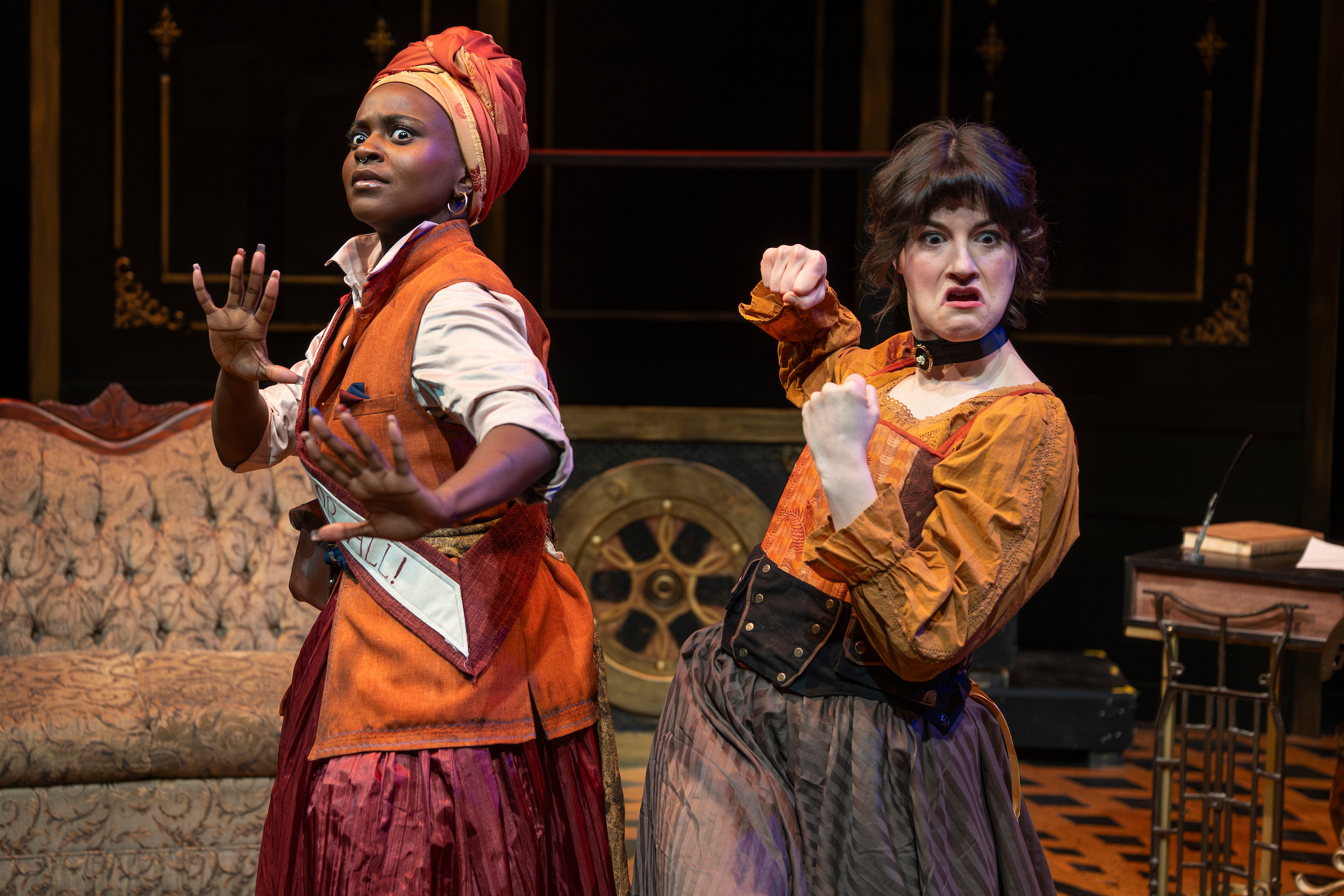
Kijo Gatama and Alex Dawkins take on the patriarchy in The Revolutionists.
Costumes Rebecca Cypher, set Cindi Zuby, lights Ken Matthews.
Images Marc J Chalifoux Photography.

I’ve seen two other plays by American playwright Lauren Gunderson: Silent Sky, based on historical figure Henrietta Leavitt a female astronomer in the 19th and early 20th centuries, and Miss Bennet: Christmas at Pemberley, a tribute-fiction contribution to the Pride and Prejudice universe, extending the story of bookish sister Mary and finding her a sympathetic happy ending. The characters in Silent Sky clearly push against the usual options for women and for deaf people at that time. As for Christmas at Pemberley, the Austen source material already provides a sharp outside eye on the society of the time; Gunderson’s play is clever pastiche and satisfying fanservice. Both plays include male-female romances with shared interests and minimal power imbalance.

The Revolutionists is my favourite of the three, because it handles serious material but doesn’t take itself too seriously. Playing at the Varscona Theatre until April 5th, with tickets here.

Magic, survival, and hidden patterns – a Fringe weekend

The last four shows I saw in Fringe 2024 included two shows with stage magic and two shows with young women prepping for endtimes or disasters. But four very different experiences!

El Diablo of the Cards was a solo sleight-of-hand performance by Ewerton Martins of Brazil, in red nose. He greets guests in line outside Gateway Theatre, then seats some people on the stage of the intimate black box and goes back outside to announce more arrivals as “next victims!” and keeps promising that the show will start in five minutes. Eventually he taps one of the audience members to give him an introduction, and the one who did it in the Saturday show did a great job. His patter is amusing and he gets help from several audience members without making fun of them. And his tricks are astonishing and delightful.

kicked in the end: a magic show was a solo performance by actor/magician/academic/author Shawn DeSouza-Coelho, in the Kick Point OSPAC space. This charismatic performer also engaged with audience members before the official show start, and then reminded us that as per the show title, before the end of show, there would be some kind of kicking of someone. While we were puzzling over that one, he gave us a long riddle of descriptive poetic phrases that didn’t fit together at all, and then gave us one word that made them all make sense. He engaged audience assistants to conduct various magic tricks. I wasn’t sure what to attribute to physics, what to attribute to impressive “reading” of participants, and what was actually sleight of hand. In between, he told stories from his life which would have made an interesting show even without the magic and interaction. Later it became clear that just as the apparently-unconnected lines of the riddle made sense once the keyword was revealed, the anecdotes also had a common thread in racist microaggression. The structure of the show, particularly the ending that subverted my expectations of what a performer “owes” the audience, had me feeling as if I discovered my own problematic beliefs rather than having someone else call me out, which was much more effective. (Emo Majok’s gentle poking fun felt similar). I don’t know whether the performer teaches undergraduates, but I hope for the sake of York students that he does. Shawn DeSouza-Coelho is also the author of the fascinating biography of Stratford stage manager Nora Polley, Whenever You’re Ready, which I recommend.

Let’s Not Turn on Each Other features creative partners and recent BFA grads Jacquelin Walters and Michael Watt, who have been making performances together at Nextfest, at U of A New Works, and elsewhere. This one, billed as a play with original folksongs, was performed at Spotlight Cabaret, but is going to be held over at the Westbury Theatre next Friday and Saturday. (Note – you might remember that in past years, holdover performances cost more than tickets to regular Fringe shows. This year they’re a flat $20 – the same as the maximum price during the festival.)

Anyway, it’s weird, and playful, and engaging. The two performers, wearing plain modest dresses and blonde milkmaid braids under kerchiefs, are members of a guild, assigned to guard an outpost until they get a signal from their leader. It’s not clear if this is a religion or a doomsday-prep group or what, but they both seem completely devoted to their required daily schedule and the instructions they get from cassette tapes. They sing and play instruments, they make an expedition around the audience space which culminates in some participation from Spotlight serving staff, and eventually they make some discoveries that upset their belief system. See the holdover — and watch for these two in future. I understand that Michael Watt will be playing the eponymous Shrek in an upcoming Nuova Vocal Arts production.

W.R.O.L. (Without Rule of Law) has a more realistic setting and tone, but again it seems to be about a group of young-teen girls who have deviated from standard Girl Guides curriculum to teach themselves survivalist prepping. The script is by Michaela Jeffery – previous works of hers I’d seen in Edmonton were Sundogs (Fringe 2014) and The Listening Room (Cardiac Theatre, 2018). Emily Marisabel directed W.R.O.L. Set designer Amanda Bertrand and prop designer Kevin Cambridge have constructed an impressively detailed space for the group to explore, especially given the 15-minute limitations on setup and strike for each show. Performers Robyn Clark, Baran Demir, Astrid Deibert, Emily Thorne, and Jordan Empson bring five different characters to life, each with their own needs and motivations for becoming competent and independent. At first, the group’s concerns about solving mysteries and defying school restrictions seem immature or foolish, but by the end it seemed to me that they had credible good reasons to mistrust their authority figures, reasons that many contemporary young people might share.