Tag Archives: erik mortimer

An Iliad – the O.G. war epic, at Shadow Theatre

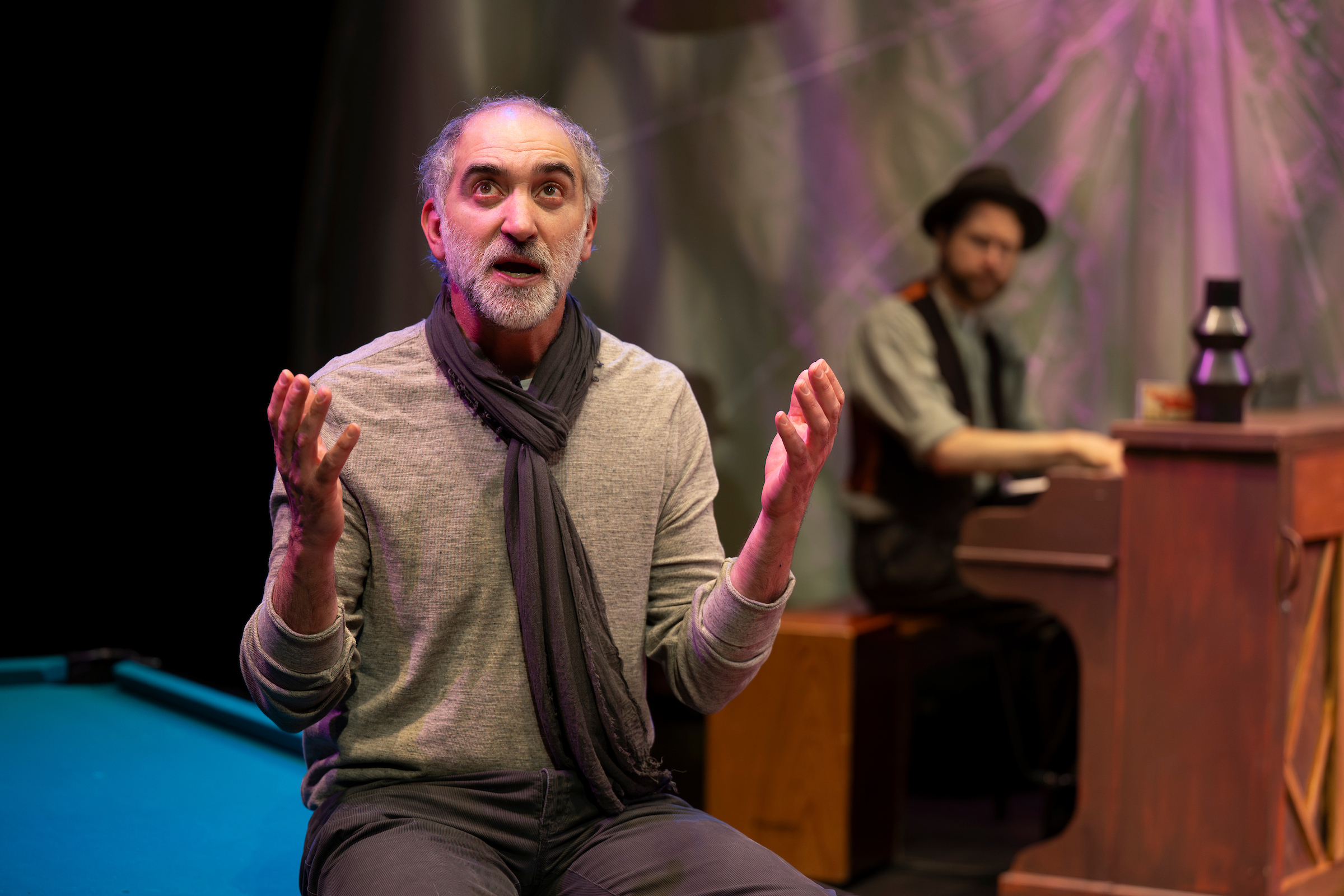
Michael Peng and Erik Mortimer in An Iliad. Set and lighting design Scott Peters, costume design Leona Brausen. Photos Marc J. Chalifoux Photography

A plain wooden table and chair, centre stage, and white dropcloths covering furniture pieces in the background. Lights up on the empty set with a bit of fog. A slow shuffle thump stage right.

A weary man on crutches (Michael Peng) hobbling in, looking at the audience, and commenting that he’s been reciting this poem, telling this story, many times, in different formats and in different places. He has a version that takes a year to tell, and a version that takes three days. Some places people love it, and sometimes the audiences are weary of it. He’s wearing ordinary, 20th- or 21st-century clothing, but the places he names might be in the ancient world. I wasn’t familiar with the details of the source material, so at first I wondered if he might be representing one of the characters – maybe the Greek warrior Achilles if he survived the war, maybe the Trojan non-combatant Paris. The limp, the exhaustion, the wooden crutches and contemporary walking-boot – those all made sense to me evoking a former soldier. But eventually I figured out that as narrator, he’s representing the canonical poet Homer.

After a little while, he stops pacing, sits at the table, and starts to sing or chant in what I’m pretty sure was Ancient Greek, with a poetic metre. I guessed that it was the start of Homer’s original verse,

“Achilles’ baneful wrath resound, O Goddess, that imposed
Infinite sorrows on the Greeks, and many brave souls losed
From breasts heroic, sent them far to that invisible cave
That no light comforts, and their limbs to dogs and vultures gave;”

And then the poet launches into the story, in English and in casual prose, of a few crucial days after ten years of war. He switches viewpoints between the Greeks on the beach, with King Agamemnon, and Greek warrior Achilles and his companion Patroclus, and the Trojan royal family in their walled city, including monarchs Priam and Hecuba, their soldier son Hector, and his brother Paris, the one who started the war by eloping with (kidnapping? seducing?) Helen, who had been married to King Menelaus of Sparta at the time. I recognized all these names, because of various other versions of the source material, but the poet gave enough information to refresh my memory about who was on which side and why.

The characters and events are rich source material, used in Euripides’ The Trojan Women, Shakespeare’s Troilus and Cressida, several of Charles Mee’s plays, Marion Zimmer Bradley’s novel The Firebrand, Madeline Miller’s 2011 novel The Song of Achilles, Jessy Ardern’s plays Prophecy and The Fall of the House of Atreus: A Cowboy Love Song, and many other plays, novels, songs, poems, and movies. In any versions, it’s always struck me as a big messy epic, hard to follow without conventional plot arc and harder to find a satisfying theme.

The version in Lisa Peterson and Denis O’Hare’s solo play that is built on the Varscona stage in this Shadow Theatre production (John Hudson directing) is surprisingly compelling. By giving us viewpoints from both armies, the playwrights don’t give us the option of dehumanizing one side and looking to rejoice with the others as “winners”. There is pride and revenge and anger and stubbornness on both sides. And there are gods and goddesses who take sides and make things worse, for their own motives. And there are horrific losses and betrayals. The script of An Iliad isn’t a selection of the source material that gives much agency or attention to female characters, focusing mainly on Achilles and Hector as well as kings and deities.

Partway through, I began thinking about ways that the back-and-forth, endless combat with no hope for peaceful resolution reminded me of more recent conflicts. Gaza. Ukraine. Minneapolis. And then later on in the play, the poet narrator appears almost overcome with the tragedy of the story he’s telling, and then he gets muddled. Oh wait, was that the Peloponnesian war, he corrects himself. Or the second battle of Sparta? He begins naming a few conflicts I’d never heard of, and then others I had, and he keeps going and going and going, to the eighteenth and nineteenth century and the twentieth, wars I’d heard of and wars I never had. And I found myself holding my breath – would he name the horrific conflicts of the New World, and the ones I’d encountered in LIFE Magazine and on TV news? He did name them, and he kept going, his rage and devastation building, repetition driving home that modern wars aren’t one-and-done either, Sarajevo, Afghanistan, Darfur, Sudan, Afghanistan, Gaza, Sudan, Gaza … It was brilliant and horrible.
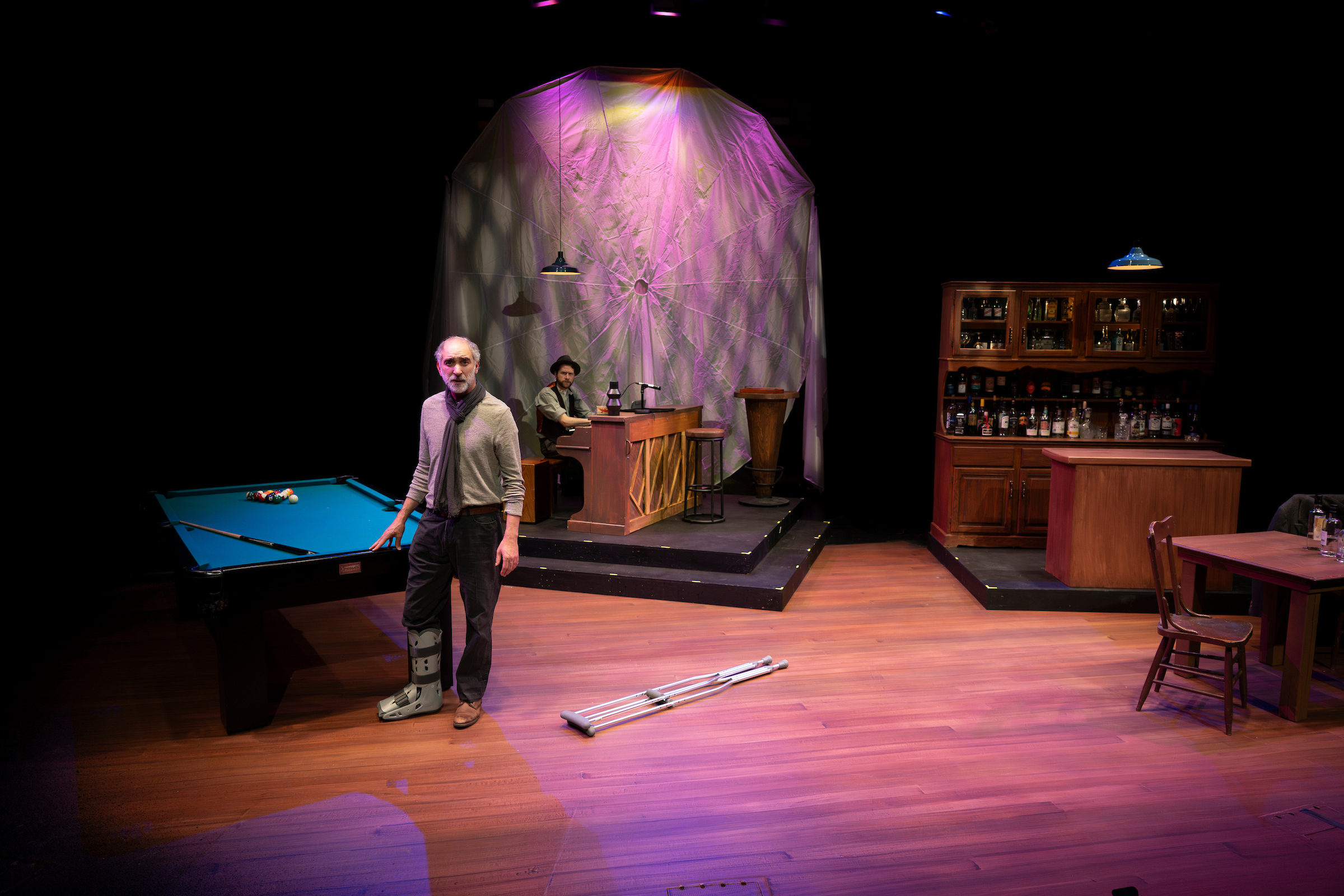
Michael Peng and Erik Mortimer in An Iliad. Set and lighting design Scott Peters, costume design Leona Brausen. Photos Marc J. Chalifoux Photography

Despite the fact that the solo narrator spends much of the 105-minute performance sitting down at a table, I found it fascinating to watch and listen to. Musician and sound designer Erik Mortimer accompanies the poem from on stage with a keyboard, a lyre, and various other percussion instruments and looping apparatus. Set and lighting designer Scott Peters enhances the performance with interesting lighting shifts, lights on a backdrop/cyclorama thing evoking sunrise, a shield, and other outlooks with a base set in a sort of timeless pub, with stocked bar, stools, and a pool table. John Hudson, outgoing artistic director of Shadow Theatre, directed the piece, and Leona Brausen provided costuming. Effective use is made of a scarf in the poet embodying different characters. One of my favourite bits of stage business was the part where Achilles and the other Greek leaders are making plans, wielding the sceptre of power – which the poet explains is “like the original talking-stick, in this cradle of democracy” – and Peng naturally hoists a crutch above his head to represent the sceptre.

I learned from members of the production team that Michael Peng’s crutches and walking splint were a recent and necessary addition, due to an ankle injury late in the rehearsal process, and that the original blocking would have had him moving about the stage, standing on the pool table, jumping over the bar, and leaning on the piano. While I would have liked to experience that version, the less mobile narrator contributed to the sense of fatigue and despair and futility.

An Iliad continues at Varscona Theatre until February 8th. Tickets are available here. Matinees offer Pay What You Can pricing at the door.

The 2026 theatre season continues after this with the Citadel’s Death of a Salesman, Walterdale’s production of the Hannah Moskovitch play This is War, Workshop West Playwrights’ Theatre’s My Testimonial (Greg MacArthur), and more.

HONK! if you love family musicals

The Ugly Duckling is the Hans Christian Anderson tale of a misfit chick raised by ducks and made to feel inferior for being different, who then matures into a graceful beautiful swan and is welcomed by a flock of other swans.  Stories of happy resolution and appreciation for young people who don’t fit in have always been in demand, although the expectations of the story tropes have changed even within my memory, as, for example, some modern viewers find the bullying in the 1960s television special “Rudolph the Red-Nosed Reindeer” to be egregiously cruel, even with some happier resolutions at the end for the red-nosed reindeer, the dentist elf, the kind abominable snow monster, and other picked-on characters.

Honk! is a musical version of the story, with music by George Stiles and book and lyrics by Anthony Drewe, which debuted in England in 2003.  And I liked this version better than previous versions I’d encountered, partly because the audience and the ugly duckling (played here by Mathew Bittroff, appropriately awkward in mismatched socks and lopsided stance) could see right from the start that the mother duck (Kayla Nickel) cared about him and admired his unusually good swimming ability, and because even when he was lost, the device of overhearing a television appeal let him see that his mother still loved him and hadn’t given up.  During the performance I got wondering whether the happy ending would still have him flying off with the flock of swans, as in the original, and I was relieved to see that after he’s both discovered himself as a swan and found his duck family, he decides to stay on the lake with the ducks and with his swan sweetie Penny (Paula Humby).  It was also nice that after some initial jokes about Drake avoiding family responsibilities and not bonding with Ugly, he stays home to take care of the ducklings and the nest while his partner Ida goes searching for Ugly, and is happy to have him return.

This version of the story has an obvious villain outside of the sibling/community bullying: a Cat, played with feline grace and predatory instincts by David Johnston of The 11 O’Clock Number and Two One-Way Tickets’ The Full Monty.  A young audience member behind me was complaining with satisfaction at intermission that he or she Didn’t Like That Cat.   I found the analogy with human would-be predators equally disturbing.  The way that the Cat concentrated on the youth who was distanced from his family and discouraged him from checking in with his mother was very similar to the grooming and luring behaviour of a child molester portrayed by Jake Tkaczyk in his original piece Play Date at Red Deer College a few weeks ago.

Johnston’s feline mannerisms were readily identifiable and very funny, particularly the way he shot his claws and caressed his astonishing facial hair.  Elisa Benzer as Turkey, and Will Mitchell as Drake and Bulldog were also particularly impressive in capturing the essence of their characters’ species in posture and movement.

In the musical, once Ugly has been separated from his family and farmyard community by the Cat and after he escapes the cat, he spends a long time searching for home and encountering various other characters – a military formation of migratory geese, a couple of domesticated pets, a bullfrog and his chorus, and a mother and daughter swan – before being found by his mother and discovered to have molted into a recognizable swan.  This gave the story more structure, and also provided opportunities for some funny characters, puns, and song/dance numbers.   Most of the cast played two or three parts.  The duckling siblings were Laena Anderson, Rachel Kent, and Lindsay Phillips, in yellow bows and shirts.  Nicole English shifted posture, demeanour, and a few costume details to distinguish between Maureen (a moorhen friend of the mother duck), Lowbutt (a domesticated chicken), and Mother Swan.

The music for the show was provided by Erik Mortimer on keyboard.  (The small child behind me commented after intermission “He’s really good!”)  The songs were pleasant and catchy and the choreography fun to watch and suitable to the characters and species.  I had trouble discerning the words in one or two of the early songs, which was irritating because the words I could make out were very clever, and I’m not sure whether the problem was tempo or balance with the keyboard.  I particularly enjoyed Kayla Nickel’s singing voice.  I think the last thing I saw her in was MacEwan’s Spring Awakening, although I may have seen her in something since.

HONK is a production of Grindstone Theatre, the people who do The 11 O’Clock Number.  It’s playing at the PCL Studio space at the Arts Barns until April 26th.  Tickets are at Tix on the Square or at the door.

The Eleven O’Clock Number

Grindstone Theatre started doing a musical improv show at the Varscona sometime last winter, at first every couple of weeks, and now every Friday night.  But I didn’t get around to going to see one of their shows until last week, on a painfully-cold Friday night.  And I had to look it up more than once to be sure, but yes, The Eleven O’Clock Number does start at 11 pm.   Apparently, “eleven o’clock number” is also an expression in musical theatre for a big memorable song in the second act.  So it’s a good title for a late-night musical improv show.

In the performance I saw, Katie Hudson was the on-stage host/narrator, Erik Mortimer provided musical inspiration and accompaniment on keyboards, and the improvisers were David Johnston, Jessica Watson, Mark Vetsch, Nathania Bernabe, and, I think, Brianne Jang.  After singing a theme song together, they started by collecting some audience suggestions, and generating a title for their production of “Never Cold”.  They then immediately launched into a catchy classical-show-tune finale scene, then jumped back in time to create the plot leading to that scene.   Mostly the narrator would call for breaks and mention the setting or maybe characters for the next scene, but did not give hints as to what would happen the way the Die-Nasty narrator/director does.

The performers built an interesting set of characters, created some plot problems that started with David Johnston’s character being infertile and his wife (Brianne Jang) having a creepy boss (Mark Vetsch) while being newcomers to the cold snowy climate from Baja California (or possibly the state of California, it wasn’t clear).  They then sang and acted their way through a not-too-convoluted story to a resolution, introducing a few more characters along the way.  Jessica Watson’s small child character was probably my favourite, with age-appropriate reasoning, self-focus, and way of speaking.  Nathania Bernabe played the small child’s mother and also had an amusing cameo as Brianne Jang’s character’s mother with an accent that I couldn’t quite place, possibly the Californian version of Brooklyn/Jewish.

The Eleven O’Clock Number plays every Friday at the Varscona Theatre, at, yes, 11 pm.  It’s a good addition to the strong improv-theatre scene in Edmonton. There’s an intermission and you’re allowed to bring drinks in to the theatre (if you buy them there, of course).  I think the show I saw finished a bit before 1 am.    You can get tickets ahead of time at Tix on the Square until sometime early on the Friday, and then you can buy them at the door.  I was also going to tell you that they’d been chosen in the Fringe venue lottery for next summer, but when I went to confirm the Fringe webpage wasn’t working.  So I’ll fix this note if I’m wrong.