Tag Archives: eli yaschuk

A new whimsy from Stewart Lemoine: I Meant What I Said

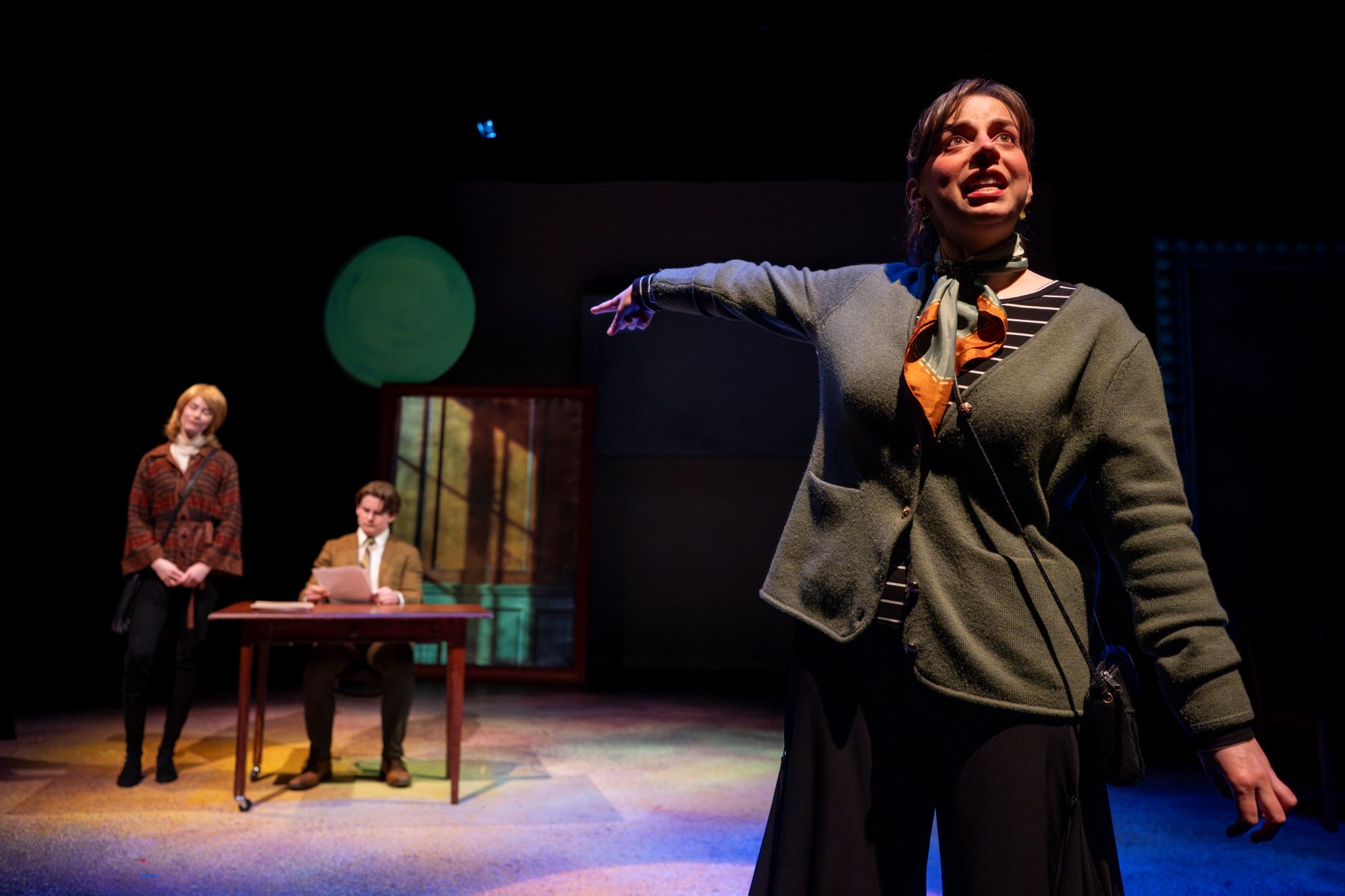
Bella King as Dinah, foreground, with Neda Vanderham and Sam Free, in I Meant What I Said. Costume Design Leona Brausen, set Chantal Fortin, lights Rory Turner.

Image Marc J Chalifoux Photography.

Stewart Lemoine, the Resident Playwright of Teatro Live!, is one of the most prolific Canadian playwrights. But all of his works I’ve seen performed have surprised me, because of the wide range of mood and subject matter. Sometimes they have delightfully specific settings (contemporary St. Albert, Grand Rapids Michigan, 1950s New York City high society). Sometimes the plot goes past rom-com coincidence into magical realism (For the Love of Cynthia). Sometimes the comedy is poignant, and comes from flawed characters doing their best (the late Julien Arnold in Happy Toes).

But last night it occurred to me that one consistent description of Stewart Lemoine’s oeuvre is “whimsical”.

Last night Teatro Live! opened the world premiere of the newest Stewart Lemoine play, I Meant What I Said. (Lemoine also directed.) It started with a young woman (Bella King as Dinah) striding to the front of the stage and addressing the audience – or maybe letting us listen to her interior monologue? She demonstrates how her thoughts jump around without follow-through, and this makes it unclear what’s real and what’s just a thought. Dinah’s 30th birthday is approaching, so she’s thinking about changes she might make and projects she might take on, for this momentous change.

There’s her old friend Helen (Jayce McKenzie) – well, not really a friend, more of an acquaintance she runs into every now and then – someone she played ringette with as a teenager – so an old acquaintance? This of course reminds Dinah of Auld Lang Syne, so she adapts a few lines of the song to fit the story she’s telling, and then carries on. I was fascinated by Helen, whom Dinah describes as having “been 35 since we were 23”. McKenzie’s portrayal of a high-status formal adult, complemented by severe-cut hair, fur-trimmed cape, and high boots (costume designer Leona Brausen), contrasted strongly with the uncertain and casual Dinah.

There’s a young man walking by (Sam Free) – he looks familiar – is he an actor? or have they been dating, and he’s in a different line of work? Lighting and sound shifts add to the shimmery uncertainty. I didn’t know how much of this was in Dinah’s mind, but I found her narrative more and more entertaining.

There’s a cafe. And there’s a server (Eli Yaschuk as Juris). Dinah’s conversation with Juris is a little more real-feeling than the previous vignettes. He’s from Riga, Latvia. He struggles a bit with figurative expressions in English, and Dinah agrees to help him. But he draws a clear boundary when she asks why he left Latvia. I was intrigued at the way they made this both a Stewart-Lemoine-mystery to note for the plot, and a realistic cringe-inducing portrayal of well meaning thoughtless locals inadvertently evoking trauma.

The narrative generally becomes more coherent. Shifts in location are handled smoothly, bringing on some simple pieces of furniture and creating backdrops with projections on various set pieces (Chantel Fortin, set design). In one scene, several characters attend an orchestra concert. They’re portrayed sitting in chairs in front of the main theatre curtain, looking towards the audience, and I was reminded of the opera-box scenes in Evelyn Strange.

Neda Vanderham, last seen at Teatro in/as The Noon Witch, plays a variety of small amusing parts, but my favourite was her bit at the end of the orchestra concert, when she appears as an usher, collecting discarded programs and encouraging patrons to clear the house, while attempting not to show impatience. As an occasional theatre usher myself, I felt so seen!
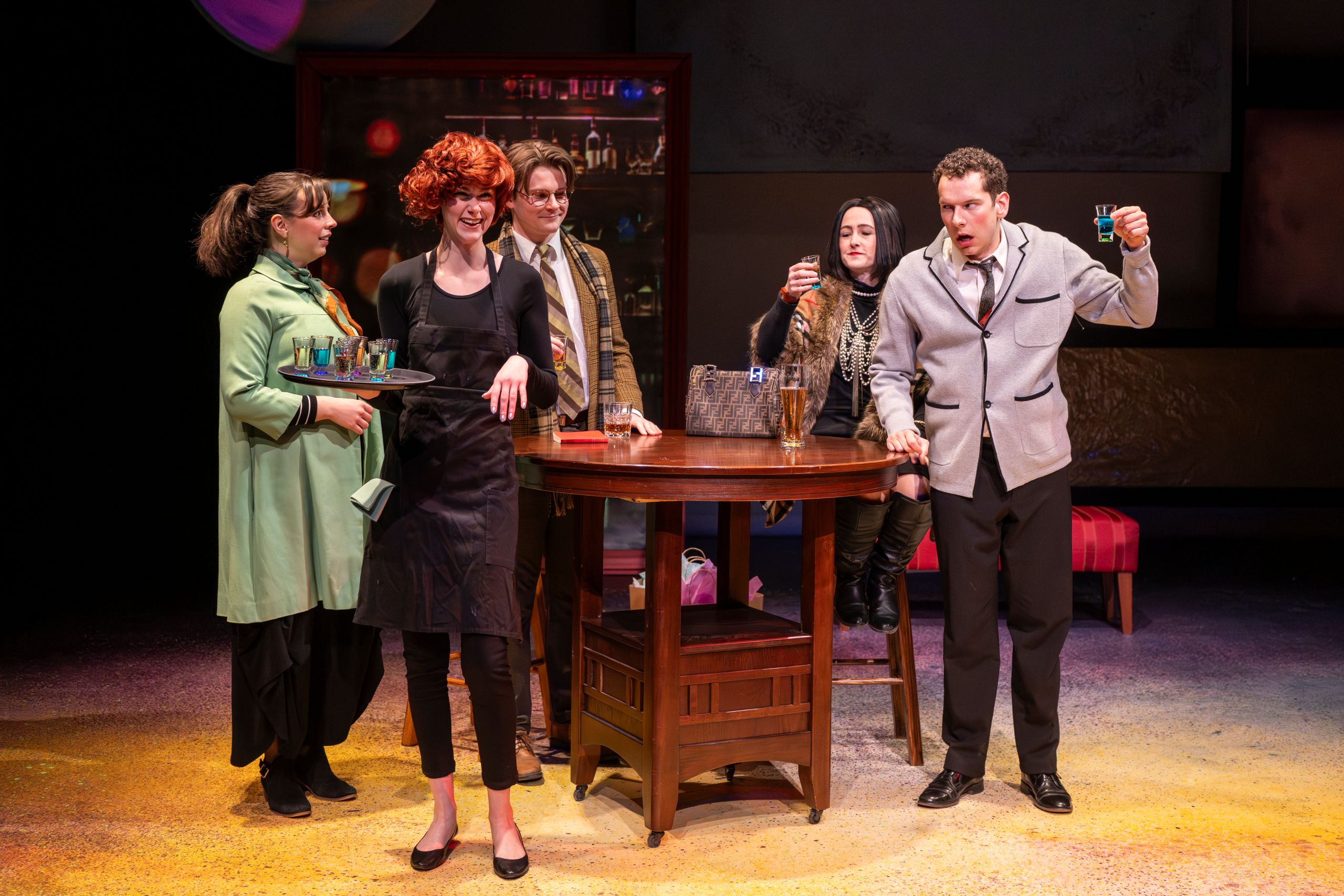
Bella King, Neda Vanderham, Sam Free, Jayce McKenzie, and Eli Yaschuk in I Meant What I Said. Costume Design Leona Brausen, set Chantal Fortin, lights Rory Turner.

Image Marc J Chalifoux Photography.

Like many of Stewart Lemoine’s plays, this one has a gentle satisfying ending in which not all ends are tied up, but many of the hints dropped early end up fitting together. It’s a small affectionate tale, unusual in the use of interior monologue and imaginings and manifestation. And the cast does a great job. I was riveted by Jayce McKenzie’s portrayal of Helen, starting as an intimidating Glenn-Close-in-Damages or Helen-Mirren-in-Paramount-Plus-ad figure and then becoming a bit more vulnerable. I’ve so often seen McKenzie play awkward young girls, tomboys, tough kids, (Robot Girls, Candy and the Beast, Supine Cobbler) that it was fascinating to see her as such a different character. And Bella King is just great as a viewpoint character, not entirely reliable as a narrator but likeable and open.

The performance runs about 80 minutes with no intermission, and works well at that length. Dinah’s first monologue explains the title – what she thinks keeps changing, but what she says out loud is real. I Meant What I Said plays at the Varscona Theatre until March 8th, with tickets here.

Radiant Vermin, hilarious and uncomfortable

Rain Matkin and Eli Yaschuk as Jill and Ollie, and Holly Turner as Miss Dee, in Radiant Vermin. Photo by Brianne Jang, BB Collective Photography.

Northern Light Theatre’s theme for their 2024-2025 season was Making a Monster. The first two plays were Trevor Schmidt’s Monstress (a gothic horror in which a Frankenstein-like scientist attempts to reanimate a dead girl but gradually appears to be more monstrous herself) and Penelope Skinner’s Angry Alan, a disturbingly-realistic portrayal of a lonely man drawn into the “men’s rights” misogynistic culture with horrifying consequences.

I was apprehensive but intrigued, to find out how the third play in the season, Philip Ridley’s Radiant Vermin, would fit into this theme. I had some guesses, but they were all wrong. And I loved being surprised. What surprised me most was that it was funny. Very funny.

An exceedingly wholesome-looking young couple, Jill and Ollie (Rain Matkin and Eli Yaschuk), address the audience with their baby, to explain about how they got their dream home and what happened there. When Jill was pregnant, they were living in a dingy flat in a crime-ridden neighbourhood, dreaming of better things for themselves and their little one. Until they get a mysterious letter and an even more mysterious visitor, Miss Dee (Holly Turner), who tells them they’ve been selected by a government department to get a free house. It’s a fixer-upper, but by renovating it they’ll start turning things around for the whole neighbourhood, and everyone will benefit. They see the house and ask about details, and a mythologically-long contract tumbles out of Miss Dee’s handbag. Everything about this screams BAD IDEA to me, from the twinkle in Miss Dee’s eye to the long golden scroll of clauses on the contract, but as soon as they sign, movers are dispatched to their old home and they move in, even before the electricity or hot water are working.

Ollie starts out confident that he can DIY the necessary renovations, but heavily-pregnant Jill is impatient. They’re both unsettled by living in an un-gentrified area. If they can see campfires of homeless people from their bare windows, can the homeless people see their vulnerable candles? Jill explains to us that she has experience of helping her mother provide charity to homeless people – that she and Ollie are good people. But they are still fearful of being targets in their good fortune. Her othering language is a little disturbing, but very familiar. But when an accident happens to a vagrant on their property, they benefit in an unexpected way. And they begin to justify it – their gain helps the neighbourhood, and nobody who mattered was hurt. By this time the characters are fully drawn – Jill’s earnestness and obliviousness, Ollie’s awkwardness and willingness to please his wife – and I felt almost complicit as they wonder about what else they could benefit from. The script builds this complicity in some direct address to the audience on benign topics, such as inviting input on whether to renovate the bathroom or the garage first.

Rain Matkin and Eli Yaschuk as Jill and Ollie, reading the letter offering them a house. Photo by Brianne Jang, BB Collective Photography.

Jill and Ollie’s house gradually gets renovated, according to the wish-list that Jill collects from magazines and catalogues. Upwardly-mobile neighbours gradually move in to the cul-de-sac, and we hear that ground’s been broken for the Never-Enough shopping mall nearby. Once all the houses are occupied, Jill and Ollie throw a garden party to mark their little son’s first birthday, with all the neighbours in attendance – and their facade of contentment and competence begins to fray, in a hilarious recounting.

I was thinking, this can’t end well. But I didn’t predict how!

The empty set (Schmidt) has a nearly-flat backdrop of a white-on-white house outline, with some harshly-shadowing sidelights. Its cleverness isn’t apparent until the show lighting (Larissa Poho) and projections (Matt Schuurman) begin to enhance it. I was fascinated about how the simple “porch” framing was used, along with shifts in light and soundscape (Chris Scott), to represent stepping from an upstairs bedroom into a staircase leading to potential danger.

The script of Radiant Vermin does have some important messages/themes, about envy and about buying in to materialistic wanting-more and about dehumanizing the have-nots, but the messages land with bouffon-esque discomfort at our own complicity. Schmidt’s production is perfectly cast. Holly Turner, most memorable as the eponymous Mary in The Testament of Mary, is hypnotically fascinating here, as the character Miss Dee needs to be, and Matkin and Yaschuk are well-matched, allowing some outrageous events to be natural character choices.

This was one of Northern Light Theatre’s most successful thematic season groupings in my memory, partly because the plays were so different. Each illuminated some facet of the question of how ordinary humans can do evil things. Each left me uncomfortable and wanting to discuss my experience with others. And each made me grateful for the community of theatregoers with whom I can share, both the roomful of audience members laughing and sighing and gasping in the moment, and the ongoing conversations like this.

Before today’s matinee, Trevor Schmidt is hosting a Director’s Circle at 1 pm. At these events, he typically discusses the motivation for choosing the play and some of the design challenges, without giving away anything about the ending. And on Thursday there’s a moderated talkback after the show – more opportunities to join in the conversation.

Trevor Schmidt and Holly Turner in a candid moment at the opening-night reception for Radiant Vermin.

Radiant Vermin continues at the Arts Barns Studio until May 3, with tickets here. Be disturbed and be delighted!