
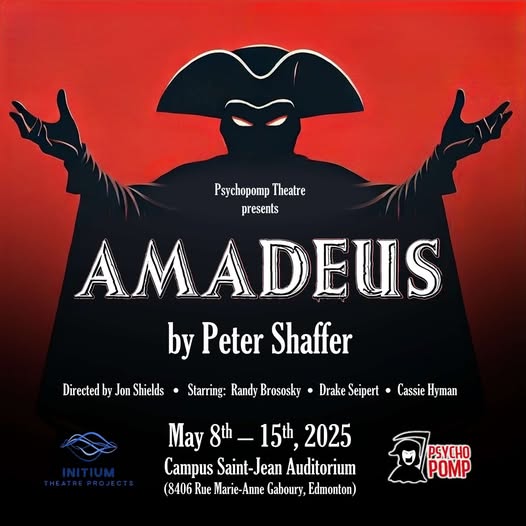
Amadeus, by Peter Shaffer, was a play (1979) before it was a movie (1985 Best Picture Oscar).
The play, in the Psychopomp Theatre production directed by Jon Shields, starts with an angelic choir singing in opera style, surrounding a very old man huddled in a wheelchair and containing a hand tremor. He is composer Antonio Salieri (Randy Brososky), the narrator and the central character in the play, despite it being named for Mozart.
Salieri rises from his chair with difficulty and calls for house lights to see the audience he is addressing. He seems to be endowing us with powers of extra-human witnessing or perhaps divine judgement – are we the choir of angels? – as he promises to tell us the story of what he did to Mozart long ago and how he’s paying for it. He speaks to us in English, but he also speaks to God in what appears to be fluent Italian.
The scene shifts – Salieri morphs to an active 30 year old – and this is when he first meets his rival, the younger composer and former child prodigy Mozart. Salieri tells us that he wanted so badly to be famous for his music that he had made bargains with God. He had the position of Court Composer to Emperor Joseph (John Evans) in Vienna. He shows the audience his servants and his “venticelli” or gentle winds, flamboyant gossips he engages to bring him the latest rumours (Andrew Mecready and Randall MacDonald). The venticelli tell him that young Mozart is coming to court, so he arranges to eavesdrop and then to be introduced. But to Salieri’s disgust, in person Wolfgang Mozart (Drake Seipert) is vulgar and annoying and self-centred. Seipert portrays Mozart with the most irritating laugh ever.
Salieri is astonished and resentful that someone so vulgar can have the gifts of music and fame that he longs for himself. The quid-pro-quo that seems to be central to his relationship with the Divine launches him into resentment and the most disturbing portrayal of artistic jealousy that I have ever seen.
Brososky’s portrayal of Salieri is brilliant. His bitterness poisons his own nature as he goes further and further in trying to harm Mozart. Mozart’s wife Constanze Weber-Mozart (Cassie Hymen) tries to protect her husband and is also affected by Salieri’s schemes.
A cast of 14 plays many ensemble roles, nobles and servants and citizens. I was fascinated to encounter references to several of Mozart’s operas I recognized, including Magic Flute, Don Giovanni, and Marriage of Figaro. Costuming (Nancy Skorobohach) conveys the excesses of the period and provides clues to class and character.
I was also fascinated to see allusions to Mozart’s character traits which I had first learned of in Erin Hutchison’s Fringe musical Regression last summer – in particular his persistent scatological humour. I’d already encountered a portrayal of Van Gogh on the Shadow Theatre stage this winter, consistent with Hutchison’s characterization, so it amuses me that the third avatar of art in the musical Regression, Willliam Shakespeare, will be on stage in Shakespeare in Love at Walterdale Theatre this summer.
Amadeus has a short run (May 8-15 only) in the auditorium at Campus St-Jean, with tickets available here. The main entrance to the building is under construction, but there is labelled access through the main entrance to an elevator.
 Ephemeral Pleasures