Tag Archives: chantel fortin

A new whimsy from Stewart Lemoine: I Meant What I Said

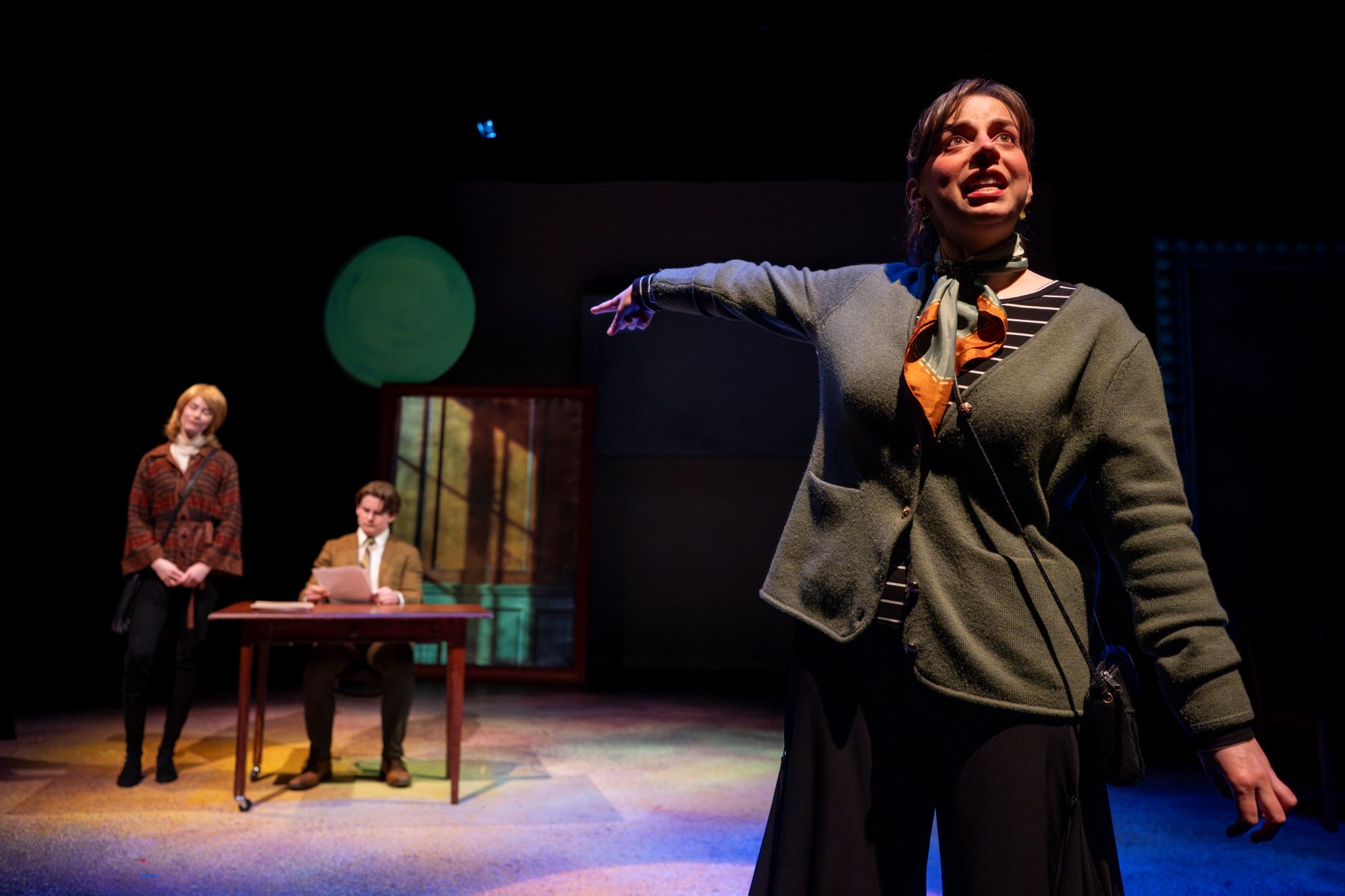
Bella King as Dinah, foreground, with Neda Vanderham and Sam Free, in I Meant What I Said. Costume Design Leona Brausen, set Chantal Fortin, lights Rory Turner.

Image Marc J Chalifoux Photography.

Stewart Lemoine, the Resident Playwright of Teatro Live!, is one of the most prolific Canadian playwrights. But all of his works I’ve seen performed have surprised me, because of the wide range of mood and subject matter. Sometimes they have delightfully specific settings (contemporary St. Albert, Grand Rapids Michigan, 1950s New York City high society). Sometimes the plot goes past rom-com coincidence into magical realism (For the Love of Cynthia). Sometimes the comedy is poignant, and comes from flawed characters doing their best (the late Julien Arnold in Happy Toes).

But last night it occurred to me that one consistent description of Stewart Lemoine’s oeuvre is “whimsical”.

Last night Teatro Live! opened the world premiere of the newest Stewart Lemoine play, I Meant What I Said. (Lemoine also directed.) It started with a young woman (Bella King as Dinah) striding to the front of the stage and addressing the audience – or maybe letting us listen to her interior monologue? She demonstrates how her thoughts jump around without follow-through, and this makes it unclear what’s real and what’s just a thought. Dinah’s 30th birthday is approaching, so she’s thinking about changes she might make and projects she might take on, for this momentous change.

There’s her old friend Helen (Jayce McKenzie) – well, not really a friend, more of an acquaintance she runs into every now and then – someone she played ringette with as a teenager – so an old acquaintance? This of course reminds Dinah of Auld Lang Syne, so she adapts a few lines of the song to fit the story she’s telling, and then carries on. I was fascinated by Helen, whom Dinah describes as having “been 35 since we were 23”. McKenzie’s portrayal of a high-status formal adult, complemented by severe-cut hair, fur-trimmed cape, and high boots (costume designer Leona Brausen), contrasted strongly with the uncertain and casual Dinah.

There’s a young man walking by (Sam Free) – he looks familiar – is he an actor? or have they been dating, and he’s in a different line of work? Lighting and sound shifts add to the shimmery uncertainty. I didn’t know how much of this was in Dinah’s mind, but I found her narrative more and more entertaining.

There’s a cafe. And there’s a server (Eli Yaschuk as Juris). Dinah’s conversation with Juris is a little more real-feeling than the previous vignettes. He’s from Riga, Latvia. He struggles a bit with figurative expressions in English, and Dinah agrees to help him. But he draws a clear boundary when she asks why he left Latvia. I was intrigued at the way they made this both a Stewart-Lemoine-mystery to note for the plot, and a realistic cringe-inducing portrayal of well meaning thoughtless locals inadvertently evoking trauma.

The narrative generally becomes more coherent. Shifts in location are handled smoothly, bringing on some simple pieces of furniture and creating backdrops with projections on various set pieces (Chantel Fortin, set design). In one scene, several characters attend an orchestra concert. They’re portrayed sitting in chairs in front of the main theatre curtain, looking towards the audience, and I was reminded of the opera-box scenes in Evelyn Strange.

Neda Vanderham, last seen at Teatro in/as The Noon Witch, plays a variety of small amusing parts, but my favourite was her bit at the end of the orchestra concert, when she appears as an usher, collecting discarded programs and encouraging patrons to clear the house, while attempting not to show impatience. As an occasional theatre usher myself, I felt so seen!
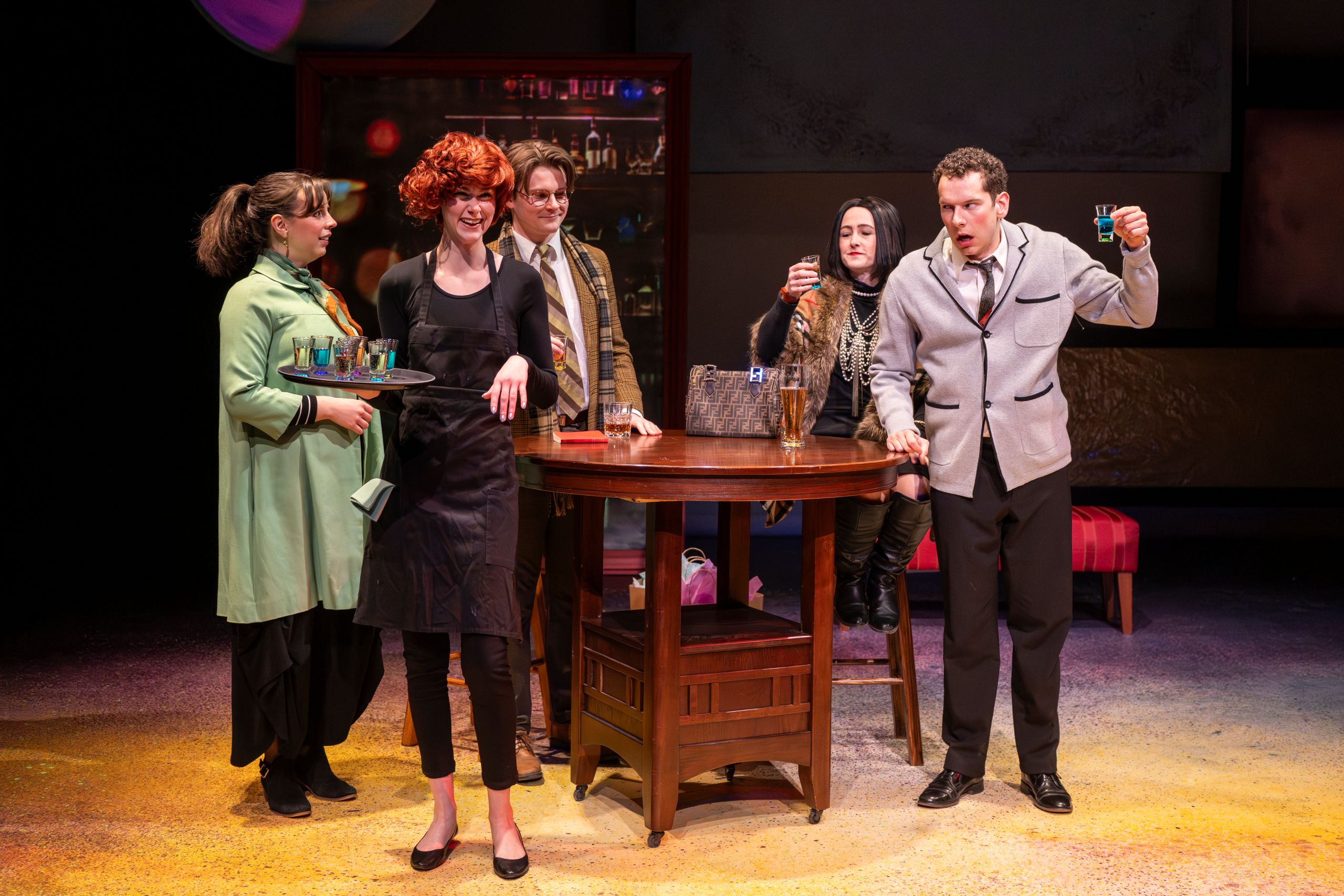
Bella King, Neda Vanderham, Sam Free, Jayce McKenzie, and Eli Yaschuk in I Meant What I Said. Costume Design Leona Brausen, set Chantal Fortin, lights Rory Turner.

Image Marc J Chalifoux Photography.

Like many of Stewart Lemoine’s plays, this one has a gentle satisfying ending in which not all ends are tied up, but many of the hints dropped early end up fitting together. It’s a small affectionate tale, unusual in the use of interior monologue and imaginings and manifestation. And the cast does a great job. I was riveted by Jayce McKenzie’s portrayal of Helen, starting as an intimidating Glenn-Close-in-Damages or Helen-Mirren-in-Paramount-Plus-ad figure and then becoming a bit more vulnerable. I’ve so often seen McKenzie play awkward young girls, tomboys, tough kids, (Robot Girls, Candy and the Beast, Supine Cobbler) that it was fascinating to see her as such a different character. And Bella King is just great as a viewpoint character, not entirely reliable as a narrator but likeable and open.

The performance runs about 80 minutes with no intermission, and works well at that length. Dinah’s first monologue explains the title – what she thinks keeps changing, but what she says out loud is real. I Meant What I Said plays at the Varscona Theatre until March 8th, with tickets here.

The 39 Steps – a new Teatro classic!

Priya Narine as Annabella Schmidt and Geoffrey Simon Brown as Richard Hannay, in The 39 Steps.

Photo Marc Chalifoux, costumes Brian Bast, set Chantel Fortin, lighting Rory Turner

The first play in the new Teatro Live! season, Farren Timoteo’s first as artistic director, is the hilarious, fast-moving, and farfetched The 39 Steps.

The 39 Steps was first a 1915 adventure novel / melodramatic thriller by John Buchan, who later served as the 15th Governor-General of Canada. I read the novel as a teenager, along with Buchan’s other works Greenmantle and Prester John, because my father had kept his childhood copies. It was adapted into a spy-thriller movie by Alfred Hitchcock in 1935, and had a few later film adaptations as well. In 2005, Patrick Barlow wrote this stage-play based on the earlier versions, but dialing everything up to the point of parody for 21st-century audiences.

The curtains open on emo-self-absorbed Richard Hannay, slouching in an armchair in his half-unpacked London flat, explaining that all his friends have moved away or died and he is bored. In this production Hannay is played by Geoffrey Simon Brown, who brings an amusing mix of bravado and bewilderment to the role.

Fortunately for the audience, his state of ennui doesn’t last long! A trip to the (vaudeville) theatre brings him an encounter with a mysterious woman (Priya Narine), who demands sanctuary in his apartment but ends up being murdered after entrusting him with vague secrets and missions.

Many many minor characters in the story of Hannay’s flight across England and Scotland are portrayed by two ensemble members (billed as Clown 1 and Clown 2), Michael Watt and Katie Yoner. Watt and Yoner are both noted physical-comedy performers in their own work as well as BFA-educated actors, and they were perfect for these roles, in which the quick-changes are acknowledged and sometimes flawed. Edmonton audiences rarely applaud transitions, but there was one shift that had Yoner’s character grabbing the four chairs and a table that had been representing a vehicle, and striking all of them in one trip, ending with crashing and banging in the wings.

Michael Watt, Katie Yoner, and Geoffrey Simon Brown in The 39 Steps. Lighting Rory Turner, Costumes, Brian Bast, Set Chantel Fortin. Photos Marc Chalifoux Photography.

Narine also portrays some other characters encountered by Hannay – an indignant rail passenger who reports him to the police, a lonely young Scottish crofter – sending up various tropes of women in early-20th-century thrillers.

I recalled a previous production of 39 Steps that I saw in the intimate space of Walterdale Theatre in 2022, where I kept swivelling my head back and forth to follow the fast-paced action of a train across the Forth Rail Bridge, a manhunt by air, a flight across misty sheep-pasture, and a final showdown back in a London theatre. I wondered how Timoteo’s direction in the larger traditional proscenium-stage auditorium would evoke the urgency and immersive nature of the script. And I was pleasantly surprised! Some of the action had me gasping and laughing because even with my vague memories of the story I hadn’t predicted what was going to happen next and how.

Design choices for this production all supported the action which was central to the play. Many set pieces (Chantel Fortin) were used in different creative ways. Lighting (Rory Turner), fog, sound, and Brian Bast’s costuming added atmosphere and affirmed the familiar tropes.

I found some of the dialogue hard to hear or understand, particularly when they were speaking quickly in unfamiliar accents over background sounds of trains or gunshots. But it wasn’t hard to follow. The plot was both farfetched and satisfying, and it was a great night out.

The 39 Steps is playing at the Varscona Theatre until November 30th, with tickets available here and at the door.

Next on my theatregoing calendar are two shows next weekend:

Guys and Dolls, the Loesser/Swerling/Burrows 1950 musical, a Foote in the Door production at La Cité Francophone / Théâtre Servus Credit Union, running Nov 21-Nov 30. Tickets here!

PepperMUNT, the bi-munt-ly late cabaret, will be on Saturday November 22nd, this time in the Old Strathcona Farmers’ Market. Tickets here!

Evelyn Strange at Teatro

Oscar Derkx and Gianna Vacirca, in Evelyn Strange. Photo credit Marc J Chalifoux Photography and Video

It doesn’t take me long to say yes when a friend offers me a ticket to opening of a Stewart Lemoine play at Teatro la Quindicina. I didn’t read anything about it ahead of time, though a glance at the program told me that Evelyn Strange was first performed in 1995, and that Shannon Blanchet, this production’s director, had played the title role in a 2006 production at Teatro.

The curtains open on a box at the opera. The Metropolitan Opera in NYC, in 1955. So it’s ornate and private and expensive — and somehow set designer Chantel Fortin and lighting designer Narda McCarroll make it feel like that, with just a few pieces that get slid away to become something else in the next scene.

The occupants of the luxury box are Nina Farrar, whose sophistication and snark are a perfect fit for Belinda Cornish, and her husband’s earnest young employee Perry Spangler (Oscar Derkx), tidy and respectful in Clark-Kent-esque glasses. Perry explains that Nina’s husband Henry gave him the ticket because he was tied up, charging him to keep Nina company and see her safely to her commuter train. And which opera is it that neither of them really wanted to see? Siegfried, a five-hour segment of Wagner’s Ring Cycle. (By the way, Sing Faster: the Stagehands’ Ring Cycle is a fascinating 1-hour documentary video, if you can find it.)

Evelyn Strange is a great example of Stuart Lemoine’s work and why Teatro does it well. The opening situation has unexplained threads, but the details and characters that appear next don’t resolve those questions but create others. The dialogue and action is amusing but never predictable. Jesse Gervais is Perry’s pushy colleague, poking into Perry’s secrets and holding his own. The eponymous confused woman who slips into the opera box after the lights go down, and slips away again before intermission, is Gianna Vacirca.

Things get odder. Some things seem to fall into place but other things are hinted. Settings like a publishing sub-editor’s office, an automat vending-machine restaurant, a hotel suite, Grand Central Station, and a bachelor’s apartment provide glimpses of mid-century modern chic, with a few well-selected details. Vacirca’s character, Miss Strange, claims to have no memory of her past – which would explain her, um, strange behaviour, assuming she’s now telling the truth.

There is a missing husband, a double-booked hotel room, evidence of trenchcoats and opera tickets and a $20 bill – in some plays, the details might never all fall into place and from other playwrights the hints would all be so obvious that we could figure out the outcomes at intermission. But not with Stewart Lemoine. At intermission my friend and I chatted about some of the possible explanations – we were right about some and wrong about others. And when the play ended, a patron behind us read out the list of predictions he’d jotted down at intermission to note how many of them he’d gotten right. It was that kind of play, like an elegant jigsaw puzzle.

And speaking of elegant, the 1950s-era costumes were designed by Leona Brausen. And speaking of jigsaw puzzle, one of the questions I had afterwards was “what did she have under that? and why didn’t it fall off?”

There are so many Stewart Lemoine plays that I haven’t yet seen, that I don’t want to use superlatives like “best”. But this production is most entertaining, with the directing and acting adding to a very clever script.

Evelyn Strange is running at the Varscona Theatre until June 12th. Tickets are available here and at the door. Masks are required when not eating or drinking – the usual list of refreshments including red licorice and Bloom cookies is available from the cheerful artistic associates staffing the lobby booth.