Tag Archives: canadian

Where You Are – family frictions and affection

Coralie Cairns as Suzanne, in Where You Are. Set and lights, Daniel vanHeyst. Costumes, Leona Brausen. Photo Marc Chalifoux.

I had read Kristen Da Silva’s play Where You Are a while ago. I couldn’t remember the details, just the tensions and affections between two sisters, Glenda and Suzanne, who live together on Manitoulin Island.

In the Shadow Theatre production that opened last night at Varscona Theatre, Davina Stewart plays restrained responsible Glenda, and Coralie Cairns plays Suzanne. With help from costume designer Leona Brausen, we see immediately that Suzanne is the kind of woman who gets up in the morning with last night’s mascara all over her face and a heavy-metal t-shirt along with her pajama pants, and Glenda is someone who always protects her skin with a sunhat and matches her purse to her shoes. The by-play between the sisters shows ongoing disagreements and old troubles but also a core of caring. Suzanne can’t talk to her grown daughter Beth without starting a fight – Glenda recommends that when Beth (Nikki Hulowski) arrives for a visit, Suzanne should just whistle instead of saying anything. We can also see hints of some other unspoken troubles – not overdramatic foreshadowing, but topics that the sisters have agreed not to address. Cairns and Stewart are brilliant together, hilarious in the superficial irritations of shared life while awkward in compassion.

Glenda and Suzanne’s neighbour Patrick (Brennan Campbell) drops in with a mis-delivered newspaper. Both sisters enjoy visiting with the handsome young man – Suzanne also takes the chance to talk him into fixing their shed roof. One of the funniest moments in the whole play concerns the roofing chore, and how Patrick responds to the heat, thinking himself alone.

As I said, I’d forgotten the plot details. After working on Mark Crawford’s comedy Stag and Doe for the last few months, I was laughing out loud hearing Patrick’s left-at-the-altar story and watching him make plans to attend his ex’s wedding.

It was easy to empathize with Beth, an only child frustrated by her mother’s and aunt’s well-meaning snoopiness into not telling them anything. As the play progresses, we also see them keeping secrets from her, all of which eventually come out. I was genuinely moved watching the comedic and defensive characters manage to connect with each other in the end. It felt very real. The script’s treatment of spirituality and religion was delicate and not ridiculous.

I also loved the specific reminders of Manitoulin Island, a beautiful part of Northern Ontario – the hawberry jelly priced higher for tourists, the “bicoastal” relationship one of the neighbours has with a woman from Espanola on the mainland, the way that missing the swing bridge timing can change destiny “like the Island wanted to keep me”. And the mention of a specific Toronto hospital cued me into the nature and severity of one character’s illness, due to memories of a family member spending time there long ago. None of this context is necessary to understand and enjoy the play; it just provided extra richness to my experience.

I couldn’t remember the title of the play beforehand, but now I understand it. Home is where you are, one character tells another.
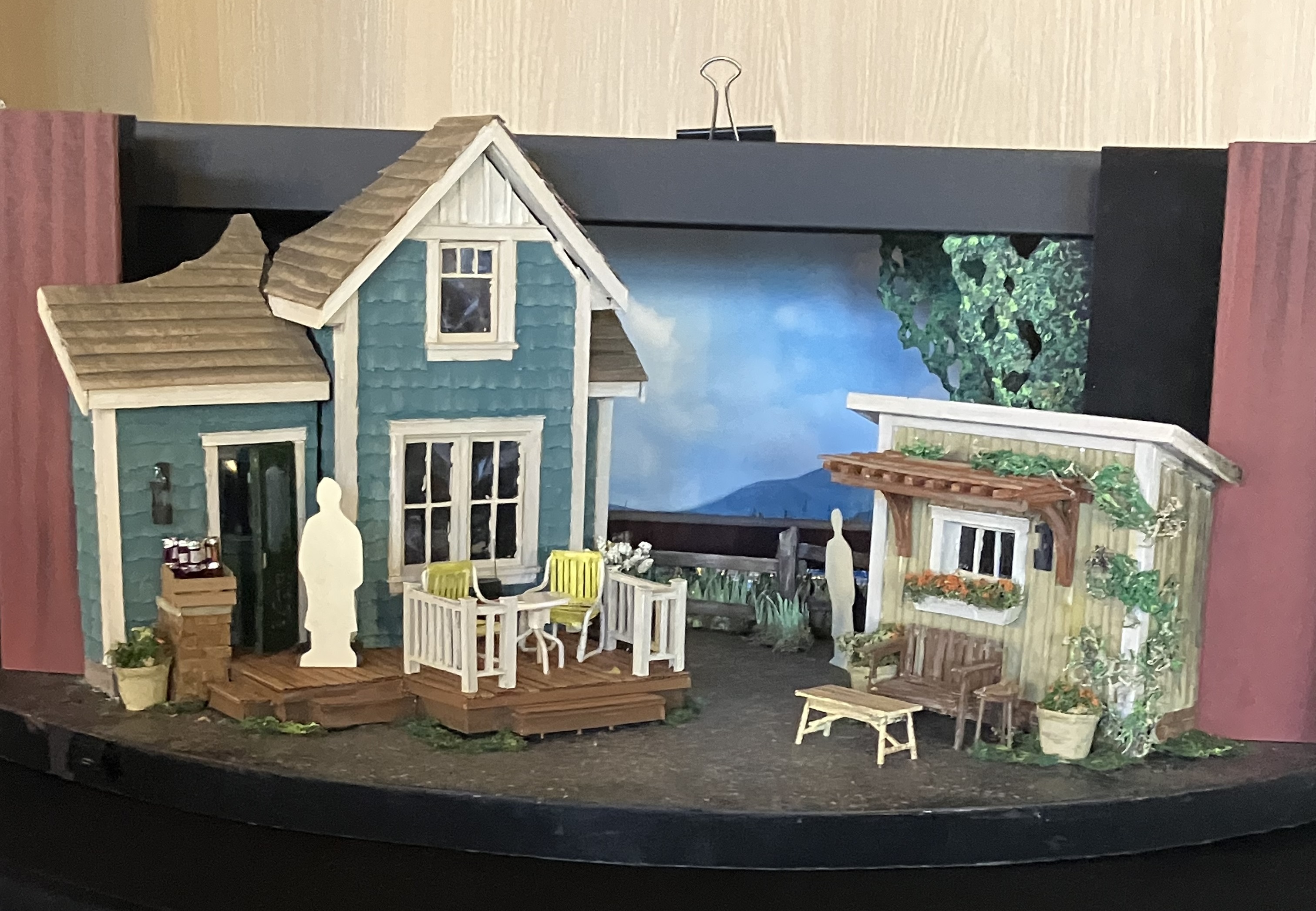
Daniel vanHeyst’s set model for Where You Are, on display in theatre lobby.

Set and lighting design are by Daniel vanHeyst. His typical attention to detail includes weathered shakes on the walls of the house, the rotating vent-stop bar at the bottom of the wooden storm windows, and lighting changes across fields throughout the day and night shown on a cyclorama. Darrin Hagen’s sound design includes many bits of original but almost-recognizable music.

Where You Are, directed by John Hudson with Lana Michelle Hughes as assistant director, is playing at Varscona Theatre until May 18th. Tickets are available here.

Intrigued by my mention earlier of Mark Crawford’s Stag and Doe? It’s playing at Walterdale Theatre until May 3 (tomorrow) with tickets here.

Francis Pegahmagabow: more than two battles and a wry wit

Monica Gate, Julie Golosky, and Garret Smith, in The Two Battles of Francis Pegamagabow, at Shadow Theatre. Photo by Marc Chalifoux.

The Two Battles of Francis Pegahmagabow, by Neil Grahn, opened last night at Shadow Theatre. Today, November 8th, is National Indigenous Veterans’ Day. So it’s a timely opportunity to experience the story of one of them, in this world premiere directed by John Hudson and Christine Sokaymoh Frederick. I knew it was going to be about an indigenous soldier in World War One, and about the challenges he faced from racist/hostile regimes in Canada after returning home with medals, but I didn’t know much else. Garret Smith plays the eponymous Francis Pegahmagabow, and he starts the tale with military posture and heavy khaki, addressing the audience (or some other audience, it’s not clear and doesn’t matter), and explaining that the following narrative jumps around in time and we’ll have to pay attention. After that warning, I didn’t find it hard to follow.

It does jump around, with many short scenes, alternating between war scenes in and out of the trenches, and a mostly sequential series of glimpses from other important experiences in his life. There’s an ensemble of five other talented actors, each playing multiple roles with shifts in costume elements, posture, and accent: Trevor Duplessis (last seen at Shadow in Cottagers and Indians, and more recently in a reading at Workshop West’s Springboards festival), Julie Golosky (I know I’ve seen her on stage before but I can’t remember where), Monica Gate, and Ben Kuchera play military men, white bureaucrats, members of Pegahmagabow’s community (then called Parry Island Band), and various family members. The scenes where he meets and woos Eva, his future wife (Gate) despite her parents’ (Duplessis and Golosky) reluctance are especially charming. Kuchera has a continuing role as a naive fellow soldier, and disturbing ones as Indian Agents refusing Pegamagabow’s applications to the band’s loan fund, and threatening him with RCMP action if he doesn’t cease his political advocacy.

In warfare scenes, we see that Francis has hunting skills and knowledge that enable him to be an unusually effective solo sniper. We also see that his superiors want him to follow orders and rules – take a partner, go out when there’s a full moon – despite his insistence that he can do things better his own way. In conversation with the audience, he explains that being good at killing people is a terrible gift. Short vignettes allude to the available facts behind his three wartime decorations.

In wartime action, his peers and superiors show typical microaggressions (not learning to pronounce his name), but seem to accept him for his skills. After returning home, however, he encounters one frustration after another. The determination and volatility that made him an effective fighter are now employed as he becomes Chief of his Band and founder of national indigenous advocacy groups. Other members of his Band (Golosky and Gate) heckle him and suggest that he’s acting in his own interest. And his reputation of being unstable, quick to anger, or unreliable gets used against him by bureaucrats. It’s heartbreaking, except for the moments when he shows his pride in successes. When World War Two arrives, and the RCMP come knocking to enforce conscription, he and Eva send their boys away for their safety, and he adds that “None of our children ever went to residential school either”.

One of my favourite things about this script and production was the humour, especially the way Francis engages the audience on his side, allowing us to share his wry understated amusement at the predictable injustices of his life, starting with receiving a medal from the King who can’t pronounce his name. There are several moments in the script that break the fourth wall or theatre conventions – he compliments the booth crew on the nice job they did on the moon, and some other fun bits I won’t spoil. It’s not a completely happy story, but it’s told with a very light touch and Smith’s delivery makes me want to watch him in something else.

The abstract set (Cindi Zuby) provides opportunities for active scenes that feel like battlefield expeditions, like moments of comfort in trenches, like intimacy sitting together at home sharing bannock, and like meetings in offices and in convention halls. A backdrop evokes rough-torn cured hides and silhouetted landscape, and creates a surface for projections.

The Two Battles of Francis Pegahmagabow continues until November 24th, with tickets available here.