Tag Archives: brennan campbell

Where You Are – family frictions and affection

Coralie Cairns as Suzanne, in Where You Are. Set and lights, Daniel vanHeyst. Costumes, Leona Brausen. Photo Marc Chalifoux.

I had read Kristen Da Silva’s play Where You Are a while ago. I couldn’t remember the details, just the tensions and affections between two sisters, Glenda and Suzanne, who live together on Manitoulin Island.

In the Shadow Theatre production that opened last night at Varscona Theatre, Davina Stewart plays restrained responsible Glenda, and Coralie Cairns plays Suzanne. With help from costume designer Leona Brausen, we see immediately that Suzanne is the kind of woman who gets up in the morning with last night’s mascara all over her face and a heavy-metal t-shirt along with her pajama pants, and Glenda is someone who always protects her skin with a sunhat and matches her purse to her shoes. The by-play between the sisters shows ongoing disagreements and old troubles but also a core of caring. Suzanne can’t talk to her grown daughter Beth without starting a fight – Glenda recommends that when Beth (Nikki Hulowski) arrives for a visit, Suzanne should just whistle instead of saying anything. We can also see hints of some other unspoken troubles – not overdramatic foreshadowing, but topics that the sisters have agreed not to address. Cairns and Stewart are brilliant together, hilarious in the superficial irritations of shared life while awkward in compassion.

Glenda and Suzanne’s neighbour Patrick (Brennan Campbell) drops in with a mis-delivered newspaper. Both sisters enjoy visiting with the handsome young man – Suzanne also takes the chance to talk him into fixing their shed roof. One of the funniest moments in the whole play concerns the roofing chore, and how Patrick responds to the heat, thinking himself alone.

As I said, I’d forgotten the plot details. After working on Mark Crawford’s comedy Stag and Doe for the last few months, I was laughing out loud hearing Patrick’s left-at-the-altar story and watching him make plans to attend his ex’s wedding.

It was easy to empathize with Beth, an only child frustrated by her mother’s and aunt’s well-meaning snoopiness into not telling them anything. As the play progresses, we also see them keeping secrets from her, all of which eventually come out. I was genuinely moved watching the comedic and defensive characters manage to connect with each other in the end. It felt very real. The script’s treatment of spirituality and religion was delicate and not ridiculous.

I also loved the specific reminders of Manitoulin Island, a beautiful part of Northern Ontario – the hawberry jelly priced higher for tourists, the “bicoastal” relationship one of the neighbours has with a woman from Espanola on the mainland, the way that missing the swing bridge timing can change destiny “like the Island wanted to keep me”. And the mention of a specific Toronto hospital cued me into the nature and severity of one character’s illness, due to memories of a family member spending time there long ago. None of this context is necessary to understand and enjoy the play; it just provided extra richness to my experience.

I couldn’t remember the title of the play beforehand, but now I understand it. Home is where you are, one character tells another.
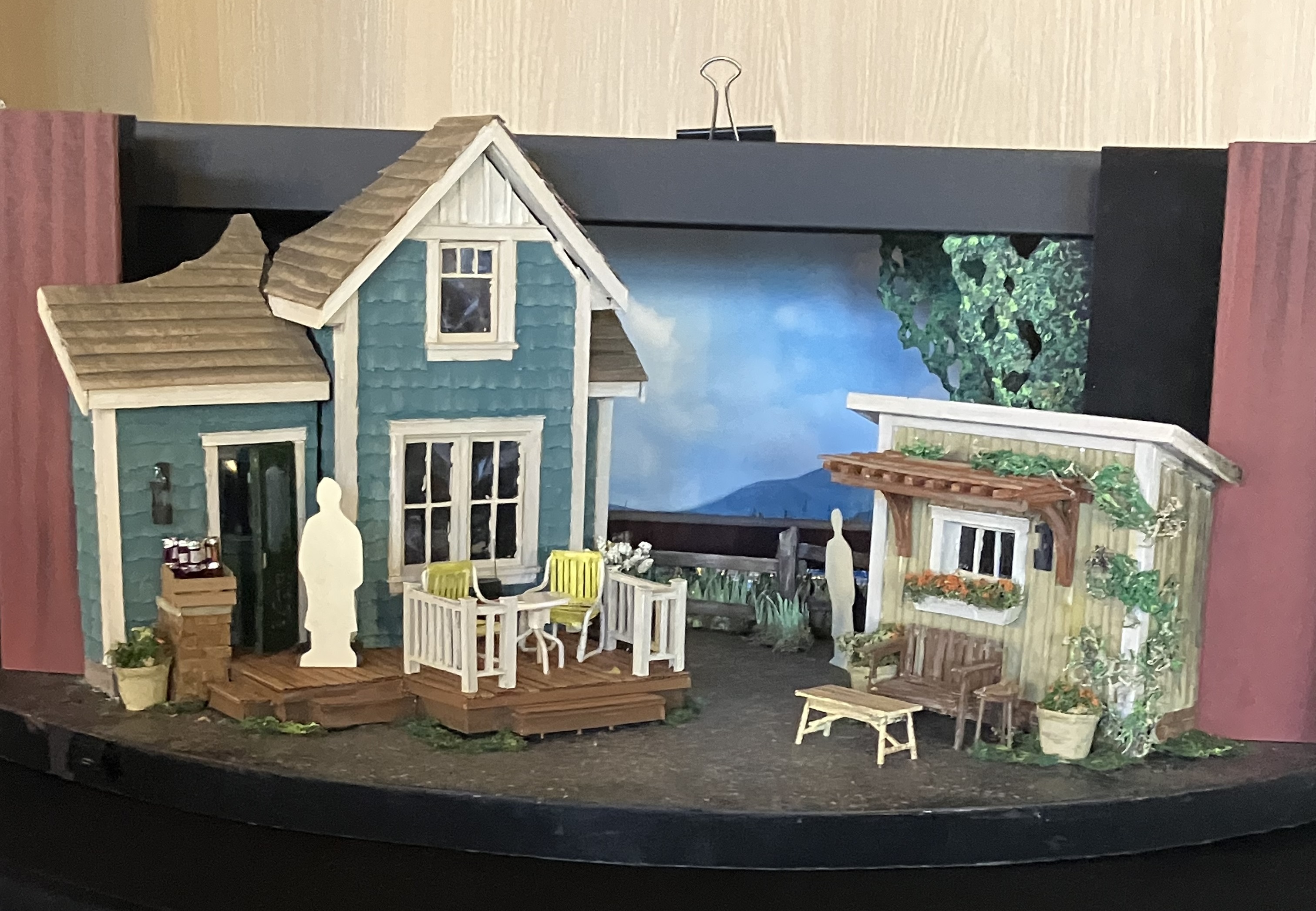
Daniel vanHeyst’s set model for Where You Are, on display in theatre lobby.

Set and lighting design are by Daniel vanHeyst. His typical attention to detail includes weathered shakes on the walls of the house, the rotating vent-stop bar at the bottom of the wooden storm windows, and lighting changes across fields throughout the day and night shown on a cyclorama. Darrin Hagen’s sound design includes many bits of original but almost-recognizable music.

Where You Are, directed by John Hudson with Lana Michelle Hughes as assistant director, is playing at Varscona Theatre until May 18th. Tickets are available here.

Intrigued by my mention earlier of Mark Crawford’s Stag and Doe? It’s playing at Walterdale Theatre until May 3 (tomorrow) with tickets here.

The Malachites’ Macbeth

I think I’ve probably seen more productions of the Scottish play than of any other Shakespeare play.  At Stratford I saw Maggie Smith play Lady Macbeth, and in a later Stratford production the handwashing scene was played on a starkly-lit stage covered with a large piece of white cloth that the Lady scrunched up in turmoil as she tried to erase the consequences of their actions.  I saw a production at Shakespeare on the Saskatchewan in which the young lead couple had sizzling chemistry, a Theatre Prospero version at the Thousand Faces Festival with Bobbi Goddard playing the Lady and Elliot James playing the title role, and Reneltta Arluk’s Cree adaptation Pawâkan Macbeth, in which the stakes are raised by making Kâwanihot Iskwew (the Lady Macbeth analogue) pregnant and in which Macikosisân (Macbeth) is drawn further into evil as he is possessed by the cannibal spirit Wihtiko.

Last night I saw the Malachite Theatre Collective version at Holy Trinity Anglican Church (playing until Jan 19th, tickets on EventBrite).  It was good and some things about it were great.  Directing choices by Benjamin Blyth had the witches (Monica Maddaford, Jaimi Reese, Kaleigh Richards) pacing near-silently up and down the aisles of the church observing and compelling the action, quietly keening and hissing and breathing like Darth Vader.  They also worked on a spinning wheel, and made a sort of cat’s-cradle with threads to wind up their charms.  Janine Waddell’s fight choreography included a splendid bit where young Fleance (Anna MacAuley) fights off the assassins using some credible martial-arts-type moves.  Banquo (Colin Matty) and Macduff (Sam Jeffrey) were both good, and the Banquo’s-ghost staging was disturbing.

Macbeth (Byron Martin)’s decay in the second half of the play was illustrated by his slumping on a throne too big for him.  I had some difficulty hearing/understanding him, both when he was shouting in this scene and near the start when he is speaking to the witches, to Duncan, and to his allies.   I also struggled to hear a couple of other characters speaking while facing away from the audience and into the choirloft space of the venue.  Lady Macbeth is played by Malachites’ principal Danielle LaRose.  She also directed/designed the music, eerie chanting, drumming, and Norse/Gaelic soundscapes which made hair-raising use of the acoustic properties of the venue space.   I liked the way that Lady Macbeth paced silently with her lantern through several scenes before the doctor and gentlewoman discussed her new tendency to sleepwalk.  I also liked seeing Macduff and Malcolm (Owen Bishop) play chess through what is sometimes a boring exposition of the state of the conflicts.  This production also did a good job of the heart-wrenchingly poignant scene where Lady Macduff (Monica Maddaford) and her child (in this case a daughter, Anna MacAuley) enjoy playful sass while the audience knows the assassins are coming.   Other actors for this production included Bob Greenwood, Dana Luebke, Brennan Campbell, Brann Munro, Naomi Aerlan, and Marie Boston – a big enough company to create the sensation of being surrounded when the soldiers march up the echoing wooden floors between audience pews.  There were a few places where I was confused about who the characters were, trying to figure out if they were double-cast.

Sarah Karpyshin’s set makes good use of the shape and existing furniture of the Holy Trinity sanctuary space, with one brilliant gun-on-the-mantle touch which I will not spoil.   Costumes (Dana Luebke) were simple, fighters in tunics and fur leggings and cloaks, women in simple robes, English soldiers in mail coifs and St George’s Cross tabards familiar from this company’s production of Henry V.

I usually have a hard time being convinced of the title character’s relatively quick transitions in this story from modesty to ambition to desperation, and this production was no exception.  If I went to see it again (I probably don’t have time), I would try to sit closer to the front and listen/watch closely in the early scenes.

If you have time and you like Shakespeare, or sword-and-dagger fighting, or stories of ambition and temptation and everything going wrong, then you should see Macbeth.