Book of Mormon (the musical) was as good as I’d hoped.

When I lived in Kingston Ontario, one of my associates developed a theory that he called the Chez Piggy effect.  Chez Piggy was one of the best restaurants in town, (and by all accounts it still is!)  The food was creative and delicious, the service usually impeccable, and the atmosphere casual enough that people who didn’t go to “fancy restaurants” often would be able to feel comfortable.   But my associate had the theory that Chez Piggy didn’t completely deserve its fabulous reputation – he said that since so many of the people who went there were going to mark an occasion (anniversary, graduation, etc), they were unlikely to express any criticism of the actual food or service because they were inclined to make good memories and not “ruin the occasion” by voicing any displeasure to their server at the time or to each other afterwards.

I didn’t actually agree with him about Chez Piggy, since I had never had poor food or poor service there, but I saw his point in general.   When I go to a lot of trouble and expense to attend something, I probably am less inclined to pay attention to its flaws.

With all of that as a circuitous disclaimer, I want to say that my first impressions of the Toronto/Mirvish production of the musical Book of Mormon were entirely positive.  I saw it on Saturday – actually I saw two performances back-to-back and I loved it more the second time through.

Book of Mormon is a story about two Mormon missionaries arriving in Uganda, and how the interaction changes both the missionaries and the Ugandans.  It’s also about faith versus works (and comes down hard on the Pope Francis side that being a good person matters more than believing all the right things).  It’s about North American / Global North views of Africa as the homogeneous themepark of Lion King.  It’s about boys trying to please their fathers, and families trying to cope in horrible situations, and metaphors versus miracles.

I am quite familiar with the soundtrack, but knew almost nothing about how the story progressed between the songs and bits of conversation on the original-cast album, and nothing at all about what I would see on stage.   So I had a general sense of plot and pacing, but there were several key points which did not become clear until I was watching the actual show.  Unlike many musical productions, the program for this one did not list the songs.

Being familiar with the lyrics meant that I wasn’t always laughing at things the rest of the audience laughed at.  Some of them laughed at swearing just because it was swearing, every time.   There’s quite a bit of swearing in the show, and we hear it as shocking because the young missionaries are shocked by it.  The alternatives-to-swearing employed by the missionaries (“Oh-Em-Gosh”, for example) sounded credible to me and were generally not played for laughs.

I was completely delighted by the dancing.  The big production number to “Spooky Mormon Hell Dream” said some original things about Hell and was creepy and funny without being ridiculous.   A historical pageant included acting out the effects of dysentery on Joseph Smith and his fellow migrants, which was just barely not too graphic for my comfort and thus hilarious.  And I loved the elder-missionaries chorus showing their flashier sides in “Man Up” and “Turn It Off!”  I am a big fan of ironic choreography that uses all the familiar gestures of 20th century stage shows in parodic ways, and Book of Mormon had lots of them – jazz hands, top hats, tap dancing, exaggerated marching, pelvic thrusts, and other bits that I don’t have the words for but have been seeing since I was a small child watching song-and-dance shows on television.

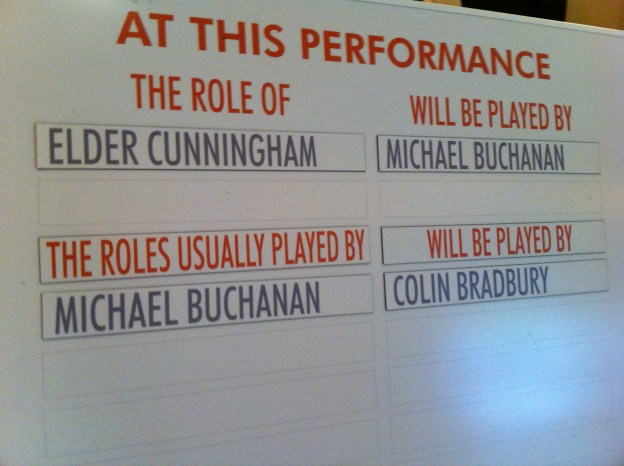
In the Saturday shows, the role of Elder Cunningham (the bumbling fanboy missionary) was played by standby Michael Buchanan rather than the usual actor Christopher John O’Neill.   The other headliners Mark Evans (Elder Price, the cocky missionary with the rockstar reputation who chokes) and Samantha Marie Ware (Nabulungi, Ugandan convert and love-interest) were performing in their usual roles.   On first viewing, I didn’t really distinguish among the Ugandan people in the story except for Nabulungi and her father (I’m not sure if he was some kind of village authority; he was the person the missionaries had been told to report to.)  Seeing it again, I saw the doctor, the man called Motumbo (whose identifying motivation is disturbing enough that I won’t repeat it here out of context), and the teacher, as well as the warlord called the General and his supporters – but except for Nabulungi the villagers are not well characterised.  Neither are the other missionaries, except for Elder McKinley (Grey Henson).

I felt uncomfortable about a few of the ways that Nabulungi, the female lead, was diminished into comedy.  There’s a running gag about Elder Cunningham, for all his crush on her, being unable to remember her name and substituting all kinds of inappropriate long words –  Nala (like in Lion King), Neosporin, Jon Bon Jovi, Nanaimo Bar, and so on.  (I’m almost positive that he didn’t say Nanaimo Bar in the afternoon show just in the evening one, so the actor may have been riffing somewhat spontaneously in the late shows of the run).   She buys a typewriter which she calls a “texting device”, and then the plot advances through her writing notes to people which she refers to as texting.  This made me feel like it was making fun of a developing-world young woman’s wish to be modern and her misunderstanding of technology and terminology.   Near the end, there’s a miscommunication plot point about her having assumed that accepting baptism would lead to her getting to emigrate to Salt Lake City with the missionaries (Sal Tlay Ka Siti, as the title of her solo is spelled). I started to be annoyed at this being another shortcut joke making fun of the naïve village girl, but some of my discomfort was redeemed for me in the way all the other villagers immediately began explaining to her that they’d always known that the religious stories were all metaphors, and had accepted the religion knowing that.  This was also a tidy way of reconciling the canonical Mormon stories with Elder Cunningham’s creative and useful extemporaneous versions, saying that the details really don’t matter very much.

The sound balance was just about perfect, from where I was sitting.  There was a small live orchestra which never overpowered the singers.  The lighting was effective and usually unobtrusive.  The scenery was fun to look at but not overly complicated or distracting.  A few things were moved by the actors (turning a door as they walked around it to indicate changing from an outdoor to indoor scene) but mostly things moved invisibly.  For the scene when the new missionaries arrive in Uganda totally overwhelmed, the visuals bring this out very well, with lots of crowded buildings, and rocks making a busy cluttered setting while the villagers go about their daily chores all over the stage, including one character dragging a dead donkey behind him, its head bobbing bloodily.

The story and the characters worked very well for me, partly because over the course of the story everyone changes, some of them quite against their will but all in a way that I saw as positive.  I wondered ahead of time if I would find it difficult to accept the premise of the story without needing to ignore inconsistency with my own beliefs.  In fact I was pleasantly surprised that after a lot of pointed criticism of that specific implementation of religion and evangelism earlier in the play, the general resolution was approximately humanist in a way that I didn’t find troubling or dramatically inconsistent.

Book of Mormon closed in Toronto after last weekend, but the tour continues.   I would definitely see it again if an opportunity I could afford arose.   Or possibly one that I couldn’t, after I finish paying for this trip.

Spelling Bee

The 25th Annual Putnam County Spelling Bee is an unwieldy name for a musical, but everything else about this Elope production went smoothly.   Kristen Finlay was the director.  The names and faces of the cast were mostly unfamiliar to me, but I haven’t been around the Edmonton musical-theatre scene very long so that isn’t a negative sign.

The story involves six junior-high-school-age children (played by adult actors Mark Sinongeo, Kristin Johnston, Curtis Knecht, Meredith Honda, Nadine Veroba, and John Evans) competing on stage in a spelling bee, their families, and the people managing the spelling bee.  For extra fun, four adult audience members were recruited in the lobby beforehand to be extra competitors.  The treatment was generally lighthearted, but there was also a consistent message about the difference between young people following their own passions and eccentric interests, and children being pushed or promoted by their families.   At the end of the show, each character tells the audience where his or her life has taken him or her since the time of the spelling bee, and each of them has a satisfying outcome.

My favourite character was Mitch (Kate Wylie), a contest support worker with a fairly small role.   The most impressive portrayals, In my opinion, were by John Evans (Leaf) and Nadine Veroba (Olive).  The choreography (Jake Hastey) was fun to watch and the live music  (musical director Sally Hunt and three additional musicians) was catchy, although not sufficiently so for me to be humming it two weeks later.

The 25th Annual Putnam County Spelling Bee continues tonight (Thursday), tomorrow (Friday), and Saturday.  Tickets are available at the door and at Tix on the Square.

From Cradle to Stage: new short works at the Walterdale

Meeting up with an actor friend and going to an evening of short theatre at the Walterdale Playhouse on a warm spring evening reminded me of the Fringe festival.  Except for a few details like the parking lot being nearly empty, and  there being no food vendors or crowds or street performers.  Oh, and in August I love the air conditioning in the Walterdale, but in May I ended up a bit underdressed, just too involved in the story in front of me to fish out my jacket from under my seat.

From Cradle to Stage is a festival of new short plays, a tradition at the Walterdale.  Playwrights make submissions earlier in the season, and the winners then work with dramaturges (is that the plural?) to develop the scripts for production in May.  This year’s event had two plays, “The Ugly Spot” by Lisa Lorentz-Gilroy and “Exposure” by Stephen Allred, Bethany Hughes, and Jessie McPhee.

“The Ugly Spot” showed a brief encounter between two young strangers who had both come to the same isolated place (the Ugly Spot of the title) for solitude.  As you might expect, they are both indignant and defensive about having to share the bit of public land that they’d thought of as private.  But because this is a play rather than real life, they don’t both get up and leave; they stay and communicate enough that we find out interesting things about both of them.  Chance Heck and Cayley McConaghy both portray unhappy lonely twitchy young people.  There was one apparent inconsistency in the related backstory that distracted me disproportionately, but I won’t write it here since it might not bother you the same way.  On the other hand, the ending was done in a more subtle way than I had expected, leaving some things for the audience to know and a character left not knowing.  I thought that was the strongest thing about the writing.

“Exposure” was a more complex portrayal, as you would expect from the longer running time (55 minutes vs 25 minutes).  There was some similarity in plot device with “The Ugly Spot”.  One or two of the people tweeting about the shows thought this juxtaposition was effective; I thought it was unfortunate.  It made the second one easier to guess and it stretched my tolerance for coincidence a bit past credulity.  The premise of this show was three different characters, each struggling with a debilitating fear, encountering each other in an inpatient treatment program and moving towards healing in their interactions with each other.  There were no counsellors or other staff members of the facility shown on stage, although there were a couple of voiceover announcements and the characters referred to their assignments and therapy-group exercises.  As the program blurb said, “sometimes it’s the people you meet there, not the program, that allows you to move forward”.  I might quibble with the grammar, but the story was effective in demonstrating how troubled people who are motivated to change can help each other.

Early on, the characters are not yet interacting with each other – we learn about their thoughts through alternating monologues with each sitting on a straight chair facing forwards.  Each of the three characters has a different set of body language for portraying his or her state of fear and avoidance – Eric (Morgan D. D. Refshauge)’s twitchiness, Anna (Sarah Culkin)’s continual chatter, and most compellingly Will (Sam Banagan)’s demeanour of completely avoiding eye contact with anyone while actually sitting front and centre facing the audience.  As the story progresses and the characters begin to reach out to each other, we see each of them begin to drop these mechanisms, relaxing a bit and then retreating a bit when challenged.  Eric seemed to recover a bit too easily for me to believe, but I found all of them likeable intelligent people and I wanted them to succeed.  There were glimpses of affectionate humour all through what was in some ways a disturbing story.  As a long-time digital immigrant, I was pleased to see Internet-friendship not being portrayed as pathological in itself, although it had been part of at least one character’s coping tools.

The plays run every night until Saturday, with tickets at Tix on the Square or at the door.  And I’d love to know what you thought of them too.

snout – even weirder theatre

My next experience with weird theatre was an Azimuth Theatre / Catch the Keys production called Snout, in the little playing space at the Arts Barns.  I believe it was written by Megan Dart and directed by Beth Dart, but that is from memory because there weren’t any paper programs.  As people entered the theatre, we saw a small tented space, draped with sheets and decorated with living room furniture, which also seemed to be where we should sit.  Atmospheric music was playing, and mysterious video images (Matt Schuurman’s work of course) were projected on the sheets.  An awkwardly-hunched character in bare feet and a burlap poncho (Ben Stevens) welcomed the theatregoers to his house and directed us to the couches, chairs, and cushions on the floor, while steering people away from a kitchen-table set at one end of the room.

We had lots of opportunity to study the space, especially those of us who were a little bit uncomfortable about engaging with the unpredictable character scuttling around.  The draped sheets made a football-shaped space, with openings at either end and at a few other places in the perimeter.  After a while I became aware of a looming bearded presence watching us from the various rents in the draping, but again I kind of averted my attention so as not to engage.  (As I’ve probably already said here, I love weird theatre – but I’m still awkward about being dragged in to participate.)

The main character turned out to be named Ori, and this was his home.  He also introduced us to a Wolf (Steve Pirot), as a friend that he played with and fought with.  The wolf stalked on his hands and feet, hair covering his face, and snarled convincingly enough that my neck got shivers.  The character felt dangerous in that form.  Later, he walked upright and delivered a monologue about possessions, theft, and exchanging valuables, while returning to people various objects of theirs that he had somehow pilfered earlier – in my case, a book about improv theatre that I’d borrowed from one of my teachers.  I was probably easy to steal from because of having tried so hard to ignore him!

The other two characters in the play were an ordinary couple, (Ainsley Hilliard and Mat Simpson), who had been together long enough to remember happier more romantic times, but unsure how and whether to try recapturing those feelings.

And the rest of the performance (I was going to say “story”, but that would suggest something more linear and less lyrical and cryptic) was just those characters interacting with each other and rebounding off each other and hurting each other.  I probably missed a lot – the box-office flyer suggested some resonance with an Isis and Osiris myth, for one thing – but I didn’t mind, because I liked it.

The Soul Collector: Eerie and elliptical

On Friday night, I attended the Catalyst Theatre production The Soul Collector, written, directed, and composed by Jonathan Christenson.  Early on, I thought that it was never going to make sense to me, and I worried that I’d have to ask my theatregoing companions, both actors, to explain to me what had happened.  My first impressions were about chill and dark and gloom. The stage was set with upside-down bare white trees, a glistening black roadway or path down a hill with white markings, wind, eerie music, and periodic snowfalls.  At first, all the characters had costumes in shades of brown and grey, with bits of black and white.  It was hard to identify them as contemporary or from any specific other period, but the colours and hats and one character’s dark glasses evoked a somewhat steampunk aesthetic.

A story began to be built, with anecdotes from the past being told to an apparently-present-day character, Memory McQuade (Karyn Mott).  Many of the two-person stories involved a death.  Early on, people started warning of a Soul Collector.  At first I thought the Soul Collector referred to the mythical horned-man figure dressed in white shorts and disturbingly uneven clawed hands, but I was confused because they seemed to be warning of “She”.  The horned figure was the Winter Hart (Brett Dahl, seen recently in The Missionary Position at U of A), and the Soul Collector turned out to be female, an Ice Queen archetype just as scary as the White Witch of Narnia (Elinor Holt).  Memory McQuade’s guides to the world or near-underworld or whatever it was were the blind mortician Mortimer (Clinton Carew) and the boy Gideon Glumb (Benjamin Wardle).  My eye kept being drawn to the boy Gideon because of an awkwardly-contorted arm, which made his hands look abnormally large.  I noticed that in some scenes (dancing) he didn’t have a deformity, but in the present-day ones he did, and I kept looking for an acknowledgement or explanation.  One character offering a bit of comic relief was Popcorn Pete (Garett Ross).  The storytelling patterns and the not-quite-realistic setting began to remind me of Charles de Lint’s stories.

Some things became clear by the end.  Not everything.  And several of the odd things I recalled from early on ended up falling into place, not explained explicitly but easy enough to figure out that I felt satisfied by the narrative.  I was also astonished at the curtain call to realise that there had only been nine performers, since I hadn’t always gotten a good look at the characters in the dark and in their bundles of winter clothing, and I hadn’t realised that I’d been seeing the same actors over and over.  I remained somewhat frustrated that I had had trouble picking up the words of the sung bits over the projected music, but one of my companions pointed out that the words were almost superfluous to the point of the musical bits which were to communicate mood, and they certainly did that.

When I left the theatre, I decided it was the most elliptical and cryptic storytelling I’d encountered since Free-Man on the Land last January.  And it continued to hold that record for almost 24 hours.

Blown away by Let the Light of Day Through

Last night I saw Collin Doyle’s play Let the Light of Day Through.

I have a huge backlog of performances I haven’t written about yet, but I couldn’t go to sleep last night until I wrote about this play, and none of my usual correspondents were on line or answering their text messages.

Let the Light of Day Through is a Theatre Network production, starring Lora Brovold and Jesse Gervais, and directed by Bradley Moss.  I didn’t read much about it ahead of time – just took a tip from a reliable friend – so I just had a vague idea that it was about a couple dealing with something sad or unmentionable in their past.

That wasn’t wrong.  And if you’d rather not know any more than the fact that I cried all the way home and am now telling you to go see it, stop here and go to the theatrenetwork website to buy tickets (it’s only playing until Sunday afternoon).

———————————————————————————————————————————-

But if you don’t mind spoilers, or if you have already seen it or you aren’t going to be able to anyway, I can go into more detail.  The show posters show a door opening from a dark hallway into a room flooded with eerie light.  The set visible before the show had a brick wall, a wooden door, and a purplish light escaping from behind it.

I was expecting to meet a couple who were angry with each other, distanced, or with some obvious psychiatric troubles.  Those are the obvious tropes for survivors of family traumas of the kind that is gradually revealed here.  I’ve been fortunate not to have relevant personal experience, but that’s how it usually is in books, movies, or theatre (Next to Normal, for example).  But the characters Rob and Chris in this play still like each other, still find joy in life and hope for their future, and are still very funny people who enjoy each other’s compatible playfulness with the shorthand of people who have known each other a long time.   These two people who have endured an awful senseless loss are the most in-tune with each other, the most respectful of any male-female couple I’ve seen in fiction in ages.  Their tolerance and mild irritation with each other’s quirks are so affectionate at base compared to many fictional couples who are supposed to be happy together but display an ongoing tension that makes me wince.  Maybe I’ve just been watching too much Mad About You on Netflix.

The common fictional trope is that a person or family who experiences unbearable trauma will somehow almost forget the whole thing or make it completely unmentionable.  But it becomes clear that Rob and Chris have done something different in order to get on with their lives.  They’ve made an agreement to pretend, and in fact when they discover that they’ve both forgotten a milestone date, they are at first horrified by the idea that they might ever forget.  This consensual pretending then turns out to be a big part of how they work through their traumatic past and how the audience gets to learn the story as they come to terms with it.  Rather than asking the audience to accept the usual convention of narrative flashback, in which the actors are suddenly playing different characters or playing the usual characters at a younger age, in this play the playwright uses the playful storytelling and reminiscing of the characters as they remain their contemporary selves but re-tell the story to each other.  “Remember that time?  Okay, I’ll be your mother in this one…”  This technique made me more fond of the characters, and it also made the story flow very easy to follow.  In a couple of places where it might have been ambiguous, the characters themselves made the clarification “Wait, is this now, or are we being seventeen?”

The funniest parts of the play were two sex scenes. One is in the contemporary story where they’re obviously both interested in each other and making fun of fantasy conventions but have slightly different expectations for how the scene will play out.  The other is a hilarious acting-out of an awkwardly acrobatic teenage encounter.

The play runs about two hours with no intermission.  This was a good choice because the trajectory of the story didn’t have a good breakpoint.  The set seemed simple but was important, and the lighting made the plain wall and door fit many different settings.   The actors were both very good, playing different people who were both likeable and sympathetic.  And Collin Doyle’s treatment of how these people cope with the events of their lives is just different enough, both in plot and in the way the story is told, that I was completely drawn in.  It didn’t feel melodramatic or emotionally manipulative at all.  Near the end of the play, the only sound I could hear from around me was an awful lot of sniffling. I definitely wasn’t the only one weeping.

One of the best performances I’ve seen since starting this blog.  Seriously.

What it means that there’s a museum

Imagine how it would feel if you loved books and libraries, but every time you visited a small town or an unfamiliar city and asked about the library, they directed you to a library museum – a building that had once been a library, that had the architecture of the Carnegie library of your youth, with a bit of the musty smell and the tall shelves preserved, a nominal admission charge and a volunteer at the desk selling bookmarks for the books that weren’t there to borrow.

If church community was a big part of your life, what would it have been like to take a big trip  to Soviet Russia, where Intourist guides showed your group through empty spaces that had once been cathedrals, reciting what they’d memorized about the peripheral details of the building but not acknowledging that people there no longer had a worship space.

What if your childhood had been centred around the local ice rink, where you learned to play house league hockey, went to public skating with your friends, hung out in the lobby and in the stands while your parents and siblings played, and had your first kiss while sitting on the rink manager’s desk with your boyfriend?  But the culture and climate had changed so much within your lifetime that all the rinks were abandoned, except the few which were preserved as arena museums?

Or schools?  If later generations were all to be educated at home and on line, would all the schools be left empty, with local advocates arguing about how to preserve samples of each era of school architecture and fought off developers keen to get at parcels of serviced land?  So that no town would have a school, but every town would have an Old Schoolhouse Restaurant or two?

That’s how I feel about train stations.

I love trains.  I love passenger trains with a passion, but I also love freight trains, even when I am in a bus or car waiting at a level crossing.  I love hearing train whistles at night.  I almost rented an apartment where I could look out on a freight-switching yard, because I thought that would be fun.

I love old train stations that are still used to sell tickets and greet passengers on passenger trains.  I love train stations that now incorporate intermodal traffic as well, like Union Station in Toronto (VIA trains, GO commuter trains, GO commuter buses, and a TTC subway station), the station in Gravenhurst that until recently had Ontario Northland trains, intercity buses, and a taxi company, or the train station in Jasper AB which is also the Greyhound bus station.  I love simple new suburban train stations with their ease of access, friendly signage, clean bathrooms, and amenities suited for a commuting public.

But when I am exploring a town, city, or village that’s new to me and one of the attractions they talk about is a railway museum?  Yeah.  Almost always it means “Trains used to stop here.  But they don’t now, and probably never will again.”  I don’t love that.

Summertime at Red Deer College: confusing reality in a magical setting

In the Ontario city where I used to live, a few of the downtown commercial blocks had internal courtyards that you could access through twisty brick passages, so that you’d end up in a magical place in the middle where you couldn’t see or hear any cars.  In the best of these, there was a restaurant patio or two, with lattice sunshades and white fairy lights wound around the sunshades and trees, so that you could have a drink or a dinner in a place that felt like a couple of twists away from reality.

Last night I walked into Studio A at the Red Deer College Arts Centre to find it transformed into such a magical courtyard, for the Theatre Performance and Creation program’s production of Charles Mee’s Summertime, as directed by Lynda Adams, an instructor in the program.  The risers for the audience were arranged on three sides, with white cloth draperies over each chair pinned with an artificial flower, like at a wedding reception.  Clear twinkling light illuminated white garden furniture and several trees; closer inspection showed the tree branches full of white teacups.  Three identically-dressed actors were already present on the stage, three young women going through stylised synchronised motions of reading, writing, sitting and standing while seeming completely unaware of each other.

Looking at the program revealed that the three, Jessie Muir, Constance Isaac and Taylor Pfeifer, were all cast as Tessa, and several other roles were also filled by two or three actors.   This was a choice made by director Adams in order to include all 21 members of the ensemble in the production, and it turned out to work surprisingly well with Mee’s source text, particularly the first bit which is cryptic, full of awkward pauses and what I think of as gnomic.  The duplicate or triplicate actors sometimes recited the line together, and sometimes alternated.  Their actions were sometimes identical and symmetrical, with each of the three Tessas looking at one James (JP Lord, Dustin Funk, Lucas Hackl) and one François (Tyler Johnston, Chase Condon, and Richard Leurer), and sometimes the three would be responding differently or all rushing to one corner of the stage.  It took surprisingly little time to get accustomed to this narrative convention.

As the story unfolds, the self-possessed young woman Tessa is rattled by two unexpected suitors, then overwhelmed by a crowd of family and friends arriving.  As the characters interact we can see why Tessa soon exclaims

“This is what I grew up with!
What chance did I have with a family like this?
And you want to fall in love with me?
How can anyone expect me to form any kind of relationship
with another human being?”

François, who at first seemed the more appropriate suitor for Tessa than the painfully awkward stranger James, seems to have previously been involved with not just the family friend Mimi (Victoria Day), but also with Tessa’s mother Maria (Julia VanDam, Megan Einarson and Brittany Martyshuk), glamorous, remote, and somehow European, with a flowered scarf in her hair or thrown around her neck.  Two staid slouching middle-aged men outfitted from an LL Bean catalogue for cottage weekends, with baggy khakis and brightly coloured sweaters, turn out to be Tessa’s father Frank (Jake Tkaczyk), and Edmund (Bret Jacobs), Frank’s friend, companion, and lover.  Other friends, connections, and a pizza delivery man (Sasha Sandmeier, Victoria Day, Wayne De Atley) react to each other showing that everything is more complicated than originally assumed, and that nobody is happy with the situations.  Barbara, who seems to be the housekeeper (Jennifer Suter and Collette Radau), interrupts with an over-the-top and very funny tirade about men.  Frank starts out as a sort of genial absentminded host and observer, but we soon find out that even the calm Edmund is full of resentments, in his case against Frank.  The first act ends with all this discontent stirred up into a wonderfully-chaotic choreographed piece by the whole cast stomping and whirling about the crowded space to percussion accompaniment, bouncing off each other and exclaiming their frustrations with love, while Frank periodically shouts “Excuse me!” You can tell this ensemble has some rigorous training in physical theatre and has been working together for many months.

In the second act, things are quieter and the dialogue a bit more conventional, but it seems unlikely that any of these people would be happy together.  Frank makes a speech which starts with the repeated motif of the play that love is complicated these days, and leads to a long thoughtful observation about life changing continuously and the past disappearing as it is lived.  Tessa seems to be considering both James and François as suitors.  Maria reconciles with Frank.  An odd challenge leads to all the male characters doffing their trousers to lie down in plaid boxer shorts and colour-co-ordinated socks.  A few neighbours, Gunther, Bertha, and Hilda (Wayne De Atley, Jessica Bordley, and Rebecca Lozinski), drop in and add to the complications, until a tilt towards resolution is hinted at by Hilda, who makes a delightful and impassioned speech in favour of pursuing love.  Eventually there are happy romantic resolutions for some of the couples, but things don’t work out as tidily as in Anything Goes, particularly for Frank, who slumps alone at the side of the stage as some of the happy couples dance tenderly and the lights dim.

I don’t know any words for the genre of this play.  Some of the marketing materials suggested a light drawing room comedy, but trying to read the script before I’d seen it was as much a struggle as trying to read Waiting for Godot or Rosencrantz and Guildenstern are Dead.  Maybe it was like Noel Coward done in the absurdist tradition?

The set design, colour choices for the costumes (both by Sheena Haug), and lighting (Heather Cornick) contributed effectively to the not-quite-real mood.  As someone who loves both bright colours and socks, I was immediately enchanted to see many of the characters wearing bright co-ordinated socks, Tessa in rainbow-stripes, James matching their turquoise shirts, and François in a bright purple that complemented their outfit.  Original music was written and performed by Jordan Galloway.

I enjoyed this performance very much, but I am still thinking about it.  Like all of Charles Mee’s work, the script is available on line.  It’s easier to read after seeing the play than it was beforehand.  I’m considering seeing it again before its run ends Sunday night, and if this sounds intriguing you should too.  Tickets are available through Black Knight Ticket Centre out of Red Deer, and at the door.  Red Deer College and its Arts Centre are easy to find right off Highway 2 in Red Deer.

Anything Goes!

Before last night, I would have said that the Westbury Theatre at the Transalta Arts Barns had a large stage.  That was before I saw Strathcona Theatre’s performance of Anything Goes, which left me with the impression that the stage was just barely large enough for the cast of 50+ (I tried to count a couple of times, but they kept dancing!)  A clever stage design evoked the multiple decks, spiral staircases, and porthole-covered swinging doors of an Art Deco cruise liner, while also providing space for the pit musicians to play on an upper deck.  Last night’s preview show played to a full house, and since many of the family, friends, and fans of Strathcona Theatre got there earlier than I did, I was grateful for being able to watch some of the action as well as musicians not so far down from where I was sitting.

Early in the show, I thought that Sydney Williams, playing the nightclub singer and former evangelist Reno Sweeney, was dominating the show as a strong singer with good stage presence.  Adam Houston, as Billy Crocker, seemed a bit outmatched at first, with a difficult first song, but he hit his stride quickly and was more convincing later in the show.  The audience was particularly delighted with David Unsworth as Lord Evelyn Oakleigh when he broke out of his rather predictable exaggerated-aristocracy role late in the show (you can’t miss it).  I will definitely keep an eye out for this young actor in future productions.

The lyrics and music of this classic show (first staged in … with several revivals and revisions since) are by Cole Porter.  A few of the songs were quite familiar, especially “You’re the Top” and “I get a Kick Out of You”.   P.G. Wodehouse (also known for Jeeves and Wooster) had a hand in the book, and you can tell.   There were love triangles, gangsters, mistaken identities, tap-dancing sailors, an exceptionally well-behaved live dog in the cast (credited as Teddy Gorman), evangelists, missionaries, and converts, puns, innuendoes, and assorted happy endings.   When two or three actors were speaking or singing, there were often many other characters on the edges of the stage doing things that were interesting but not distracting, adding to the sense that more was happening than we could watch.

I was a little uncomfortable with the portrayals of the two Chinese converts Luke and John (James Kwak and Spencer Lloyd), complete with Mao jackets and the stereotypical accents common in fictional portrayals of the early 20th century, and the later adoption of “Chinese” disguises by other characters.  I’m not sure why the humorous portrayal of the English aristocrat didn’t disturb me the same way.   Maybe it felt a bit like blackface.   I would not be surprised if it had been toned down from Broadway versions, though.

Linette Smith is Director and Choreographer, and Stephen Delano is Musical Director.  There were a few technical glitches in this first preview performance – some sound balancing or sound cuing that was a bit slow, and one door that came off its hinges distractingly – but nothing that should interfere with the audience’s appreciation during the run of the show.  It continues until Saturday night at the Westbury Theatre, with tickets available at Tix on the Square .

Two fun shows I forgot to write about, or, a Blind Date with Billy Elliot

In February I went to Rebecca Northan’s show Blind Date at the Club/Rice space at the Citadel Theatre.  I giggled a lot, but I guess I didn’t have anything pressing to say about it and it slipped out of the posting queue of my brain.  Like a real blind date, it was unexpected, occasionally awkward and embarrassing, and kind of sweet.

The show played last year around Valentine’s Day as well.  The concept is that the main character, named Mimi, asks someone from the audience to participate in the play as her date.  In the performance I saw, the participant was a very good sport and amusing fellow named Travis.  There were also several minor characters; I can’t find my program to give proper credits but my notes say they were played by Jamie and Christian.

I think it might be a fun show to see more than once, to see how much it varies with a different participant.  It would also be fun to do gender-flipped or with a same-sex date.

In late March, I saw the Broadway Across Canada production of Billy Elliot at the Jubilee Auditorium.  I was lucky that I hadn’t got an opening-night ticket, as the first night performance got cancelled due to some of the trucks of properties got delayed at the border due to the snowstorm.  The production travels with four actors taking turns as Billy, and two as Michael.  We saw Mitchell Tobin (age 12) as Billy.  The movie Billy Elliot, which came before the musical, overlaps in my memory with The Full Monty, Brassed Off!, and Kinky Boots as a genre of late 1990s-early 2000s comedies about working class people in England coping with hard financial times in creative ways – and the musical is the same story with an Elton John score.  (That reminds me – am I the only person entertained by the bizarrely detailed genre categories that Netflix comes up with as it tries to work out what else I’d like to watch based on what I’ve seen so far?)

The show was polished, fun, and touching.  There was at least as much wooden-chair choreography as in a production of Spring Awakening.  In one particularly surreal dance number, there was a chorus of striking miners and a chorus of police with riot shields, sharing the stage with a crowd of little girl ballet dancers.  The miners’-families Christmas party scene included some puppets like the Spitting Image political-caricatures.

I was disturbed that I had no recollection of the miners’ strike portrayed in the show at the time it was happening, even though background reading for the show illustrated its monstrous import in destroying coal mining in Britain.  And although the show illustrates the excitement and determination of the new strikers, and the persistence and sacrifice as they held out, later history showed their efforts to be as heartbreakingly futile as those of the 1832 Paris Uprising shown in the plot events of Les Misérables.