Monthly Archives: May 2025

Amadeus – according to Salieri

Amadeus, by Peter Shaffer, was a play (1979) before it was a movie (1985 Best Picture Oscar).

The play, in the Psychopomp Theatre production directed by Jon Shields, starts with an angelic choir singing in opera style, surrounding a very old man huddled in a wheelchair and containing a hand tremor. He is composer Antonio Salieri (Randy Brososky), the narrator and the central character in the play, despite it being named for Mozart.

Salieri rises from his chair with difficulty and calls for house lights to see the audience he is addressing. He seems to be endowing us with powers of extra-human witnessing or perhaps divine judgement – are we the choir of angels? – as he promises to tell us the story of what he did to Mozart long ago and how he’s paying for it. He speaks to us in English, but he also speaks to God in what appears to be fluent Italian.

The scene shifts – Salieri morphs to an active 30 year old – and this is when he first meets his rival, the younger composer and former child prodigy Mozart. Salieri tells us that he wanted so badly to be famous for his music that he had made bargains with God. He had the position of Court Composer to Emperor Joseph (John Evans) in Vienna. He shows the audience his servants and his “venticelli” or gentle winds, flamboyant gossips he engages to bring him the latest rumours (Andrew Mecready and Randall MacDonald). The venticelli tell him that young Mozart is coming to court, so he arranges to eavesdrop and then to be introduced. But to Salieri’s disgust, in person Wolfgang Mozart (Drake Seipert) is vulgar and annoying and self-centred. Seipert portrays Mozart with the most irritating laugh ever.

Salieri is astonished and resentful that someone so vulgar can have the gifts of music and fame that he longs for himself. The quid-pro-quo that seems to be central to his relationship with the Divine launches him into resentment and the most disturbing portrayal of artistic jealousy that I have ever seen.

Brososky’s portrayal of Salieri is brilliant. His bitterness poisons his own nature as he goes further and further in trying to harm Mozart. Mozart’s wife Constanze Weber-Mozart (Cassie Hymen) tries to protect her husband and is also affected by Salieri’s schemes.

A cast of 14 plays many ensemble roles, nobles and servants and citizens. I was fascinated to encounter references to several of Mozart’s operas I recognized, including Magic Flute, Don Giovanni, and Marriage of Figaro. Costuming (Nancy Skorobohach) conveys the excesses of the period and provides clues to class and character.

I was also fascinated to see allusions to Mozart’s character traits which I had first learned of in Erin Hutchison’s Fringe musical Regression last summer – in particular his persistent scatological humour. I’d already encountered a portrayal of Van Gogh on the Shadow Theatre stage this winter, consistent with Hutchison’s characterization, so it amuses me that the third avatar of art in the musical Regression, Willliam Shakespeare, will be on stage in Shakespeare in Love at Walterdale Theatre this summer.

Amadeus has a short run (May 8-15 only) in the auditorium at Campus St-Jean, with tickets available here. The main entrance to the building is under construction, but there is labelled access through the main entrance to an elevator.

The Ballad of Maria Marten – a woman who was more than a victim

Eerie image of Ballad of Maria Marten cast. Photo Kendra Nordstrom

Before attending a preview of the Leduc Drama Society production of Beth Flintoff’s The Ballad of Maria Marten, I didn’t know very much about the play. I did know that it was based on a true story, and I was pretty sure the title character would die.

That’s not much of a spoiler, since very early in the performance the narrator (Emily Rutledge) introduces herself to the audience and explains that she sees things differently now that she’s dead – and it’s a relief. Now that she knows the truth, she knows that none of it was her fault, despite what “he” had been telling her. That was a fascinating viewpoint and I was curious to know more.

The character crumpled at the narrator’s feet turns out to be the younger/alive Maria (Sarah Gibson). And the company then takes us through the story of her life from about age 10 to her murder about 15 years later. I was reminded of other narrative conventions – like the way that After Mourning, Before Van Gogh uses two actors to portray different periods in the protagonist Joanna’s life, or the way that Our Town has the spirit of the dead girl walking through the community while the other characters go about their lives. I was repeatedly reminded of Tess (the Roman Polanski movie, as I’ve never tackled the Thomas Hardy book), because the title character often seemed doomed by her class and gender, penalized unfairly because she was a woman in poverty who dared to seek for survival and hope for love.

However, the playwright Beth Flintoff takes the known facts about Maria Marten’s life and death and shapes them into a compelling narrative of a likeable lively girl/woman with significant agency and female support – from her friendships with other girls (Marisa Scarbeau, Anglia Redding, Bethany Doerksen, Lee-Anna Semenyna) and allying with her new stepmother (Karen Huntley) to finally experience some childhood happiness now that she wasn’t responsible for keeping house. I was struck by the choice not to have her father be an on-stage character in the story – he seemed to be benign, but not relevant to Maria’s life and death the way her stepmother was. I was also impressed at the sex-positive threads woven through the storyline, especially through the character of Sarah (Scarbeau), sharing contraceptive folk-remedies with her friends and proud of her “bastard” children (delightful cameos from Willow Marshall and Cooper Marshall).

Michael Leoppky and Ryan Mattila play Maria’s various partners and the fathers of her children. There was nuance to these portrayals as well, even though none had much stage time.

Knowing that the title character dies, murdered by a man, I spent much of the first act wondering who, and then wondering why. A quick Wikipedia browse tells me that the case has been popular with true-crime fans ever since the original trial. In one of the most unsettling moments of the play, Rutledge’s spirit-of-Maria narrator confronts the audience directly about us coming in hopes of seeing the violent death.

But that’s not the story she chooses to tell/show. We do see the murderer on stage, but never hear him speak. We don’t see Maria’s death. We do see her friends and family struggling with whether and how to testify in the trial, and meeting to enact their own version of justice. There is another plot thread with a much more satisfying ending as well, leaving me with a sense of hope, a reminder that women supporting each other can make a difference, even in cultures of systemic oppression. Maria wasn’t saved, but she was vindicated, and others were saved.

Director Shawn Marshall has created a sensitive portrayal of these 19th-century characters, with glimpses of joy and humour and kindness. Costumes (Cyndi Wagner), props (Kendra Nordstrom) and the simple but haunting set and lights (Len Marshall builder) enhance the mood, hopeful and oppressive by turns.

The Ballad of Maria Marten plays tonight through Saturday night, and Saturday afternoon, at the Maclab Centre for the Performing Arts in Leduc (next to Leduc Composite High School), and then plays for one night at the Manluk Centre in Wetaskiwin on May 30. Tickets for this weekend’s run are available here. It’s disturbing and it’s uplifting, and it’s worth the drive.

Where You Are – family frictions and affection

Coralie Cairns as Suzanne, in Where You Are. Set and lights, Daniel vanHeyst. Costumes, Leona Brausen. Photo Marc Chalifoux.

I had read Kristen Da Silva’s play Where You Are a while ago. I couldn’t remember the details, just the tensions and affections between two sisters, Glenda and Suzanne, who live together on Manitoulin Island.

In the Shadow Theatre production that opened last night at Varscona Theatre, Davina Stewart plays restrained responsible Glenda, and Coralie Cairns plays Suzanne. With help from costume designer Leona Brausen, we see immediately that Suzanne is the kind of woman who gets up in the morning with last night’s mascara all over her face and a heavy-metal t-shirt along with her pajama pants, and Glenda is someone who always protects her skin with a sunhat and matches her purse to her shoes. The by-play between the sisters shows ongoing disagreements and old troubles but also a core of caring. Suzanne can’t talk to her grown daughter Beth without starting a fight – Glenda recommends that when Beth (Nikki Hulowski) arrives for a visit, Suzanne should just whistle instead of saying anything. We can also see hints of some other unspoken troubles – not overdramatic foreshadowing, but topics that the sisters have agreed not to address. Cairns and Stewart are brilliant together, hilarious in the superficial irritations of shared life while awkward in compassion.

Glenda and Suzanne’s neighbour Patrick (Brennan Campbell) drops in with a mis-delivered newspaper. Both sisters enjoy visiting with the handsome young man – Suzanne also takes the chance to talk him into fixing their shed roof. One of the funniest moments in the whole play concerns the roofing chore, and how Patrick responds to the heat, thinking himself alone.

As I said, I’d forgotten the plot details. After working on Mark Crawford’s comedy Stag and Doe for the last few months, I was laughing out loud hearing Patrick’s left-at-the-altar story and watching him make plans to attend his ex’s wedding.

It was easy to empathize with Beth, an only child frustrated by her mother’s and aunt’s well-meaning snoopiness into not telling them anything. As the play progresses, we also see them keeping secrets from her, all of which eventually come out. I was genuinely moved watching the comedic and defensive characters manage to connect with each other in the end. It felt very real. The script’s treatment of spirituality and religion was delicate and not ridiculous.

I also loved the specific reminders of Manitoulin Island, a beautiful part of Northern Ontario – the hawberry jelly priced higher for tourists, the “bicoastal” relationship one of the neighbours has with a woman from Espanola on the mainland, the way that missing the swing bridge timing can change destiny “like the Island wanted to keep me”. And the mention of a specific Toronto hospital cued me into the nature and severity of one character’s illness, due to memories of a family member spending time there long ago. None of this context is necessary to understand and enjoy the play; it just provided extra richness to my experience.

I couldn’t remember the title of the play beforehand, but now I understand it. Home is where you are, one character tells another.

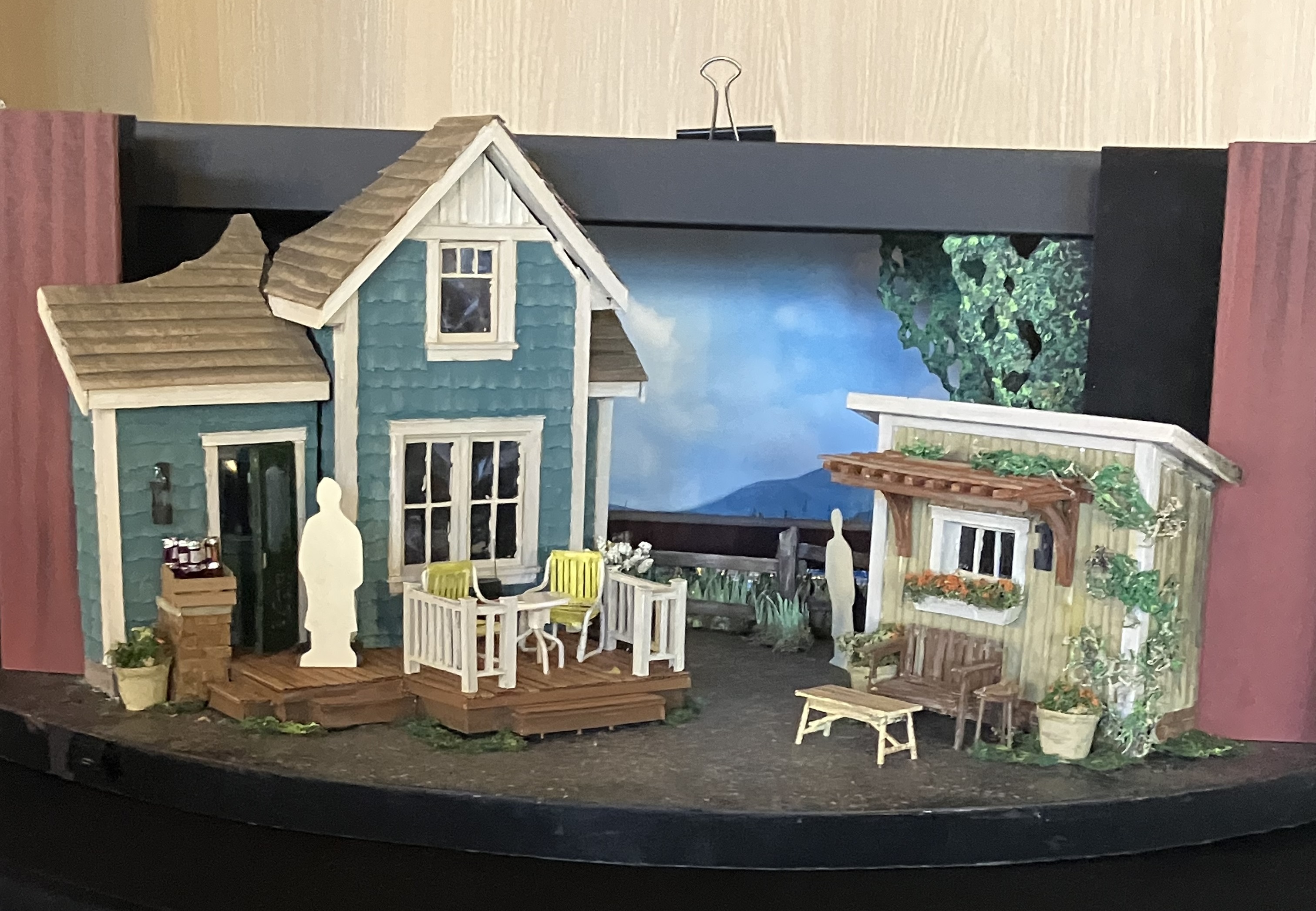
Daniel vanHeyst’s set model for Where You Are, on display in theatre lobby.

Set and lighting design are by Daniel vanHeyst. His typical attention to detail includes weathered shakes on the walls of the house, the rotating vent-stop bar at the bottom of the wooden storm windows, and lighting changes across fields throughout the day and night shown on a cyclorama. Darrin Hagen’s sound design includes many bits of original but almost-recognizable music.

Where You Are, directed by John Hudson with Lana Michelle Hughes as assistant director, is playing at Varscona Theatre until May 18th. Tickets are available here.

Intrigued by my mention earlier of Mark Crawford’s Stag and Doe? It’s playing at Walterdale Theatre until May 3 (tomorrow) with tickets here.